New regulations for commercial rocket listings are in place: retail investors can "launch rockets" now, who benefits the most?

China's commercial space industry welcomes new regulations, as the Shanghai Stock Exchange releases the "Guidelines for the Fifth Set of Listing Standards Applicable to Commercial Rocket Enterprises," providing clear norms for the listing of commercial rocket companies. These guidelines will transform supportive policies into actionable review standards, allowing rocket companies that meet listing requirements to apply for an IPO. Companies like Landspace have already begun IPO counseling, and the verifiability of rocket technology achievements has become a reason for prioritizing the standards. The guidelines examine enterprises from four dimensions: technology, achievements, procedures, and market
When an industry support policy is refined into an "operating manual," China's commercial space industry stands at a new starting point.
On December 26, the Shanghai Stock Exchange officially released the "Guidelines for the Application of the Shanghai Stock Exchange Listing Review Rules No. 9 - Applicable to Commercial Rocket Enterprises under the Fifth Set of Listing Standards for the Sci-Tech Innovation Board" (hereinafter referred to as the "Guidelines"), which clearly regulates the entry of commercial rocket enterprises into the Sci-Tech Innovation Board and provides a clearer "reference checklist."
In June 2025, the China Securities Regulatory Commission (CSRC) issued the "Opinions on Enhancing the Institutional Inclusiveness and Adaptability of the Sci-Tech Innovation Board's Growth Layer," which explicitly proposed to expand the scope of the fifth set of listing standards for the Sci-Tech Innovation Board, including commercial space and other cutting-edge technology fields as key support directions.
The released "Guidelines" focus on the niche track of commercial rockets, transforming principled support into operational review standards and quantitative requirements.
The introduction of this new regulation comes at a timely moment, as the listing demand for commercial space enterprises has already become apparent. According to disclosures on the CSRC's official website, Landspace has completed IPO guidance acceptance and is officially making a push for the Sci-Tech Innovation Board; Tianbing Technology, Xinghe Power, and China Aerospace Science and Technology Corporation are also intensively starting IPO guidance filings in the second half of 2025.
Against this backdrop, the release of the "Guidelines" is timely. It serves as a detailed "operating manual," clearly outlining previously vague standards, allowing eligible rocket companies to apply for IPOs based on these standards.
Faced with such intense listing demand, why are commercial rocket enterprises the first to receive clear standards?
A private rocket industry practitioner explained to Tencent Technology: "Compared to conceptual tracks like 'space computing' and 'low-orbit satellite constellations,' the technological achievements of rockets are easier to verify. For example, whether they can reach orbit or be recovered are visible hard indicators with the highest certainty. More importantly, whether it's space computing or satellite networking, rockets are needed to send equipment into space; they are an indispensable foundational element of the entire industry chain."
New Listing Regulations: Four Dimensions to Lock in "Hardcore" Commercial Rockets
The "Guidelines" consist of 14 provisions. In simple terms, they mainly assess enterprises from four aspects: technical capability, tangible results, completeness of procedures, and market recognition, establishing a complete "health check standard" for companies seeking to go public.
Technical Strength: Must Master "Hard Technology"
The "Guidelines" first clarify that the main business of the enterprise must be the independent research and development, manufacturing, and space launch services of commercial rockets, emphasizing the "hard technology" attribute. The review will focus on the enterprise's independent research and development capabilities in core technology products and key components, as well as critical technical indicators such as carrying capacity and the ability to launch multiple satellites with one rocket. Enterprises that have undertaken national missions or participated in national projects will receive priority support.
An aerospace practitioner told Tencent Technology: "The policy environment and industrial atmosphere for commercial space are improving, but relying solely on the 'windfall' is not enough. What capital ultimately favors are those enterprises that truly have engineering strength and can deliver phased results."
Phase Achievements: Must Have "Real Firepower"
No matter how advanced the technology is, it needs to speak through actual results. The "Guidelines" set a clear red line for achievements: companies "must achieve the phased result of successfully placing payloads into orbit with reusable medium and large launch vehicles at least at the time of application."
This requirement delineates the boundary between "paper technology" and "engineering practice." At the same time, the new regulations emphasize that companies must not have significant adverse issues affecting their ability to undertake launch missions in terms of technology, ensuring the sustainability of the technological route.
Li Chao, Chief Analyst at iResearch and Executive Dean of iResearch Technology Institute, told Tencent Technology that focusing on reusable medium and large launch vehicles has two main considerations: "The technical threshold for small rockets is relatively low, relying heavily on mature solid engines, and the significance of technological breakthroughs is limited. More importantly, recovering small rockets can lead to severe capacity losses and poor economics. In contrast, the core power system required for medium and large rockets cannot be easily obtained from existing technology sources and is likely to require independent breakthroughs by companies, which itself represents the technological strength of the company. While reusability may reduce capacity to some extent, a sufficiently high upper limit can still achieve a certain payload capacity. Moreover, from an international perspective, this technological route has already been proven feasible."
An employee from a private aerospace company also stated: "The current watershed in the industry is not about whether the concept is advanced, but whether it can be launched stably, so recovery is a bonus, and 'being able to launch' is the passing line. The technical principles are no longer a bottleneck; the real challenge is the high cost of debugging and the endurance of continuous investment."
Compliance Qualifications: Procedures Must Be Complete
Commercial space is a highly regulated industry, and compliance with qualifications is a baseline requirement. The "Guidelines" clearly state that companies must possess relevant research and manufacturing qualifications during the development and manufacturing process of commercial rockets and must obtain launch permits before rocket launches.
This clause effectively sets a "threshold for entry" for companies, ensuring that commercial rocket enterprises entering the capital market are recognized by relevant national departments and possess legal operational qualifications.
Market Position: High Recognition in the Industry
In addition to technology and qualifications, the "Guidelines" set clear requirements for the market competitiveness of companies. Companies need to rank high in the industry, occupy an important position in the industrial chain, and gain high recognition from relevant market entities.
Specifically, the commercial rocket business or products of the company should have a clear target market, possess a first-mover advantage compared to competitors, and be at the forefront of the industry in terms of R&D progress and key indicators. More importantly, companies need to develop clear, feasible commercialization arrangements that explain how to transition from the technology validation phase to large-scale operations.
Impact of New Regulations: Industry Enters "Hard-Hitting" Phase
The most direct impact of the new regulations is to make previously vague standards quantifiable and comparable. Companies know whether they "meet the qualifications," investment institutions know "who to invest in and who not to," and reviewers have a unified basis for judgment. This increase in certainty significantly reduces the trial-and-error costs for companies and the decision-making risks for investors An investment institution representative told Tencent Technology: "In the past, it was difficult to judge which commercial space companies had a real chance of going public. Now, with clear standards, we can more selectively screen targets, and the efficiency of capital allocation will significantly improve."
Secondly, it accelerates the survival of the fittest: companies with real technology find it easier to secure financing, while those that are merely filling the ranks are kept out.
Experts from private space companies believe that there is still incremental space in the international market, and domestically, there is an urgent situation of "waiting for rockets"—a large number of satellite constellations are waiting to be launched, but rockets with high-frequency and stable launch capabilities are in short supply. Because real opportunities exist, it is even more important to accurately filter and leave opportunities for companies that truly possess core technologies, avoiding "assembly-type companies" from taking advantage of the situation and wasting precious capital resources.
From this perspective, such a screening mechanism will also force the industry to accelerate differentiation. Leading companies can accelerate research and development after going public and obtain funding, further widening the technological gap; while companies lacking core capabilities face financing difficulties and may be forced to exit or transform. Commercial space has entered a new stage of "hard confrontation."
Industry insiders point out that once leading companies successfully go public, the "synergistic effect" of the entire industry chain will gradually become apparent. Publicly listed companies can increase procurement and investment in the upstream supply chain after obtaining funds, driving the development of supporting enterprises; at the same time, stable launch capabilities will also release demand in downstream fields such as satellites and space applications.

Market Restructuring is Imminent: First to Go Public May Lock in Competitive Advantage
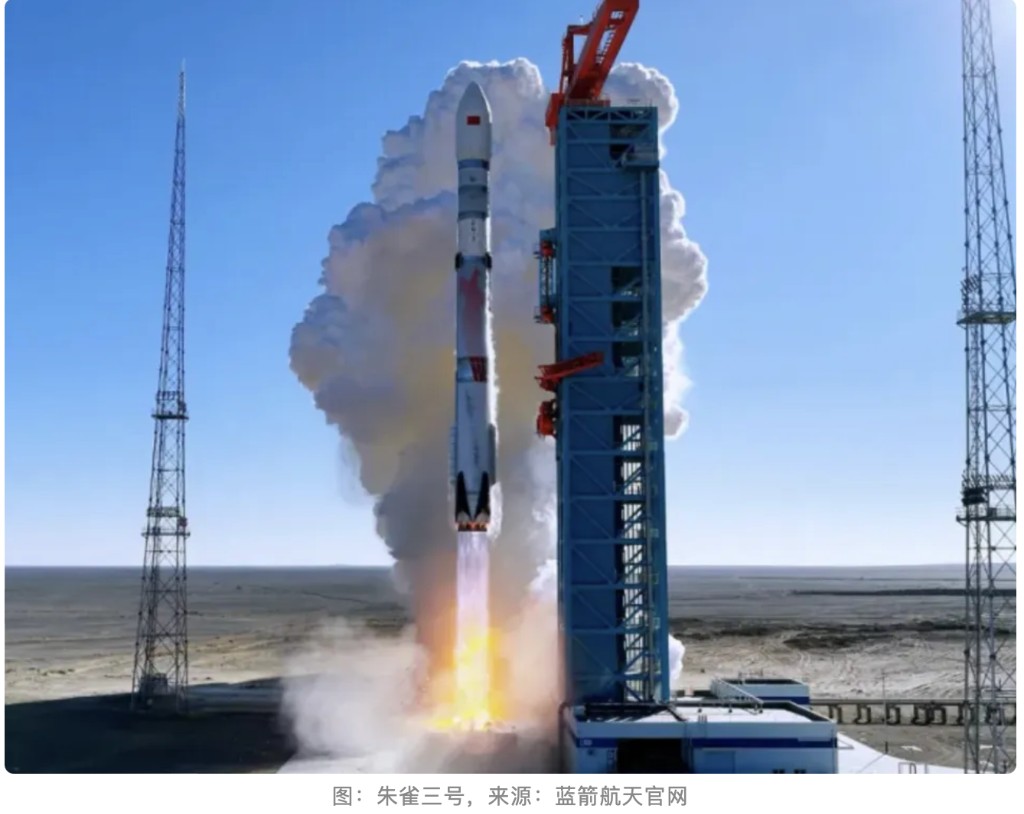
Several industry analysts believe that this set of rules is clearly favorable to leading companies that have completed technological validation, especially companies like Blue Arrow Aerospace that have taken the lead in completing IPO guidance acceptance.
From the current situation, Blue Arrow Aerospace is at the forefront among commercial rocket companies that can simultaneously meet the three conditions of "medium to large rockets + reusability + successful orbit insertion," having completed technical certification. This means that Blue Arrow not only occupies a first-mover advantage but is also likely to become the first commercial space company to land on the Sci-Tech Innovation Board, obtaining ample funds through its IPO to further widen the technological gap with competitors.
Aerospace industry analyst Bai Xue told Tencent Technology: "Rockets are a capital-intensive and foundational area of aerospace that requires the most capital; the recovery and reuse of rockets is a global trend; medium to large rockets can meet economic and capacity demands. The combination of these three conditions essentially sets the current status of qualified companies as the entry threshold, effectively tailoring a listing pathway for companies that 'get the ticket to enter.'"
For other commercial rocket companies, the challenge is not just the technology itself. Even if they complete orbit verification in the future, the market landscape may have already been reshaped by the pioneers. Once Blue Arrow successfully goes public and gains sustained financing capabilities, technological iterations will occur more rapidly, and high-frequency launch contracts will be locked in ahead of time. Latecomers will face a dual test: they must prove their technological strength while finding their place in the already established market landscape
Listing is the Starting Point, the Test of Commercialization Has Just Begun
With new regulations implemented, companies racing to go public, and the market landscape beginning to take shape, China's commercial aerospace industry is standing at a new starting point. The new regulations have opened up capital channels for the industry, and leading companies are about to enter the capital market, with the industrial ecosystem taking initial form.
Although pioneers like Blue Arrow Aerospace hold a clear advantage, this does not mean that latecomers have no opportunities. Rocket launches are not standardized products; the demands for payload capacity, orbit, price, and reliability vary greatly across different missions. Coupled with the practical considerations of safety and industrial resilience, the long-term coexistence of multiple rocket companies aligns more closely with industry norms.
An investment institution representative stated, "Going public is not the goal, but a tool for continuous financing, supporting long-term R&D, and ensuring cash flow. Even without going public, technological advancements in the industry will continue; going public is merely an accelerator."
The entry of capital means that companies must answer a series of more challenging questions:
- How to establish a stable and predictable launch rhythm, turning "a few times a year" into "the norm";
- How to continuously reduce the cost of each launch, making launch services truly competitive in terms of pricing;
- How to build a complete and controllable supply chain system, reducing reliance on external and imported components;
- And how to gradually expand from serving domestic clients to broader international markets.
In the future, once the new regulations open the path to going public, the core issue facing commercial rocket companies will shift from "Can the technology be realized?" to "Can the business model be viable?"
Especially in the expansion of international markets, China's commercial aerospace also faces opportunities and challenges. Currently, the Chinese and American aerospace systems are relatively independent. Outside of the United States, there is still significant real demand for launch services in Europe, the Middle East, and Southeast Asia, providing expandable space for Chinese companies.
Some aerospace analysts believe that the competitive strategy and opportunities for Chinese rockets do not lie in pushing the limits of payload capacity but in differentiated positioning. "The opportunities for Chinese rockets are more likely to come from systematic optimization of specific orbital demands, domestic constellation missions, launch certainty, and industrial synergy capabilities, rather than comparisons based on single parameters."
The listing of commercial aerospace companies also opens a window for ordinary investors. From an investment opportunity perspective, in addition to the rocket companies themselves, upstream supply chains and downstream application companies may also welcome new space with the industry's development. An investor cautioned, "This is an opportunity, but it also requires rational judgment. Commercial aerospace is a long-cycle, heavy asset, high-tech barrier industry. We cannot only look at concepts; we must also consider technological achievements, launch frequency, customer orders, and cost control capabilities."
China's commercial aerospace is standing at a new starting point. The competition has just begun. Transitioning from technological breakthroughs to large-scale operations, from capital enthusiasm to long-term returns, is a path that requires patience and is a true long-distance race.
Risk Warning and Disclaimer
The market has risks, and investment requires caution. This article does not constitute personal investment advice and does not take into account the specific investment goals, financial conditions, or needs of individual users. Users should consider whether any opinions, views, or conclusions in this article align with their specific circumstances. Investing based on this is at one's own risk