Silver plummets, traders search for reasons, Goldman Sachs Asia trading desk: "No conclusive evidence"

In response to this pullback, Goldman Sachs' Asian trading desk pointed out that there is no "conclusive reason to short" the market. Analysts generally believe that the scarcity of liquidity during the holiday period, the exchanges raising margin requirements, and the extreme overbought signals indicated by technical indicators have collectively contributed to this sharp price correction
Silver prices experienced a sharp decline after initially breaking through the $80 per ounce mark, ending a nearly vertical upward trend in recent times. Despite the market experiencing significant volatility, traders found it difficult to identify a single clear catalyst for this plunge, as extreme market sentiment faces correction.
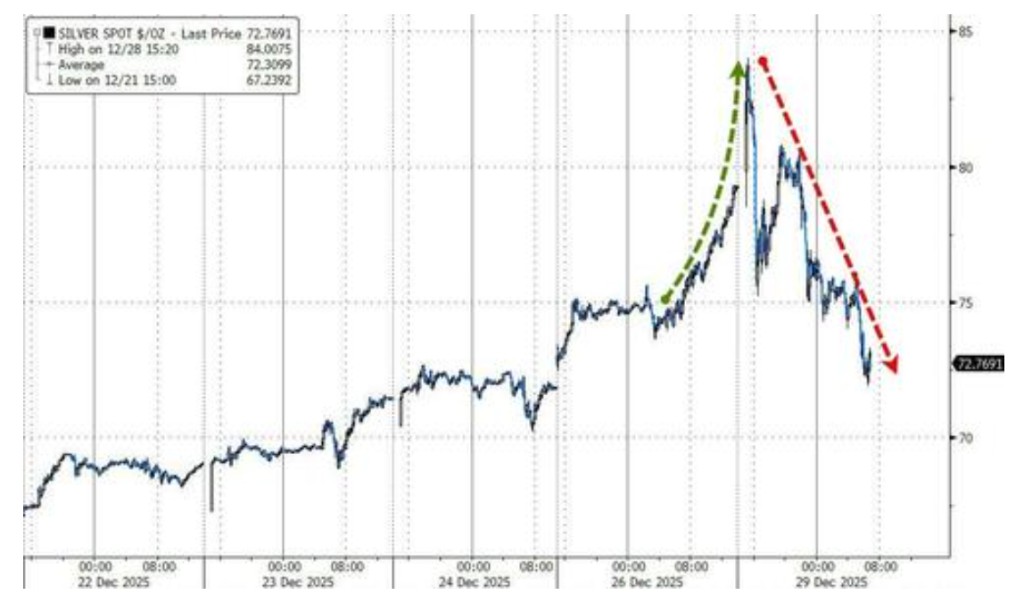
In the overnight market on Monday, silver prices briefly surged above $84, then plummeted sharply, nearly erasing early gains, and ultimately closed up only 0.51%. Meanwhile, the precious metals sector faced collective pressure, with both platinum and palladium hitting their daily limit down, and gold also falling by 0.91%, with a decrease in open interest across all four major precious metal contracts.
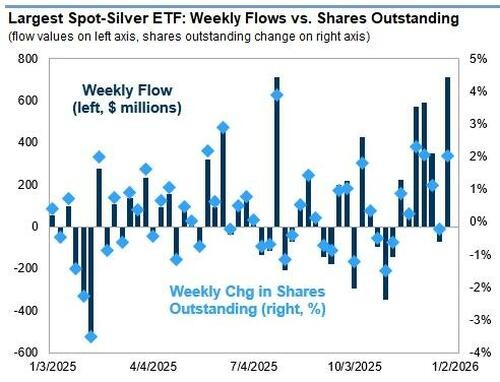
This market reversal occurred against the backdrop of a surge in investment demand from China. The premium of Shanghai spot silver over London prices once exceeded $8, setting a historical high. In the face of frenzied market sentiment, China's only pure silver fund had to take the extreme measure of refusing new clients after multiple risk warnings proved ineffective.
In response to this pullback, Goldman Sachs' Asian trading desk pointed out that there is no "conclusive reason for shorting" the market. Analysts generally believe that the combination of scarce liquidity during the holiday period, increased margin requirements from exchanges, and extreme overbought signals indicated by technical indicators contributed to this sharp price correction.
Lack of Clear Shorting Reasons
Despite the significant market fluctuations, institutions remain cautious about the specific causes of the decline.
Goldman Sachs' Asian trading desk noted that although there are only three days left until the New Year, the Chinese commodity market remains highly volatile. Silver surged by 9.25% before the lunch break, but then shifted to a risk-off mode without any obvious bearish news, leading to a significant correction in the precious metals sector.
Bloomberg macro strategist Adam Linton agreed with Goldman Sachs on the lack of a single triggering factor. He pointed out that while there is no clear driving force behind silver's pullback, low liquidity and the parabolic rise of silver previously mean it is highly susceptible to backlash.
Macroeconomic drivers and liquidity remain weak, which suggests that this unstable price trend in the metals market may become a norm for the remaining trading days in 2025.
Speculative Frenzy and Regulatory Brake
The speculative atmosphere is seen as a key driver of recent market movements. Wang Yanqing, an analyst at China Futures Ltd., stated that the current speculative environment is very intense, and the hype surrounding tight spot supply has become somewhat extreme.
Tightening regulatory measures are having a cooling effect on the market. CME's statement indicated that the margin for some Comex silver futures contracts will be raised starting Monday, from $3.2 per ounce to $4.4 per ounce. Wang Yanqing believes this move will help reduce speculative behavior. Additionally, the Guangqi Exchange (GFEX) recently tightened measures to curb excessive trading in palladium and platinum.
Liquidity Drain and Technical Pullback
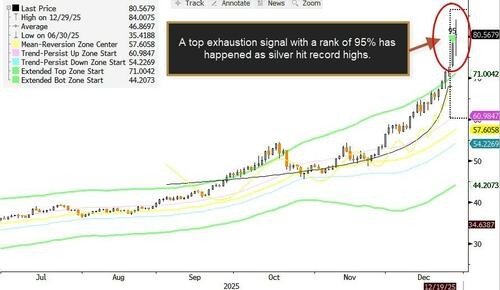
Market structure and technical indicators also indicate the necessity of a pullback. The PFR ExtremeHurst model—a tool used to identify herd behavior that triggers self-reinforcing frenzies—has triggered a top exhaustion signal for silver. Similar signals accurately predicted an 11% pullback in gold in October.
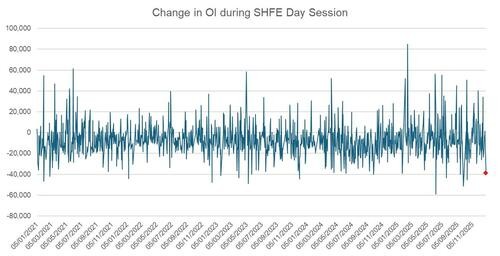
In terms of capital flow, Goldman Sachs futures trader Robbie Dwyer noted a significant liquidation wave during Monday's morning session, with 40,000 contracts sold throughout the day. Although ETFs bought 13 million ounces of silver between December 19 and 26, this did not prevent profit-taking in the futures market. Dwyer emphasized that while the increase in margin requirements may have contributed to the sell-off, funds may have begun to reduce long positions amid high volatility and high prices over the past week.