Breakfast | Federal Reserve officials expect it to be appropriate to continue cutting interest rates after December, with the three major indices declining for three consecutive days

Wallstreetcn
2025.12.31 00:20
portai
I'm PortAI, I can summarize articles.

The Federal Reserve "most" officials expect it to be appropriate to continue cutting interest rates after December, and the three major indices have fallen for three consecutive days; the craze for Pop Mart has disappeared, scalpers have stopped hoarding, and the premium myth of Labubu has been shattered

Market Overview

In the absence of new catalysts and with liquidity tightening, the Federal Reserve's meeting minutes failed to boost U.S. stocks. The three major U.S. stock indices fell for three consecutive days, with small-cap stocks performing poorly and facing selling pressure right at the market open for three trading days in a row. The large-cap technology stocks, which collectively weakened the previous day, showed some relief on Tuesday. U.S. stocks in the communication services and materials sectors briefly outperformed, while momentum assets remained under pressure overall.

Due to unchanged expectations for interest rate cuts, U.S. Treasuries experienced slight fluctuations, with the 10-year yield rising by less than 1 basis point. The U.S. dollar rebounded by 0.2%, approaching the 98 mark. The offshore renminbi once appreciated by 0.2%, then narrowed its gains to report at 6.992.

Cryptocurrencies continued to rise and fall. Bitcoin once increased by 2.4%. Ethereum approached $3,000 before its gains receded.

Metal prices showed divergence. Spot gold once rose by 1.60%, reclaiming the $4,400 mark, but subsequently retraced most of its gains during U.S. trading hours. Silver saw a strong rebound during the session, reaching a peak of around $78, and by the end of trading in New York, its gains were still over 5%. London copper rose nearly 4%, while London nickel reached a 14-month high.

During the Asian session, the Shanghai Composite Index recorded 10 consecutive days of gains, with robots and AI agents surging, the Hang Seng Index rising nearly 2%, led by semiconductors, and the Hong Kong IPO of Envision Intelligence rising about 25%. The Guotou Silver LOF experienced fluctuations, and the onshore renminbi broke the 7 mark.

Key News

Central Rural Work Conference: Strengthen the tackling of key core technologies in agriculture and the efficient transformation and application of scientific and technological achievements, developing new quality productive forces in agriculture according to local conditions.

Li Qiang: Refine the taxpayer and tax collection scope, and determine the calculation methods for tax amounts under different circumstances.

2026 National Subsidy Plan released: New smart products added, home decoration and electric bicycles excluded, and adjustments made to subsidy standards for home appliances and automobiles. The first batch of 62.5 billion yuan of ultra-long-term special government bonds to support the old-for-new funding plan for consumer goods has been issued in advance.

Four Departments: Promote the digital transformation of the automotive industry, explore the construction of public computing power infrastructure for the industry, and focus on tackling key equipment such as intelligent robots.

Starting next year, individuals selling homes purchased for more than 2 years will be exempt from value-added tax.

Federal Reserve Meeting Minutes: “Most” officials expect it to be appropriate to continue cutting interest rates after December, with some advocating for a “period of inaction.” A Federal Reserve survey: respondents expect to purchase about $220 billion in short-term U.S. Treasuries over the next 12 months.

Ukraine wants “50 years of security guarantees,” while Trump only wants to provide 15 years.

Tesla rarely disclosed analyst predictions: Q4 delivery volume may decline by 15%, impacted by the tapering of tax subsidies and intensified competition affecting demand. Musk confirmed that xAI has acquired a third building, with training computing power approaching 2 gigawatts.

China's first storage chip stock is here! Changxin Technology's Sci-Tech Innovation Board IPO has been accepted, marking the first case under the pre-review mechanism, aiming to raise 29.5 billion yuan

MiniMax plans to raise HKD 4.2 billion in its Hong Kong IPO, with Alibaba, Abu Dhabi, and others as cornerstone investors.

The Pop Mart craze is cooling: scalpers have stopped hoarding, and the Labubu premium myth is collapsing.

Facing significant oversupply pressure, OPEC+ plans to remain inactive this week and maintain its pause on production increases.

Market Closing Report

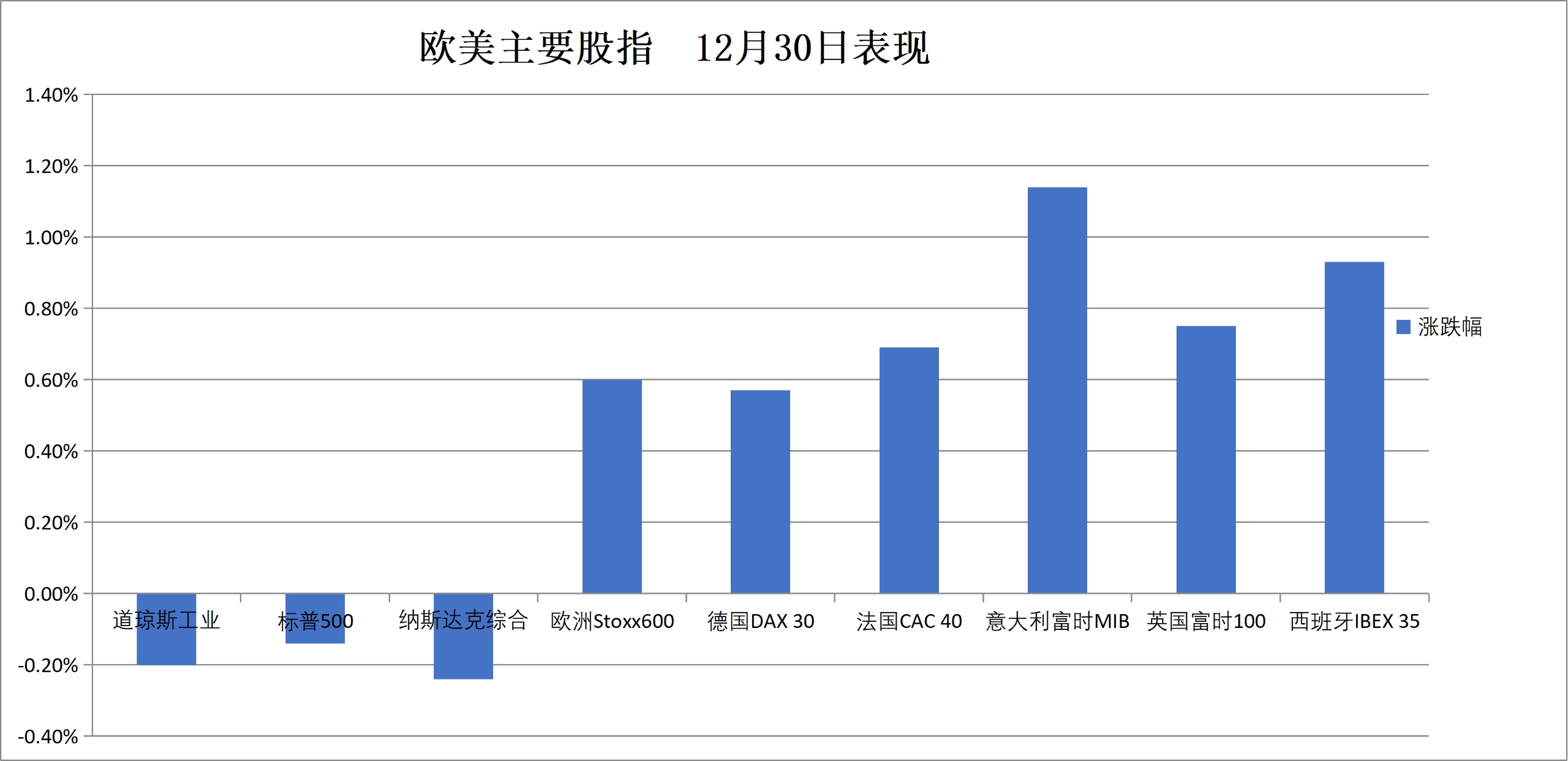
U.S. and European Stock Markets: The S&P 500 fell 0.14%, closing at 6,896.24 points. The Dow Jones fell 0.20%, closing at 48,367.06 points. The Nasdaq fell 0.24%, closing at 23,419.08 points. The European STOXX 600 index rose 0.6%, closing at 592.78 points.

A-shares: The Shanghai Composite Index closed at 3,965.12 points, nearly flat. The Shenzhen Component Index closed at 13,604.07 points, up 0.49%. The ChiNext Index closed at 3,242.90 points, up 0.63%.

Bond Market: The yield on the U.S. 10-year Treasury rose by 1.56 basis points to 4.1258%. The yield on the 2-year Treasury fell by 0.61 basis points to 3.4484%.

Commodities: WTI February crude oil futures fell 0.22%, closing at $57.95 per barrel. Brent February crude oil futures fell 0.03%, closing at $61.92 per barrel. COMEX gold futures rebounded 0.43%, closing at $4,362.20 per ounce. COMEX silver futures rose 8.57%, closing at $76.490 per ounce. COMEX copper futures rose 3.44%, closing at $5.7580 per pound.

News Details

Global Highlights

Central Rural Work Conference: Strengthen key core technology breakthroughs in agriculture and the efficient transformation and application of scientific and technological achievements, and develop new agricultural productivity according to local conditions. According to Xinhua News Agency, the conference pointed out the need to strengthen key core technology breakthroughs in agriculture and the efficient transformation and application of scientific and technological achievements, developing new agricultural productivity according to local conditions. It is necessary to establish a regular mechanism to prevent poverty and ensure a sound support policy system, continuously supporting the development of underdeveloped areas and consolidating and expanding the achievements of poverty alleviation. Efforts should be made to promote stable income growth for farmers and improve the income guarantee mechanism for grain-producing farmers. It is also essential to coordinate services for migrant workers and support employment and entrepreneurship for returnees, promoting stable employment for migrant workers.

Li Qiang: Refine taxpayer and tax scope, determine calculation methods for taxable amounts in different situations** Refine the scope of taxable transactions for goods, services, intangible assets, and real estate as stipulated by the Value-Added Tax Law; further clarify the standards for taxpayers among units and individuals, general taxpayers and small-scale taxpayers, as well as the specific circumstances of domestic consumption of services and intangible assets.

The 2026 National Subsidy Plan is out: New smart products added, home decoration and electric bicycles removed, and adjustments made to the subsidy standards for home appliances and automobiles. Next year, the national subsidy targets will include new smart products such as smart glasses and smart home devices. The subsidy for purchasing new cars will be 12% or 10% of the car price, with the subsidy cap continuing the 2025 standard (i.e., 20,000 yuan or 15,000 yuan). The scope of national subsidies for home appliances has been narrowed, with the subsidy ratio for first-level energy-efficient appliances reduced from 20% to 15%, and the maximum subsidy amount per appliance decreased from 2,000 yuan to 1,500 yuan.

The first batch of 62.5 billion yuan in ultra-long-term special government bonds to support the old-for-new fund plan for consumer goods has been issued in advance. According to Xinhua News Agency, the National Development and Reform Commission has informed that in order to optimize the implementation of the "two new" policies, ensure a smooth and orderly transition of policies, and meet the consumption demand during peak seasons such as New Year's Day and Spring Festival, the National Development and Reform Commission, in conjunction with the Ministry of Finance, has issued the first batch of 62.5 billion yuan in ultra-long-term special government bonds to support the old-for-new fund plan for consumer goods in advance.

Four departments: Promote the digital transformation of the automotive industry, explore the construction of public computing infrastructure for the industry, and focus on key equipment such as intelligent robots. The Ministry of Industry and Information Technology and three other departments issued the "Implementation Plan for the Digital Transformation of the Automotive Industry," which proposes to strengthen the tackling of key technology products. Focus on tackling foundational software such as simulation design, R&D testing, middleware, and operating systems, as well as key equipment such as intelligent robots and intelligent detection devices, and core technologies such as cyber-physical systems. Encourage enterprises to apply independently controllable technology products, enhance the resilience and security level of the industrial chain and supply chain. Encourage key enterprises to collaborate with universities and research institutions to carry out technological breakthroughs, strengthen data sharing and platform co-construction, and accelerate the formation of a collaborative innovation closed loop of "R&D—verification—iteration."

Starting next year, individuals selling houses purchased for more than 2 years will be exempt from value-added tax. The announcement states that those holding for less than 2 years will be subject to a full payment at a rate of 3%. The new policy will take effect on January 1, 2026, and will abolish the transitional provisions regarding individual housing sales in the 2016 pilot program for the transition from business tax to value-added tax. The policy also sets a transitional arrangement. For individual housing sales involving value-added tax that have not been declared and paid before January 1, 2026, those that meet the new regulations can be executed according to the new policy.

Federal Reserve Minutes: "Most" officials expect it to be appropriate to continue lowering interest rates after December, with some advocating for "a period of time" to hold steady** Most participants believe that if inflation gradually decreases as expected, it may be suitable for further interest rate cuts; the majority support a rate cut in December, with a minority believing this decision was made after careful consideration, and they might have supported maintaining the current rate. Supporters of the rate cut generally mentioned the increased risk of employment downturn in recent months; most participants believe that a rate cut would help prevent labor market deterioration, while some pointed out the risk of entrenched inflation rising. Participants unanimously agreed that reserve balances have fallen to adequate levels** and will manage reserves by purchasing short-term government bonds as needed (RMP).

Federal Reserve Survey: Respondents expect RMP to purchase approximately $220 billion in short-term U.S. Treasury bonds over the next 12 months. The Federal Reserve stated in the minutes of the December FOMC meeting released on Tuesday that, on average, respondents expect net purchases to be around $220 billion in the first 12 months after the purchase program begins. The Federal Reserve indicated that RMP will initially purchase short-term U.S. Treasury bonds at a scale of about $40 billion per month, gradually reducing the purchase scale thereafter. The Federal Reserve has already purchased approximately $38 billion in short-term U.S. Treasury bonds this month and will conduct two more operations in January next year.

Metal prices diverge, silver rebounds, gold's gains significantly narrow, London copper rises nearly 4%, London nickel hits a 14-month high. Spot silver rose nearly 5.6% to $76.16 per ounce, after plummeting 9% in the previous trading day. Spot gold briefly rose over 1.5%, retreated after hitting the 200-hour moving average, and further narrowed its gains after the Federal Reserve meeting minutes, approaching the previous day's New York closing price of around $4,335. Base metals generally rose, with London copper up about 3.7%, London nickel up over 6%, London tin up 3.56%, and London zinc up over 1%.

Amid soaring silver prices, battery cell companies will shift from production control to production halt! It is estimated that for every 1,000 yuan/kg increase in silver prices, the cost of battery cells rises by 0.01 yuan/watt. The shift from "production control to maintain prices" to "production halt" mainly depends on the breakthrough of four key thresholds: cash cost line being breached, cash flow exhaustion, financing channels being cut off, and inventory pressure limits.

Ukraine wants "50 years of security guarantees," while Trump only wants to offer 15 years**.**According to reports, when Zelensky proposed extending the 15-year term by at least double, Trump responded that he would "consider it." Zelensky stated that he believes the presence of foreign troops in Ukraine is an essential part of any agreement to ensure Kyiv's security and end the war. It is still unclear what form such guarantees would take.

Tesla rarely discloses analyst predictions: Q4 delivery volume may decline by 15%, impacted by tax subsidy reductions and intensified competition affecting demand Analysts expect Tesla's fourth-quarter delivery volume to decline by 15% year-on-year, with total deliveries for 2025 projected to be between 1.6 million and 1.65 million, representing an approximate 8% year-on-year decrease, facing two consecutive years of declining sales. Due to multiple impacts such as the expiration of U.S. tax credits, intensified global competition, and demand exhaustion, despite Tesla launching a cheaper model, the North American and European markets remain weak.

Elon Musk confirms xAI has purchased a third building, with training computing power approaching 2 gigawatts. xAI has established its first data center, Colossus, in Memphis and is currently constructing a second facility, Colossus 2, nearby.

China's first storage chip stock is here! Changxin Technology's Sci-Tech Innovation Board IPO has been accepted, the first under the pre-review mechanism, aiming to raise 29.5 billion yuan. Changxin Technology has completed two rounds of pre-review as it rushes for the Growth Enterprise Market. As China's "largest, most advanced, and most comprehensive" DRAM manufacturer, Changxin Technology's revenue exceeded 32 billion yuan in the first nine months of this year, with a compound annual growth rate of 72% in main business revenue from 2022 to 2024. In the first half of this year, R&D investment accounted for nearly 24%, far exceeding the top three global DRAM giants like Samsung.

MiniMax's Hong Kong IPO aims to raise 4.2 billion Hong Kong dollars, with Alibaba, Abu Dhabi, and others as cornerstone investors. According to MiniMax's prospectus, it plans to issue 25.4 million shares, with a price guidance range of 151-165 Hong Kong dollars per share, potentially raising up to 4.19 billion Hong Kong dollars (538 million USD). This fundraising amount is slightly lower than the previously expected over 600 million USD. The company generated 30.5 million USD in revenue last year and is expected to start subscriptions as early as this week, with a listing anticipated in January. IDG Capital, Yizhi Capital, and others will also participate as cornerstone investors.

Alibaba's Qwen Code major update: allowing AI programming to break out of the command line. The Qwen Code v0.5.0 version has been officially released. This update introduces a VSCode plugin and TypeScript SDK, enabling developers to seamlessly use its code generation and intelligent Q&A capabilities in a familiar IDE environment for the first time, and to integrate Qwen Code's intelligence (such as automatic website generation, translation, and drawing) into their own web or mobile applications through programming. This evolution aims to delve deeper into developers' core workflows in a more flexible and customizable way, and to co-build a broader AI programming ecosystem with the community.

Pop Mart's craze cools: scalpers stop stockpiling, the premium myth of Labubu is collapsing. The Pop Mart craze is facing severe challenges, with the premium myth of its iconic IP "Labubu" first collapsing in the secondary market: scalpers have stopped stockpiling due to the disappearance of resale profits Some series of second-hand prices have fallen below the official retail price. This phenomenon has directly triggered a sharp decline in stock prices and forced the market to reassess the sustainability of its business model—whether the growth narrative driven by a single blockbuster IP has reached its ceiling.

Facing significant oversupply pressure, OPEC+ plans to remain inactive this week and maintain the suspension of its production increase plan. Core member countries of OPEC+ will hold a monthly video conference on January 4th, and in light of the global oil supply surplus pressure, it is expected to maintain the suspension of its production increase plan. OPEC+ unexpectedly accelerated production recovery in April this year, but due to intensified surplus pressure, it suspended the process last month, with approximately 1.2 million barrels per day of capacity still not restored.

Review & Outlook

Reviewing the top ten global macro events of 2025: Trump's tariff storm, the US-Israel-Iran Middle East "great brawl," and the Federal Reserve's leadership change. In 2025, the global macro order will experience systemic fractures, with turmoil becoming the new normal: Trump's "reciprocal tariffs" severely damage the multilateral trade system, US fiscal policy expands comprehensively under the "Great Beautiful Act," the federal government shutdown sets a new historical record, the US-Iran "Twelve-Day War" reshapes geopolitical risk pricing, and global central banks experience directional splits for the first time, with the independence of the Federal Reserve facing unprecedented challenges. Institutional failures are quickly priced by the market: gold breaks through $4,500, and the dollar records its worst performance in twenty years.

Asian stock markets welcome a bumper year: South Korea surges 76%, Japan surpasses the peak of the bubble economy era, Indonesia sees its best year in 11 years. The Seoul Composite Index in South Korea achieves its strongest annual performance since the 21st century, led by AI infrastructure and chip stocks, with SK Hynix rising 270% and Samsung rising 125% throughout the year. The Tokyo Stock Exchange Index rises 22% this year, with valuation corrections driving the index to new highs multiple times. This year, foreign capital has net exited the Indonesian stock market by $1 billion, the largest scale in five years, but retail investors have helped the Jakarta Composite Index rise 22% this year.

The winners of AI trading in 2025 will still be the "shovel sellers," but the biggest winner is no longer NVIDIA. Statistics show that in 2025, data storage companies lead the S&P 500, with SanDisk rising 580% to top the list, while NVIDIA only rises 40%, falling to 71st place. The boom in data center construction drives a surge in stocks related to power supply, construction contracting, wiring, and cooling systems. Analysts point out that when the benchmark index is quite concentrated, it becomes crucial to find themes that can drive sales and profit growth. Therefore, investors are broadening their horizons beyond the technology sector itself.

AI memory demand surges, Kioxia's stock rises 540% this year, leading global AI stocks. After going public in December last year, the Japanese memory chip manufacturer Kioxia has seen its stock rise by 540% this year, surpassing all components of the MSCI World Index, with a current market value of $36 billion Clients include tech giants such as Apple and Microsoft, benefiting from the surge in AI infrastructure construction, leading to a spike in demand for storage chips and tight supply. Strategists say that in the tech sector, the focus in 2026 will be on memory, whether through direct investment in Kioxia or related derivative targets.

Domestic Macro

Onshore RMB against USD breaks 7, the highest since May 2023. On December 30, the onshore RMB broke the 7.0 mark against the USD, reaching a high of 6.9960, an increase of 0.1%, marking the highest level since May 17, 2023. Previously, the offshore RMB had already surpassed this psychologically significant level on December 25. Market participants expect that with capital inflows and economic recovery expectations supporting it, the RMB still has room for appreciation.

Hong Kong IPO market ends strongly: six mainland companies listed, raising $900 million in a single day. The Hong Kong stock market closed out a strong recovery year with a series of concentrated IPOs, with the total amount raised from stock issuance in 2025 reaching a new high since 2021. Recently, multiple companies have listed together with solid first-day performances, and the launch of a new round of large-scale financing, including for Zhipu AI, has collectively bolstered market confidence, demonstrating its strong return as an Asian equity financing center.

Domestic Companies

Zhipu launches IPO: receives HKD 3 billion subscription from Beijing core state-owned assets, valuation exceeds HKD 50 billion, listing on January 8. The IPO is expected to end on January 5, 2026, and is planned to be listed on the Hong Kong Stock Exchange on January 8, 2026. Based on an issue price of HKD 116.2 per share, Zhipu's total fundraising from this IPO is expected to reach HKD 4.3 billion, with an expected IPO market value exceeding HKD 51.1 billion. Prior to the IPO, Zhipu had completed eight rounds of financing, raising over 8.3 billion yuan.

Behind Manus's acquisition by Meta for billions: Founder Xiao Hong reviews the darkest moments. Manus's development path is filled with unconventional choices. Over the past two years, Xiao Hong has led three counter-consensus decisions: concerning "life and death," halting the AI browser project for seven months to shift towards independent computers for AI; concerning "speed," insisting on a zero market budget when traffic was expensive, betting on computing power for experience; concerning "organization," promoting 80% of code generated by AI, exploring the future of "company forms in the AI era."

  • Founded in less than 3 years, acquired by Meta for over $2 billion! Manus becomes a "new benchmark for Chinese entrepreneurship in the AI era". Meta acquired the AI startup Manus for over $2 billion, with the entire acquisition negotiation completed in a very short time, taking only a little over ten days Manus's annual recurring revenue reached $125 million earlier this year by selling AI agents to businesses through subscription services. This acquisition will provide Meta with a more direct revenue return on its massive investments in AI.

Huawei's rotating chairman Meng Wanzhou's New Year speech: Chase the wind and catch the moon without stopping, the spring mountains are at the end of the flat and desolate. A new journey in the intelligent era has begun.

Taiwan Semiconductor Manufacturing Company 2nm quietly enters mass production. TSMC has started mass production of the 2nm (N2) process in the fourth quarter of 2025, becoming the first in the industry to adopt gate-all-around (GAA) technology in advanced processes. The N2 process achieves significant improvements over N3E: a 10-15% performance increase at the same power consumption, a 25-30% reduction in power consumption at the same performance, and a 15-20% increase in transistor density. TSMC will launch an enhanced version N2P and the A16 process with back power supply in the second half of 2026 to meet strong demand from partners.

The rise in both volume and price drives a significant increase in performance, Zijin Mining's net profit for 2025 is expected to increase by 60% year-on-year.

The AI pharmaceutical company praised by Jensen Huang, Insilico Medicine, will IPO on the Hong Kong stock market on Tuesday.

Overseas Macro

Learning from history, has gold "overheated"? Guotai Junan Securities believes that although gold prices will see the largest increase in 46 years in 2025, historical comparisons show that it has not overheated: compared to a 24-fold increase in the 1970s, this round has only increased 5.7 times since 2008 and 2.4 times since 2022. Looking ahead to 2026, as the market's pricing logic regarding "AI unknown" has not changed, the lack of order remains a favorable environment for gold. Once the AI narrative becomes clear, gold's shining moment may come to an end, and silver, as an asset with both "gold-like" properties and a narrative related to AI power, will also return to rationality.

Huatai: Index weight adjustments cause short-term technical disturbances in gold and silver, passive allocation pressure on silver may be stronger than on gold. Huatai stated that precious metals are significantly overweight in funds passively tracking BCOM, and passive funds tracking this index will be forced to sell gold and silver futures positions during the rebalancing period. Considering that the market capacity and liquidity of silver futures are significantly lower than those of gold, the scale of passive adjustments in silver will account for a significantly higher proportion of total open contracts, and silver may face more concentrated technical selling pressure during the rebalancing window, while gold will reflect more as a mild technical correction Supply chain concerns drive year-end rebound, copper prices surge 40% to create the largest annual increase since 2009. Driven by supply chain disruptions, a weakening dollar, and a "rush to ship" triggered by expectations of U.S. tariffs, copper prices have seen their longest consecutive rise since 2017, with an annual increase of over 40%, marking the largest annual gain since 2009. On Tuesday, LME copper prices regained momentum, leading to a broad rise in base metals.

Indonesia plans to cut production by 2026, pushing nickel prices to a nine-month high. Influenced by signals from Indonesia, the world's largest producer, regarding production cuts in 2026, LME nickel prices surged by 4.7% to a high not seen since March. Indonesia plans to intervene in supply by tightening mining quotas to reverse the long-term low-price dilemma caused by a surge in production and weak demand from the battery industry. This move aims to alleviate high inventory pressures and reshape supply-demand balance.

Overseas Companies

Report: SoftBank has fully invested $40 billion in OpenAI. According to reports, SoftBank transferred the final payment of $22 billion to $22.5 billion last week. Previously, SoftBank had raised $10 billion through joint investments and directly invested $8 billion in OpenAI. This investment has increased SoftBank's stake in the company to over 10%.

Three auditor changes in six weeks! "Trump's cryptocurrency assets" Alt5 Sigma facing financial troubles? The cryptocurrency company Alt5 Sigma, associated with the Trump family, is facing a serious operational crisis. The company has changed auditors three times in six weeks, and the latest auditing firm's license has expired. Several senior executives, including the CFO and CEO, have left the company. Due to failure to submit financial reports on time, Alt5 Sigma faces the threat of delisting from Nasdaq. The company reached a deal with World Liberty Financial, a firm owned by the Trump family, in August this year and currently holds WLFI tokens valued at approximately $1.1 billion.

Andrew Ng's year-end summary: 2025 may be remembered as the dawn of the AI industrial era. Renowned scholar in the AI field Andrew Ng has characterized his year-end summary as "the dawn of the AI industrial era." In 2025, AI will transition from academia to infrastructure, with trillion-dollar capital expenditures supporting computational power expansion and even driving the restart of nuclear power. Technologically, the popularization of reasoning models and coding agents will achieve a leap from quantitative change to qualitative change. Meanwhile, the talent war is driving top researchers' valuations to exceed hundreds of millions, and the global AI ecosystem is undergoing profound reshaping

Today's News Preview

President Xi Jinping delivers the New Year message for 2026.

China's December Manufacturing, Non-Manufacturing, and Composite PMI.

The number of first-time unemployment claims in the U.S. last week.

U.S. EIA crude oil inventory changes last week