December PMI returns, what is unusual about the expansion?

In December, the manufacturing PMI rose to 50.1%, marking a return to expansion against seasonal trends. Compared to historical seasonality, the expected index for production and business activities, the production index, and the purchasing volume are all significantly higher than historical averages, indicating an increased willingness among enterprises to expand production. The later timing of the Spring Festival has prompted companies to produce in advance, while the exit of inefficient capacity has provided market space for high-quality enterprises. Price indicators show a deepening effect of policies, with a decrease in raw material purchase prices and an increase in factory prices, suggesting an improvement in profit margins for downstream industries. The export sector is also conveying unusual signals
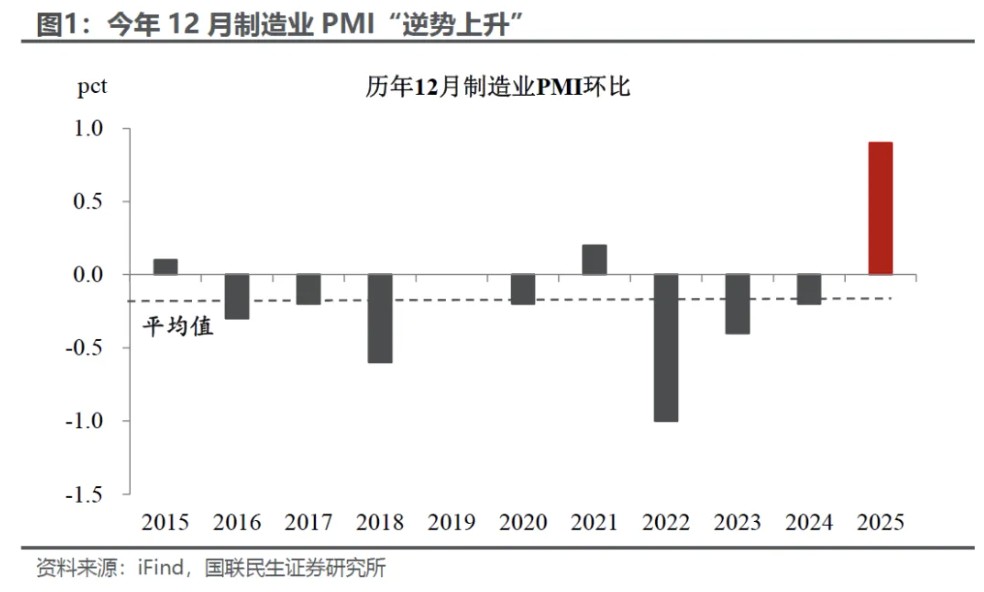
The "counter-seasonal" rise of the manufacturing PMI in December is indeed remarkable. Not only has the PMI returned to the expansion zone after an 8-month hiatus; more importantly, compared to the pulse-like increase of the March PMI after the "Spring Festival effect" fades, this December's "counter-seasonal" rise in PMI seems to carry more weight—affected by special factors such as the cold wave and domestic and international holidays, the December PMI typically experiences a seasonal decline, but this year it has significantly increased by 0.9 percentage points month-on-month, achieving a good result of 50.1%.

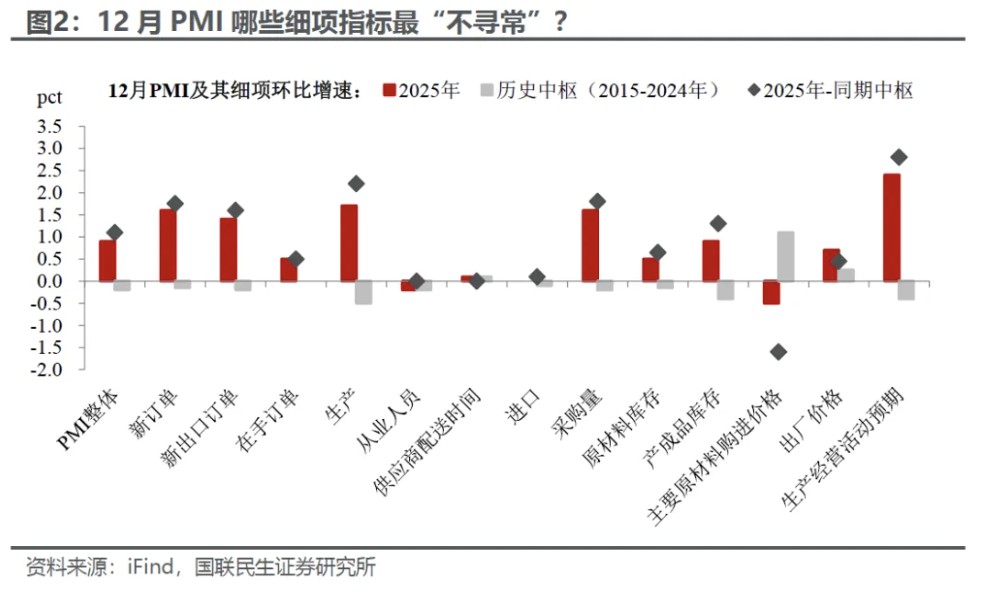
Who is the most "unusual"? Looking at the performance of the PMI sub-indicators, compared to historical seasonality, the top three indicators with the largest increase in December this year are: the PMI Production and Business Activity Expectation Index (greater than the historical month-on-month growth center of 2.8 percentage points for December 2015-2024, same below), the PMI Production Index (greater than the historical center by 2.2 percentage points), and the PMI Purchase Volume (greater than the historical center by 1.8 percentage points). Interestingly, these indicators are all related to enterprise production, collectively outlining a clear chain from "improved expectations" to "actual stocking," and then to "accelerated production," indicating a strong willingness for current production expansion.

Why has the willingness of enterprises to expand production increased? On one hand, the Spring Festival is later this year, and some enterprises have proactively adjusted their production tasks forward to avoid production interruptions caused by the Spring Festival, resulting in a "rush to produce" phenomenon; on the other hand, some inefficient production capacities that relied on low-price competition and disrupted the market have been curtailed or exited, freeing up market space for high-efficiency and compliant quality enterprises. As the competitive environment improves, the willingness of these quality enterprises to expand production has naturally begun to rise.
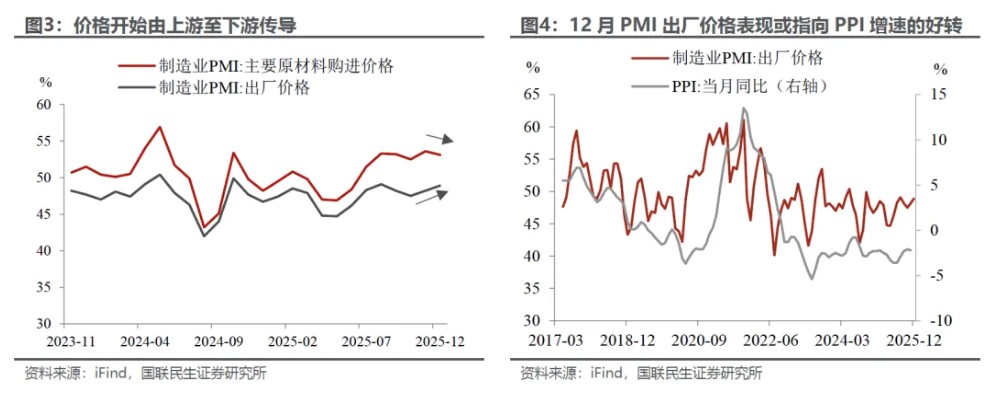
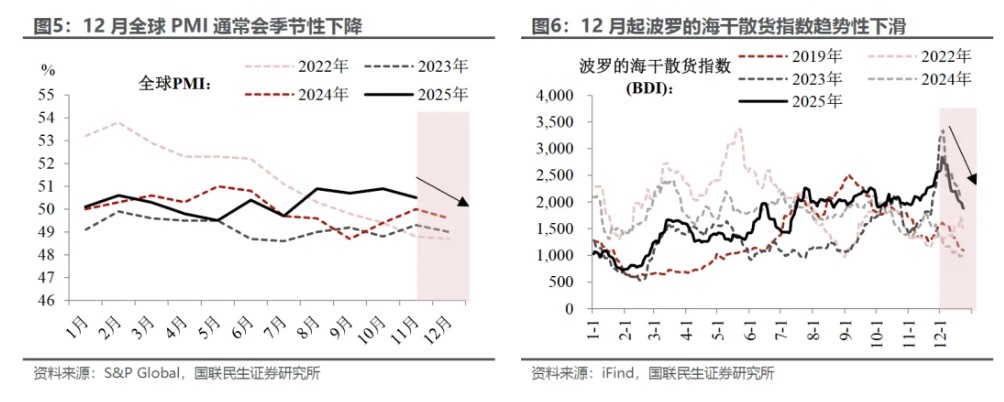
Price indicators show key signals of the deepening effects of "anti-involution" policies, entering the latter half. In the early stages of the policy, inefficient and excess production capacities were forcefully cleared in the upstream raw materials sector, which temporarily pushed prices up due to supply contraction. Entering the latter phase, as the competitive order in the industry has gradually improved, prices have begun to transmit from top to bottom—the PMI Raw Material Purchase Price Index representing the upstream decreased by 0.5 percentage points in December, while the PMI Factory Price Index representing the downstream continued to rise by 0.7 percentage points. This not only indicates that the profit margins for mid- and downstream industries are expected to open up, but may also "lay the groundwork" for the overall improvement of the December PPI.
The export sector is also conveying "unusual" signals. Due to Christmas orders typically being released before November, external demand in December tends to be lackluster in previous years, with the PMI new export orders index often showing seasonal declines month-on-month. This is corroborated by the simultaneous weakening of global PMIs and the Baltic Dry Index entering a downward trend. However, in December this year, the PMI new export orders index unexpectedly rose by 1.4 percentage points, reflecting a further strengthening of China's export resilience—the diversification of markets and the upgrading of product structures are reducing the dependence of export growth on specific markets, thereby demonstrating stronger stability and growth potential.

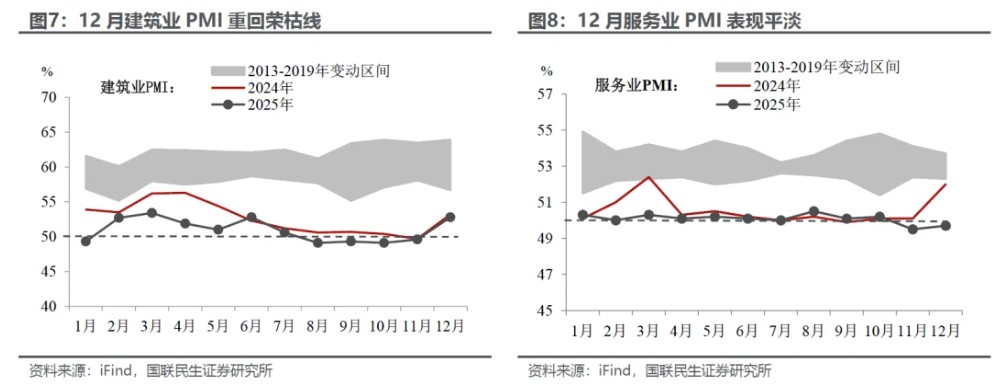
The non-manufacturing sector shows a differentiated pattern. In December, the construction PMI rebounded significantly by 3.2 percentage points to 52.8%, returning to the expansion zone. This rebound, supported by new policy financial tools and other funding sources, also reflects the reality of various regions accelerating project reserves and construction in preparation for the start of the 14th Five-Year Plan, laying a physical workload foundation for achieving a "good start" in the economy next year. In contrast, the services PMI only slightly increased by 0.2 percentage points and remains in the contraction zone, showing a lackluster performance. This further confirms that the current recovery of terminal consumer demand is not yet solid, and the recovery of domestic demand remains uneven, which will be a key direction for macro policies to continue to exert force next year.

Risk Warning and Disclaimer
The market has risks, and investment requires caution. This article does not constitute personal investment advice and does not take into account the specific investment objectives, financial conditions, or needs of individual users. Users should consider whether any opinions, views, or conclusions in this article align with their specific circumstances. Investment based on this is at one's own risk