"Stock Boom"! Global stock markets have risen for the third consecutive year with double-digit gains

Driven by corporate profit resilience, expectations of Federal Reserve interest rate cuts, and better-than-expected economic growth, global stock indices are expected to rise over 20% in 2025. This round of market performance shows concentrated risks: the combined weight of the Mag7 in the MSCI Global Developed Markets Index has reached about one-quarter, and with the networked capital associations in the AI industry, systemic market risks are amplified, significantly increasing the likelihood of a substantial correction
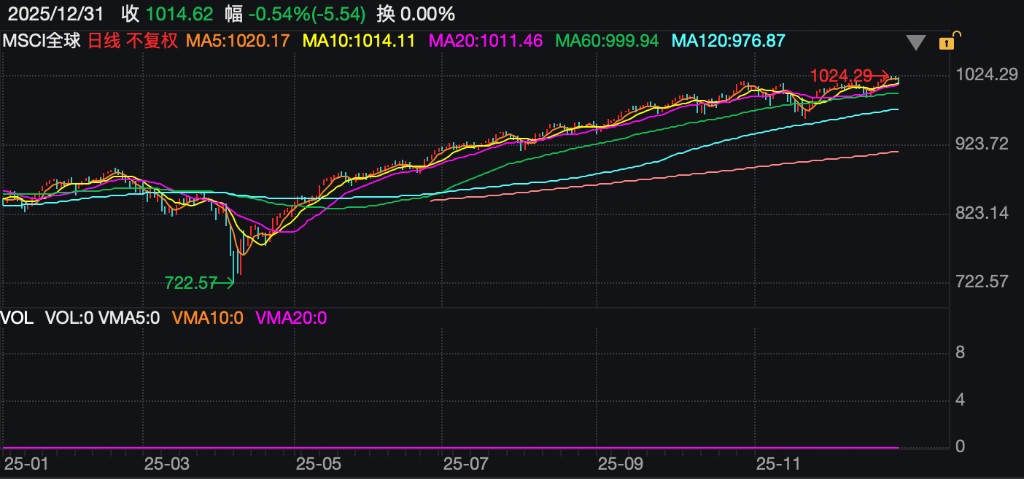
Global stock markets achieved double-digit growth for the third consecutive year in 2025, despite uncertainties caused by Trump's trade policies and concerns over the artificial intelligence sector bubble. The MSCI Global Index rose over 20% this year, outperforming most analysts' expectations.

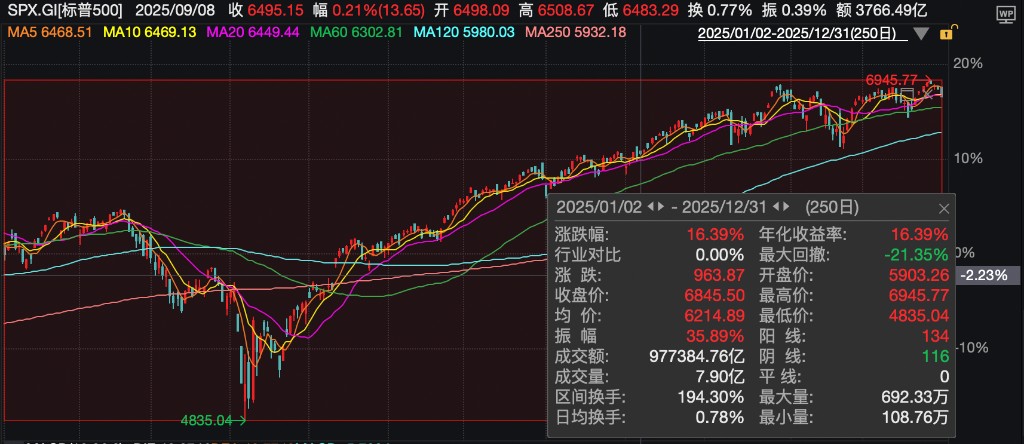
After a sharp decline at the beginning of the year, the U.S. stock market rebounded strongly, with the S&P 500 Index gaining nearly 16.5% for the year. DeepSeek released a large language model at the beginning of the year, shocking Silicon Valley and leading to a plunge in tech stocks. In April, Trump announced large-scale tariff measures, triggering another sell-off in stocks, bonds, and the dollar. However, strong corporate earnings, expectations of interest rate cuts from the Federal Reserve, and better-than-expected economic growth quickly prompted investors to return to the market.

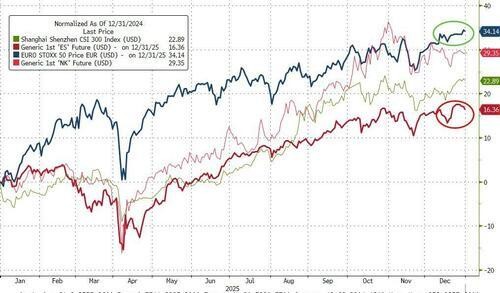
Despite the strong performance of U.S. stocks, markets in China, Japan, the UK, and Germany all outperformed the S&P 500 Index this year, and emerging market stock indices also performed better than U.S. stocks. Investors sought more diversified allocations after experiencing volatility in U.S. stocks at the beginning of the year.

However, market valuations are now far above historical averages, and analysts warn that this rally led by tech giants may be difficult to sustain. The Shiller cyclically adjusted price-to-earnings ratio of the S&P 500 is close to 40 times, second only to the levels before the bursting of the internet bubble in the early 2000s.
Economic Resilience Supports Market Performance
The strong earnings resilience of U.S. companies, combined with the clear prospect of a shift in Federal Reserve monetary policy towards interest rate cuts, forms the core support for the market, driving a large-scale influx of capital into the stock market and reinforcing investors' long-term bets on the potential of artificial intelligence. Meanwhile, better-than-expected U.S. economic growth data further eased market anxieties and boosted market risk appetite.
Venu Krishna, head of U.S. equity strategy at Barclays, stated, "This has been an extremely strong year, exceeding our expectations. Despite policy uncertainties, including tariffs, the U.S. economy and stock market have shown strong resilience overall."
Kasper Elmgreen, chief investment officer for equities and fixed income at Nordea Asset Management, said, "If you had told me at the beginning of the year that there would be such a restructuring of global trade, I would not have predicted such strong stock market performance. But what we are seeing is a resilient economy and very strong corporate fundamentals."
High Valuations Raise Concerns
After such a strong rally, market sentiment began to breed caution. Some investors and analysts have warned about the sustainability of the market, pointing out that this bull market exhibits significant structural concentration and valuation deviation characteristics, with the rally primarily driven by a few tech giants in Silicon Valley, leading to a substantial divergence of overall market valuations from long-term historical averages, and stock index returns increasingly relying on the continued performance of leading stocks. **
Simon Adler, head of value stocks at Schroders, stated: "When the market is so strong, there is a risk of complacency. As we enter 2026, certain areas of the market look very, very fully valued. The risk of a significant correction has increased significantly."
He pointed out that the Shiller cyclically adjusted price-to-earnings ratio of the U.S. stock market is approaching 40 times by the end of 2025, which is extremely high relative to historical levels. The S&P 500 has only seen higher ratios before the bursting of the internet bubble in the early 2000s. From this valuation level, the market has never generated returns for investors above inflation.
Elyas Galou, an investment strategist at Bank of America, said: "It is very rare for the S&P 500 to achieve double-digit returns for four consecutive years. It can happen, but the threshold is very high. We are starting from a very high valuation."
Concentration Risk Intensifies Market Vulnerability
Altaf Kassam, head of European investment strategy and research at State Street Global Advisors, warned that the current market rally driven by a few stocks is accumulating structural risks. He noted that the so-called "Seven Giants" of U.S. technology have reached about a quarter of the total weight in the MSCI World Developed Markets Index, and this extreme concentration of weight has deeply tied the performance of global indices to that of individual giants, exacerbating the overall vulnerability of the market. He stated:
"This is a bullish market that feels unsettling. Whenever you see a concentration of companies with very similar business models, it is concerning... It makes the market more fragile."
The increasing concentration trend in the current market is prompting a deep examination of the merger frenzy in the artificial intelligence sector. This trend has given rise to a complex and interdependent network of financial relationships. A typical case is that the developer of ChatGPT, OpenAI, not only holds stakes in some key infrastructure suppliers but also receives large-scale investments from other participants in the supply chain. This intertwined capital relationship is reshaping the industry ecosystem and may amplify systemic risks.
Kassam stated: "It's like a game of Jenga. If you pull out one key block, the whole structure could collapse."