The stock god takes a bow! In the final year of his Berkshire career, Buffett firmly "sells stocks and hoards cash"

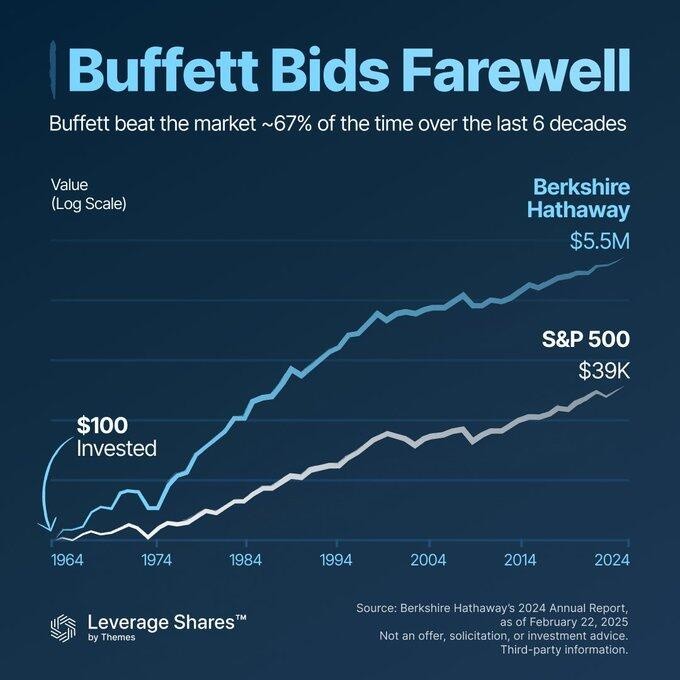
Buffett officially stepped down as CEO of Berkshire Hathaway today. In the first nine months of this year, Berkshire net sold $10 billion in stocks, becoming a net seller of stocks for the third consecutive year, with cash reserves soaring to a historic high of $358 billion. Since Buffett took the helm of Berkshire, an initial investment of $100 has grown to approximately $5.5 million, while the S&P 500 index has returned about $39,000 during the same period, with the performance of his investment portfolio exceeding the market benchmark level about 67% of the time
In his final year as CEO of Berkshire Hathaway, 94-year-old Warren Buffett adhered to his investment principles that have guided him for sixty years: maintaining patience at market highs. This year, he has continued to sell stocks, pushing cash reserves to a historic high. The legendary investor officially stepped down today, handing the company over to his successor, Greg Abel.
In 2025, a year when U.S. stocks hit new highs and artificial intelligence stocks surged, Buffett chose to "sell stocks and hoard cash." Berkshire net sold $10 billion in stocks in the first nine months of this year, becoming a net seller of stocks for the third consecutive year, with cash reserves soaring to a historic high of $358 billion.
Buffett leaves behind a record etched in financial history: since he took the helm, an initial investment of $100 has grown to approximately $5.5 million (based on the price of Berkshire Hathaway Class A shares), while the S&P 500 index has returned about $39,000 during the same period. His portfolio has outperformed the market benchmark approximately 67% of the time.

In May of this year, Warren Buffett announced at the Berkshire Hathaway annual shareholder meeting that he would step down as CEO by the end of the year, with Greg Abel, who has long served as vice chairman, taking over. This significant personnel change even surprised Abel himself. In the letter to shareholders released in November, Buffett candidly stated that he would "remain quiet" in the future and reiterated his full trust in Abel's leadership abilities.
In his final year in office, Buffett continued to reduce his stake in Apple and made a $10 billion cash acquisition of OxyChem, a chemical company under Occidental Petroleum, marking his last major acquisition during his tenure as CEO of Berkshire.
Adhering to Value Investment Principles
Amid market euphoria, Warren Buffett demonstrated his consistent and almost stringent investment discipline. Chris Bloomstran, president and chief investment officer of Semper Augustus Investment Group, commented:
"Buffett's actions in his final year are entirely consistent with his creed over the past sixty years: maintain patience, seek opportunities, and never put the company at risk."
At this year's shareholder meeting, when asked about Berkshire's continuously rising cash reserves, Buffett's response reaffirmed this classic philosophy. He stated that the company is simply following a time-tested strategy. Buffett further clarified that once a "meaningful" major opportunity arises, he would not hesitate to deploy $100 billion for acquisitions. He stated:
"One of the challenges of the investment business is that opportunities do not appear in a predictable manner. This will certainly happen again. I cannot predict whether it will be next week or five years from now, but it will not be fifty years from now. By then, we will be glad to have ample cash on hand."
Continued Reduction of Apple Holdings
Berkshire Hathaway continuously reduced its core holding in Apple Inc. in the second and third quarters of 2025, with a significant increase in the reduction during the third quarter.
Specifically, following the initiation of the reduction in the second quarter, Berkshire further sold approximately 41.79 million shares of Apple stock in the third quarter, bringing the total holdings down by over 14.9% compared to the end of the second quarter, corresponding to a decrease in market value of about $10.6 billion. Thus, the cumulative reduction over the two quarters has exceeded 60 million shares.
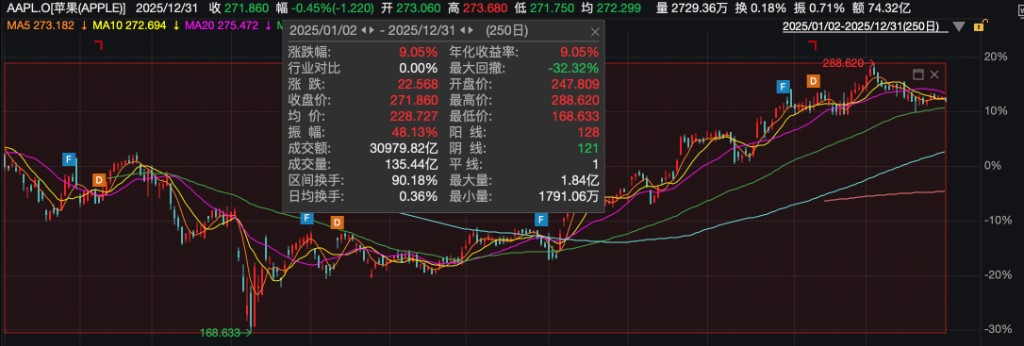
It is noteworthy that this series of operations occurred against the backdrop of Apple’s stock price still rising by 9% within the year. Despite the continued reduction, Apple remains one of the largest holdings in Berkshire's investment portfolio. Historically, since establishing its position in Apple in 2016, Berkshire has achieved a massive return of 834% by the end of 2024, with this position once referred to by Buffett as one of the company's "four pillars."

This choice to phase out during a period of extreme optimism in tech stocks further confirms Buffett's classic strategy of "stockpiling cash when prices are too high." His past record shows that he is adept at reserving liquidity during market euphoria to wait for significant opportunities, similar to investing in Goldman Sachs and General Electric during the 2008 financial crisis.
The Last Major Acquisition
In 2025, Berkshire Hathaway completed its iconic last major acquisition: acquiring the chemical manufacturer OxyChem, a subsidiary of Occidental Petroleum, for $10 billion. This deal provided much-needed cash for Occidental Petroleum, which is seeking to reduce debt, while Berkshire may have obtained it at an attractive price. Morningstar analyst Gregory Warren pointed out that for decades, it has been these types of attractively priced acquisitions that have continuously driven Berkshire's profit growth.
However, even in advantageous areas, Berkshire has demonstrated great discipline. Despite being one of the core railroad operators in the U.S., when Union Pacific Railroad announced in July its acquisition of Norfolk Southern Railway, sparking widespread speculation that its BNSF Railway would participate in industry consolidation, Buffett did not chase the trend. He quickly denied the rumors of related transactions and subsequently chose to establish a new business partnership with another railroad company, CSX, rather than pursue a large-scale acquisition.
Leadership Transition Triggers Personnel Changes
In his Thanksgiving letter to shareholders in November, Warren Buffett, with his usual restraint and humor, told investors that he would "remain quiet"—he then added "to some extent"—and reaffirmed his strong confidence in his successor, Greg Abel. As the Vice Chairman of Berkshire's non-insurance business, Abel's capabilities have received high praise from Buffett. He stated:
"Greg's understanding of the upside potential and risks of our property and casualty insurance business far exceeds that of many seasoned executives who have been deeply involved in this field for years." However, the leadership change is also accompanied by changes in the core team. At the same time, one of its key deputies, Geico CEO Todd Combs, will leave to join JP Morgan, and Marc Hamburg, who has long served as Chief Financial Officer, also plans to retire in June of the following year.
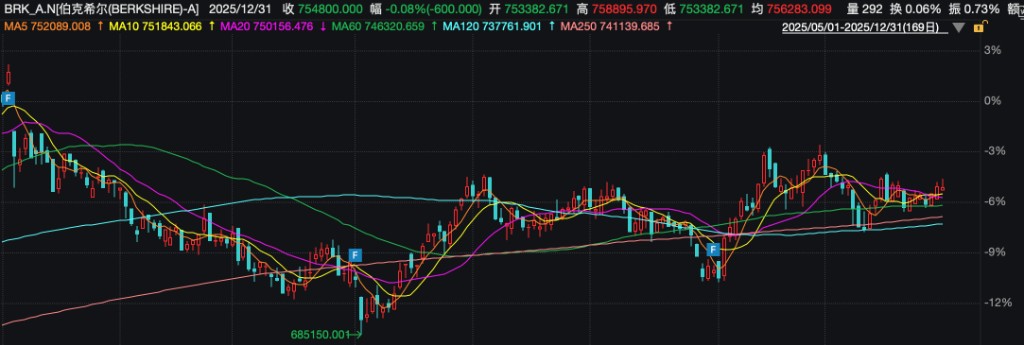
Since Buffett announced his retirement, Berkshire's stock price has fallen by more than 6% cumulatively. In response, Bill Stone, Chief Investment Officer of Glenview Trust, which holds Berkshire shares, commented: "When the company no longer has Buffett as its core attraction, it will become more like an ordinary company, and talent will leave for other jobs or retire at the appropriate age."