


2 days and 20 hours, with zero interventions across the United States, has Tesla FSD passed the "physical Turing test"?

Tesla FSD has completed a long-distance drive across the United States for the first time in a real traffic environment, covering complex scenarios such as highways, city roads, night driving, and multiple entries and exits from supercharging stations, with a total distance of 2,732 miles, relying 100% on FSD. Meanwhile, the head of NVIDIA's robotics business pointed out that the driving behavior of Tesla FSD v14 exhibits a high degree of naturalness, making it "difficult to distinguish whether it is driven by a human" in actual experience, suggesting that it may have passed the "physical Turing test."
Tesla's Full Self-Driving (FSD) system is crossing a critical threshold.
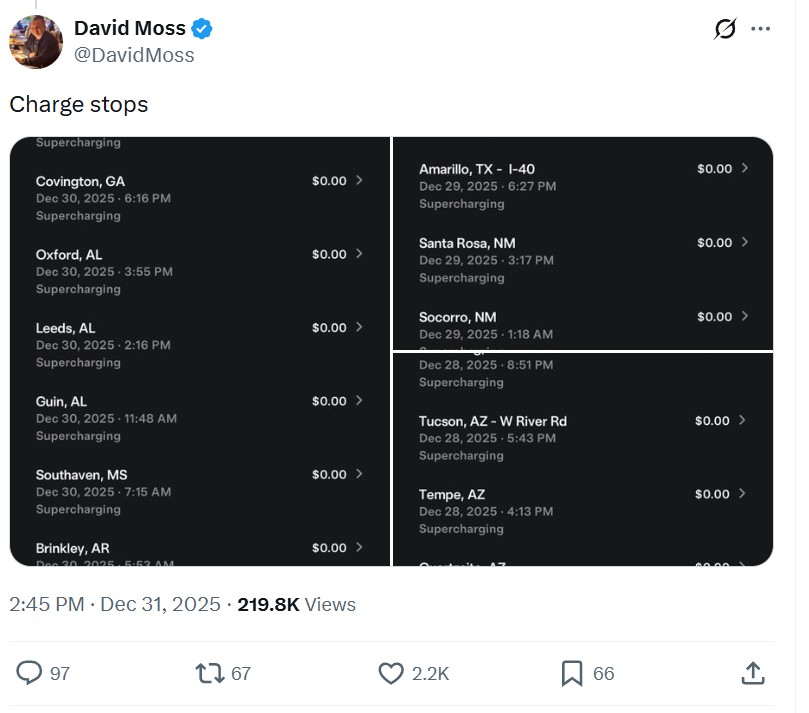
Recently, a Model 3 equipped with FSD v14 traveled across the continent from Los Angeles on the U.S. West Coast to South Carolina on the East Coast in 2 days and 20 hours. The entire journey of 2,732 miles relied 100% on FSD, covering complex scenarios including highways, city roads, nighttime driving, and multiple entries and exits at Supercharger stations, with no human intervention throughout the trip.

This is not an official demonstration or a laboratory test, but a real-world record completed by an ordinary car owner in a genuine traffic environment.
For the autonomous driving industry, the significance of this journey goes beyond just "traveling far"; it concretely raises the question: Can FSD fully replace human drivers?
Zero Takeover Across America
The journey across America was completed by Tesla owner Davis Moss.
According to Moss's post on social media platform X, his Model 3 is equipped with AI4 hardware and runs FSD v14.2.1.25. According to the FSD database and community tracker, before completing this coast-to-coast drive, Moss had already driven 10,638.8 miles using FSD, relying 100% on FSD throughout.
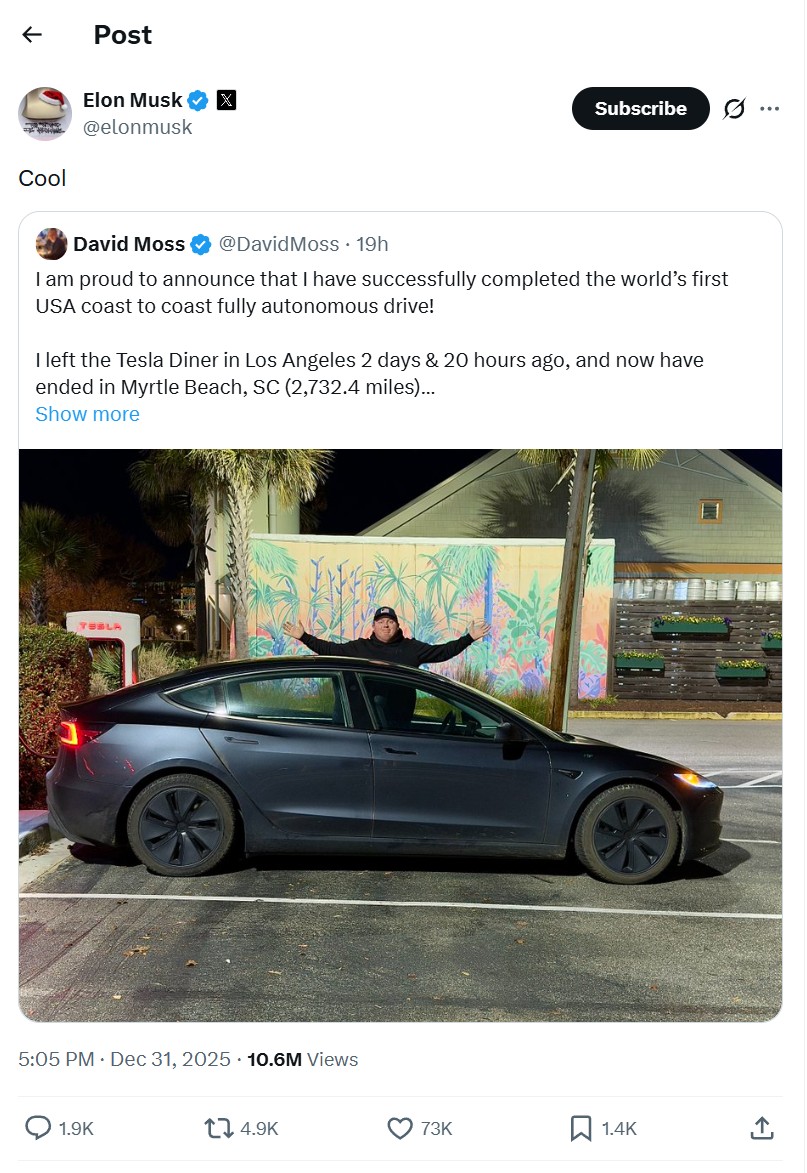
Moss started from the Tesla restaurant in Los Angeles and ultimately arrived at Myrtle Beach, South Carolina, using FSD v14 without any form of human takeover.
This 2,732.4-mile journey covered the diverse road environments of the United States, including highways, city roads, and various traffic conditions. Moss emphasized that FSD v14.2 not only completed the entire driving task but also handled all parking operations, including automatic parking at Tesla Supercharger stations, with "not a single dangerous situation" occurring throughout the trip.
Elon Musk himself quickly retweeted to congratulate. It is worth mentioning that this route is the very one Musk has repeatedly referred to since the release of Autopilot 2.0 in 2016, yet has never been realized. Back then, he predicted that Tesla could achieve "coast-to-coast" autonomous driving by 2017. Looking back now, this goal does not seem impossible.
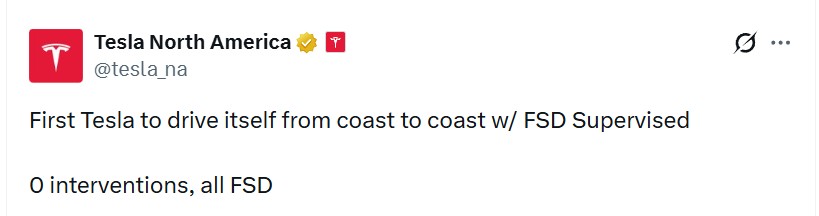
The Tesla community reacted enthusiastically to this achievement, as zero takeover coast-to-coast driving has long been regarded as an important indicator of the maturity of autonomous driving technology. Tesla's official North America account confirmed on social media: "The first Tesla to autonomously drive coast-to-coast using FSD Supervised, zero takeover, fully FSD." "
Through the "Physical Turing Test"?
At this moment, Jim Fan, head of NVIDIA's robotics business, made an intriguing judgment: Tesla FSD v14 may have passed the "Physical Turing Test." This concept originates from the classic Turing Test proposed by mathematician Alan Turing in 1950, but shifts the evaluation criteria from text-based dialogue to physical behavior in the real world. If an observer cannot distinguish whether a task is performed by a human or a machine, then the machine has passed the test.
After experiencing FSD v14, Fan felt that it was already difficult to distinguish.
In his test ride experience, Tesla's driving behavior did not resemble that of a rigidly rule-following robot, but rather acted like a cautious, experienced human driver—slowly proceeding at intersections, braking smoothly, changing lanes naturally, and responding to subtle cues that are difficult to program manually.
Fan believes that passing the physical Turing test requires overcoming four major challenges: understanding three-dimensional space, finely processing objects, mastering real-world contextual knowledge, and bridging the gap between digital instructions and physical actions. Driving happens to combine all four of these challenges, making it one of the hardest embodied AI problems to tackle.
7 Billion Miles Data Advantage
The breakthrough performance of FSD v14 stems from Tesla's shift from a rule-based system to an end-to-end neural network. Early autonomous driving systems relied on hard-coded rules, while FSD v14 learns driving patterns in a human-like manner through training on billions of miles of real driving data.
Tesla claims that its vehicles equipped with FSD have accumulated nearly 7 billion miles of driving, with about 2.5 billion miles completed in urban environments. Urban driving is far more complex than highway driving, involving unprotected turns, unpredictable pedestrians, bicycles, traffic lights, and adverse weather—scenarios where autonomous driving systems often struggle.
A recent case further demonstrated the system's capabilities: a Tesla owner posted a video showing FSD driving continuously for 7 hours in a hailstorm with extremely poor visibility and severe water accumulation, without any human intervention. This performance made the concept of "human-like driving" feel more tangible.
Fan likened this transformation to the process of smartphone adoption: initially astonishing, then becoming the norm, and ultimately becoming indispensable. If machines can move and behave in the real world as naturally as humans, it will open the door to understanding intent rather than merely following instructions.
However, Tesla's system still requires human supervision, and even the most enthusiastic supporters acknowledge that perfection is unattainable. Whether driven by humans or machines, cars always face risks. The system is currently still defined as "FSD Supervised," requiring drivers to remain alert and ready to take over at any time
