Digital Renminbi 2.0: Mechanisms and Technological Innovations of "Interest-bearing Digital Currency"

Wallstreetcn
2026.01.01 08:06
portai
I'm PortAI, I can summarize articles.

Dongxing Securities believes that the core of this upgrade lies in "redefinition of liability attributes + incorporation of macro framework into the balance sheet." Coupled with the dual upgrade of the "account system + currency string + smart contract" technical architecture, it will push the digital renminbi from "pilot product" to "core bank liabilities and infrastructure." Guotai Haitong believes that this adjustment not only alleviates the user retention issue caused by the non-interest-bearing nature of the digital renminbi but also incorporates it into the reserve system, streamlining the bank's asset-liability logic and solidifying the digital foundation for the internationalization of the renminbi

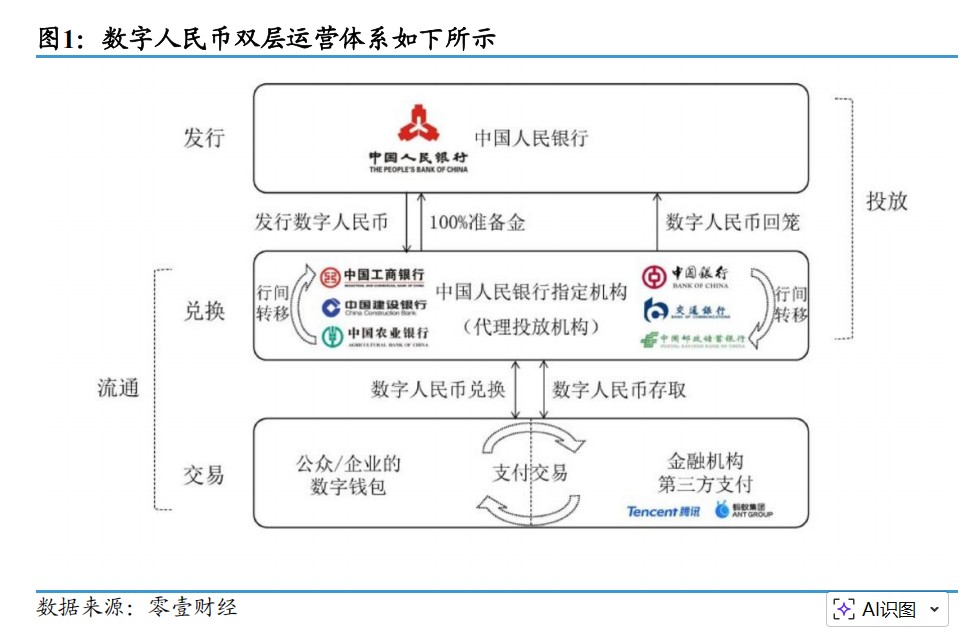
The People's Bank of China has officially launched a historic transformation of the digital renminbi from "cash-type 1.0" to "deposit currency-type 2.0." This reform upgrades the digital renminbi from a mere payment tool to a financial asset with value storage functions through the introduction of a three-in-one system innovation that includes an interest-bearing mechanism, deposit insurance, and reserve management, reshaping the underlying architecture of digital finance.

According to a report by Xinhua News Agency on December 29, the People's Bank of China issued the "Action Plan for Further Strengthening the Management Service System of Digital Renminbi and Related Financial Infrastructure Construction," clearly stating that the new generation of digital renminbi measurement framework, management system, operational mechanism, and ecological system will officially launch on January 1, 2026. Lu Lei, deputy governor of the central bank, pointed out that the digital renminbi in customer wallets now belongs to the liabilities of commercial banks and is in the form of account-based deposits.

Dongxing Securities pointed out in its industry commentary report that the core of this upgrade lies in "redefining liability attributes + incorporating macro framework into the balance sheet," combined with the dual upgrade of "account system + currency string + smart contracts" technology architecture, pushing the digital renminbi from a "pilot product" to "core liabilities and infrastructure of banks." As of the end of November 2025, the digital renminbi has accumulated 3.48 billion transactions, amounting to 16.7 trillion yuan, with the number of personal wallets opened through the app exceeding 230 million.

Guotai Haitong Securities' research report believes that this qualitative change not only solves the user retention problem caused by the lack of interest on the digital renminbi in the past but also closes the asset-liability logic on the bank side by incorporating it into the reserve management system, providing a high-frequency and low-loss digital foundation for the internationalization of the renminbi.

Mechanism Innovation: From Payment Tool to Value Carrier

Dongxing Securities analyst Wang Zijing emphasized in his latest report that the core mechanism innovation of version 2.0 is reflected in "redefining liability attributes + incorporating macro framework into the balance sheet." The plan clarifies that the digital renminbi balance in customers' real-name wallets at commercial banks belongs to "account-based commercial bank liabilities," and the wallet balances of banking institutions are uniformly included in the base for deposit reserve requirements.

Guotai Haitong Securities reached a similar conclusion. Analysts Wu Wei, Yao Shijia, and Bao Yanxin pointed out in their report that the central bank's cancellation of the "non-interest-bearing" policy for digital renminbi directly introduces liquidity from the liabilities of commercial banks into the electronic wallet system, marking the end of the digital cash era. Banking institutions autonomously agree to pay interest on real-name wallet balances at deposit interest rates, and deposit insurance provides legal safety guarantees equivalent to deposits, expanding the digital renminbi from a payment tool primarily characterized by M0 attributes to a "digital demand deposit" with value storage capabilities.

This mechanism arrangement significantly enhances the willingness to hold and use on the user side, while creating manageable asset-liability management space on the bank side. Dongxing Securities believes that the new framework grants banks the autonomy to manage the digital renminbi balance as assets and liabilities, enabling them to cover operational costs through asset-side allocation, achieving a self-circulating business model

Technical Architecture: Programmable Digital Payment Infrastructure

Dongxing Securities report elaborates on three major innovations at the technical architecture level—the digital path of "account system + currency string + smart contract."

On one hand, it upgrades the wallet system based on a broad account framework, maintaining regulatory consistency and low-friction integration with existing bank account rules; on the other hand, it introduces the "currency string" form to achieve value transfer and offline circulation, while enhancing verifiability and system resilience under the premise of compatibility with Distributed Ledger Technology (DLT). At the same time, it upgrades the digital renminbi smart contract ecological service platform to support the construction of an open-source ecosystem for smart contracts, promoting the transition of digital renminbi from "electronic payment" to "programmable digital payment."

The significance lies in: standardization on the account side provides regulatory consistency, clearing efficiency, and operational controllability for large-scale promotion; the compatibility of currency strings with DLT solidifies the foundation for cross-institutional, cross-scenario, and even cross-border collaboration. Smart contracts embed business rules into the flow of funds, enabling condition-triggered and automatic verification in scenarios such as supply chain finance, prepayment fund supervision, fiscal subsidy distribution, and carbon inclusive incentives, thereby reducing the risk of misappropriation and compliance costs.

The "one account for the whole system" capability strengthens risk control and statistical accuracy, helping to enhance the precision of monetary statistics and liquidity management, and improving the accuracy of policy transmission and counter-cyclical adjustments.

Guotai Haitong Securities report further points out that through "separation of management and operation" and the coordination of the management committee, along with the self-regulatory office leading industry standards, it strengthens the symmetry of rights and responsibilities and the efficiency of compliance and anti-money laundering governance, providing technical support for auditing large-scale concurrent transactions and penetrating supervision of distributed ledgers.

Cross-Border Applications: Reshaping the Global Settlement System

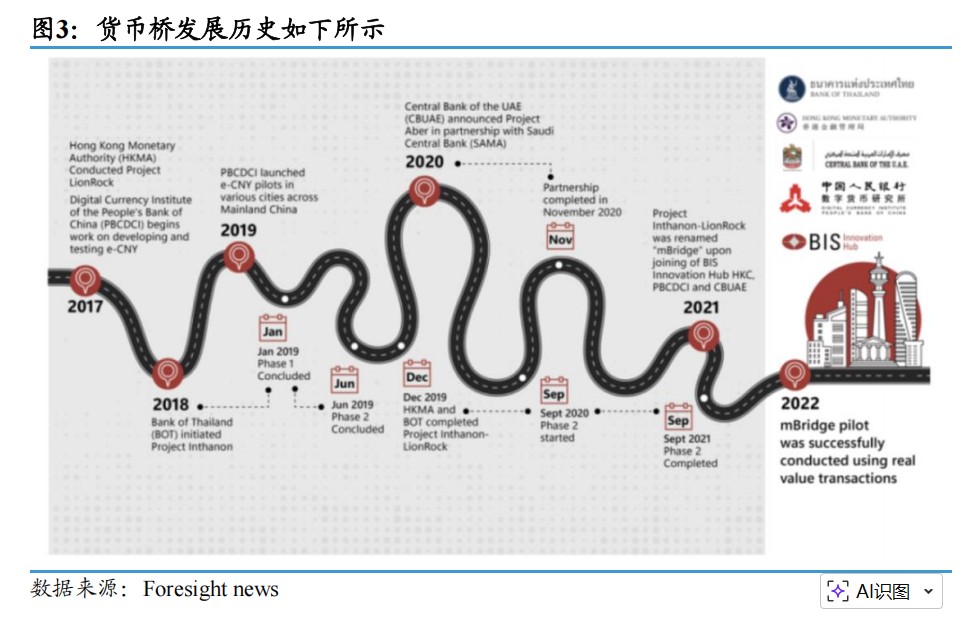
The research team at Guotai Haitong Securities believes that the leap of digital renminbi towards "digital deposit currency" is reshaping the liquidity foundation and settlement efficiency of the multilateral central bank digital currency bridge (mBridge). With the 2.0 version architecture officially defining digital renminbi as a liability of commercial banks and incorporating it into the reserve framework, it no longer merely serves as a zero-interest payment medium in cross-border scenarios but evolves into a high-quality liquid asset with interest-bearing attributes and sovereign credit guarantees.

According to Xinhua News, digital renminbi currently occupies an absolute dominant position of 95.3% in the currency bridge business. As of the end of November 2025, mBridge cross-border payments totaled 4,047 transactions, equivalent to 387.2 billion yuan. The Guotai Haitong Securities report points out that by introducing a deposit insurance mechanism, the risk cost for overseas participating institutions holding digital renminbi is significantly reduced, thereby achieving more robust fund position management on the basis of "payment equals settlement."

Dongxing Securities report verifies the new architecture's support capability for scaling and cross-border scenarios. This architectural upgrade directly optimizes the PVP (Payment versus Payment) efficiency of multi-currency settlements, significantly compressing the complex clearing paths under the traditional agent bank model Guotai Haitong emphasized that the new generation management system enables real-time value interaction for cross-border trade settlement directly within the bank's core account system by granting operational institutions the rights to manage assets and liabilities, thus avoiding the high fees and settlement delays of traditional models. This new capital formation method, driven by interest-bearing deposit currency, is becoming a core force to disrupt the global traditional payment and settlement system by reconstructing the clearing path and credit foundation