分水嶺時刻:2025 年,A 股表現跑贏美股!

In 2025, the global stock market closed, with A-shares achieving a historic surpass over U.S. stocks in annual return rates. The major broad-based indices of A-shares, represented by the CSI 300 and ChiNext, generally saw higher gains than their U.S. counterparts. The market driving logic shows structural differences: U.S. stocks are highly concentrated in AI computing giants, exhibiting a "head dependency" characteristic; while A-shares demonstrate a diversified pattern, with sectors such as semiconductors, new materials, and high-end manufacturing flourishing in multiple areas
The global stock market officially closed for 2025. Throughout the year, A-shares significantly outperformed U.S. stocks in terms of overall return rates.
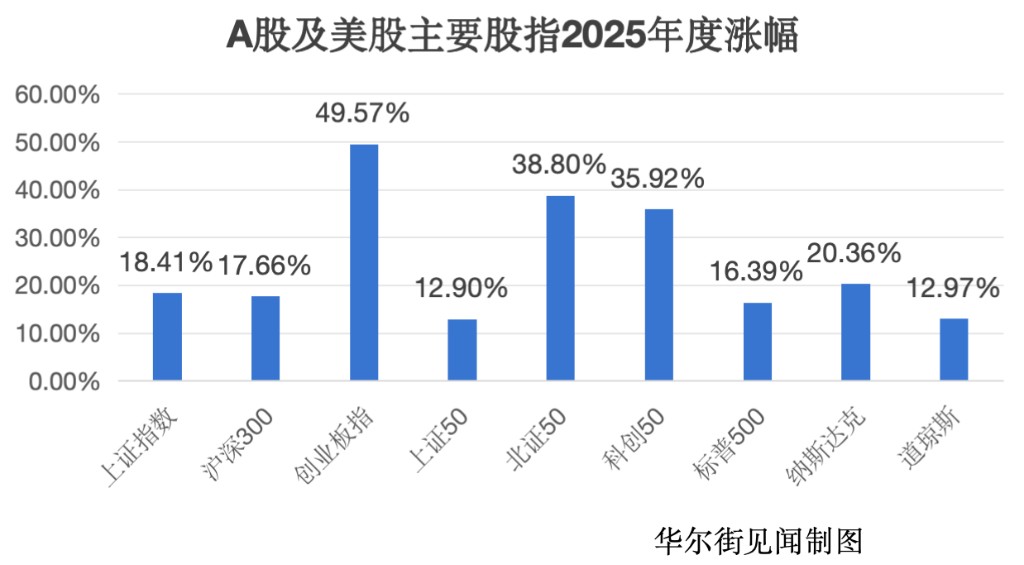
All major A-share indices ended the year in the green, with the CSI 300 index rising 17.66% for the year, the ChiNext index up 49.57%, and the SSE 50 index increasing by 12.9%. Meanwhile, the Beijing Stock Exchange 50 index rose 38.8%, and the Sci-Tech 50 index increased by 35.92%. The Shanghai Composite Index broke through the 4,000-point mark on October 28, reaching a nearly ten-year high.
In the U.S. stock market, after experiencing fluctuations in April, the S&P 500 index recorded a 16.39% annual increase, the Nasdaq narrowly held a 20.36% annual increase, and the Dow Jones rose 12.97%. 
Comparative analysis at the index level shows that the major broad-based indices of the A-share market achieved better gains than their U.S. counterparts in 2025. Among them, the CSI 300 index, representing China's large-cap blue chips, performed slightly better than the U.S. benchmark S&P 500 index; while the ChiNext index, Sci-Tech 50, and Beijing Stock Exchange 50 indices, which focus on technological innovation and growth, significantly outperformed the Nasdaq index, which is also dominated by tech stocks.
Divergence in Technology Narratives: Multi-Engine Driving A-shares, U.S. Stocks Highly Dependent on Tech Giants
At the industry structure level, although both capital markets share the grand narrative of "technology," their paths to realization and market ecosystems have shown profound differences.
The U.S. stock market exhibits a distinct giant-driven pattern, with the annual market trend highly focused on the single theme of "AI capital expenditure - computing power industry chain." The information technology and communication services sector, centered around the seven major U.S. tech giants, has become the absolute engine for market growth, showing typical characteristics of head-dependent growth.
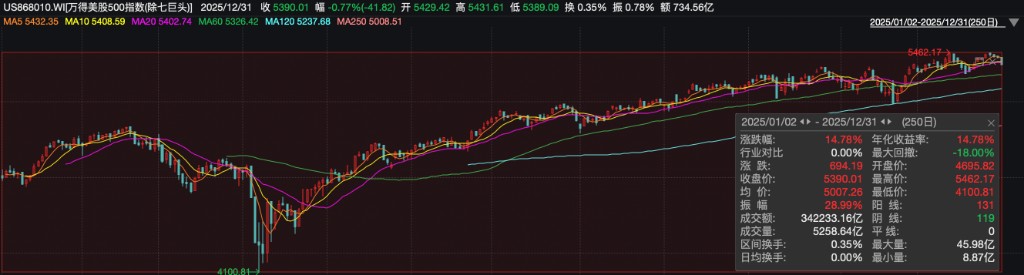
It is noteworthy that this highly concentrated market structure is accumulating significant risks. Currently, the market capitalization of the "seven giants" represents nearly 40% of the total market capitalization of the S&P 500 index, a historical high. Data shows that in 2025, the Wind U.S. 500 index, excluding the seven tech giants, had a growth rate of 14.78%, significantly lagging behind the overall performance of the S&P 500 index, which includes the giants at 16.39%.
This gap clearly reveals the limitations of the upward momentum in the U.S. stock market—market breadth is narrowing, and the performance divergence between leading companies and other constituents is intensifying. The strength of the index relies more on the continued pull of a few giants rather than a broad recovery of the overall economy.

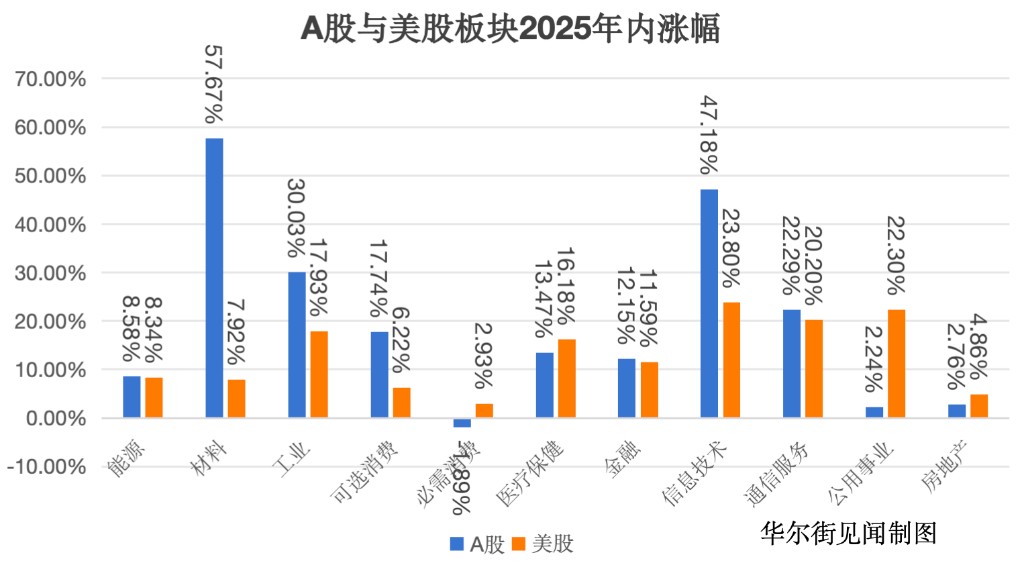
In contrast, the A-share market demonstrates a more balanced and multi-polar growth pattern. From the industry performance data of 2025, the market shows characteristics of blooming in multiple areas: materials (+57.67%), information technology (+47.18%), and industrials (+30.03%) are leading sectors, collectively forming a dual-engine structure centered on the "advanced manufacturing industry chain" and "key resource supply chain." This structural feature indicates that the A-share market is not dominated by a single logic. On one hand, driven by both domestic production and global AI hardware demand, sectors such as telecommunications, electronics, and computers continue to strengthen; on the other hand, the strategic resource sector, represented by non-ferrous metals, performs particularly well, reflecting a strategic reassessment by the capital market regarding supply chain security and the autonomy of key materials in the context of global industrial chain restructuring and energy transition.
The resonance between "manufacturing upgrade" and "resource security" essentially reflects the capital market's recognition of China's dual role in the global industrial chain: as a "world factory" with continuously improving high-end manufacturing capabilities, and as a "resource hub" ensuring stable supply of key raw materials. This multi-engine driven industrial pattern provides the A-share market with a more solid fundamental support and a more resilient growth structure, contrasting sharply with the highly concentrated technology-driven model of the US stock market.

Two Tenfold Stocks in A-shares
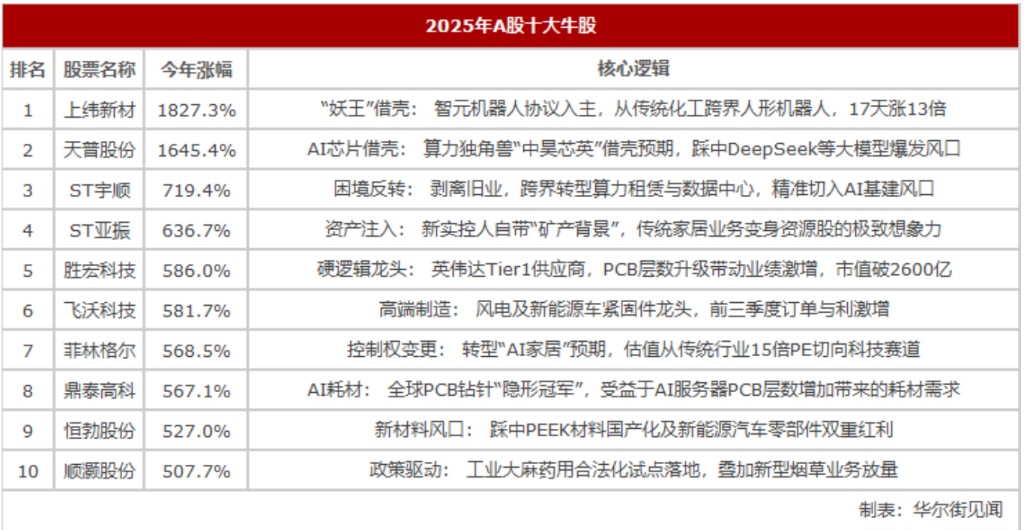
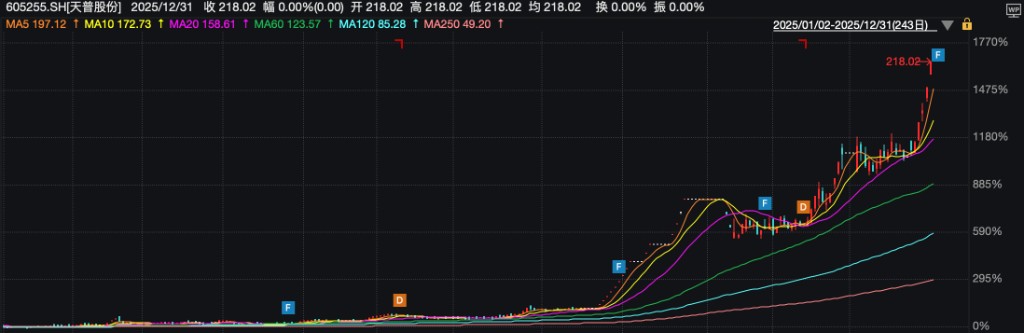
According to Wallstreetcn, as of the close on December 31, the top ten A-share stocks for 2025 are Shangwei New Materials, Tianpu Co., Ltd., ST Yushun, ST Yazhen, Shenghong Technology, Feiwo Technology, Feiling'er, Dingtai High-tech, Hengbo Co., Ltd., and Shunhao Co., Ltd.
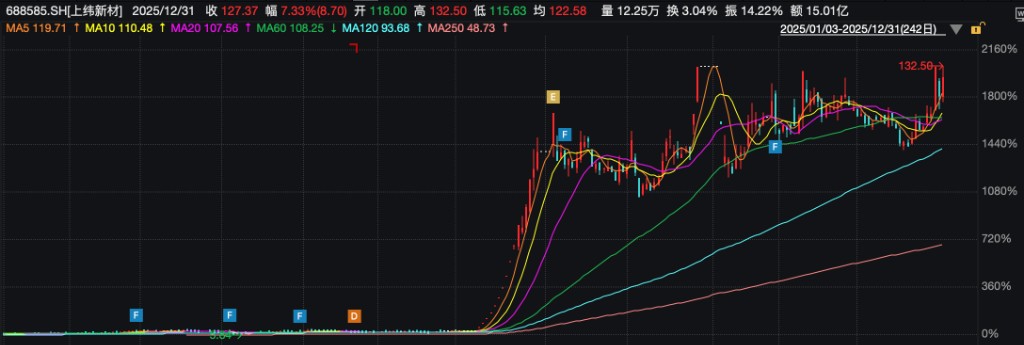
The top ten stocks of the year have all increased by more than five times, with two stocks achieving tenfold growth. Among them, Shangwei New Materials ranks first with a growth rate of 1689.13%.

Shangwei New Materials has become the "monster stock" of A-shares in 2025 with an increase of over 18 times, driven by the dual logic of "track transformation expectations + main business recovery support."
Since July, Zhiyuan Robotics' related party Zhiyuan Hengyue has gradually acquired shares of Shangwei New Materials through a combination of "agreement transfer + tender offer," becoming the company's controlling shareholder, with the actual controller changing to Zhiyuan Robotics Chairman Deng Taihua. This change in control has become the core trigger for the stock price increase.
Additionally, the company's carbon fiber composite materials can be used in domestically produced large aircraft, providing solid fundamental support.

Tianpu Co., Ltd., which mainly produces automotive parts, achieved a 16-fold surge in stock price in 2025, rising from 10 yuan to a high of 218 yuan, driven by the dual fermentation of AI chip backdoor expectations and TPU themes, attracting capital's collective pursuit.
It is worth noting that by the end of 2025, domestic GPU companies have also accelerated their capitalization. The "Four Little Dragons of GPU" in the industry—Moore Threads (688795.SH), Muxi Co., Ltd. (688802.SH), Biren Technology, and Suiruan Technology—have all entered the capital market.
US Tech Stocks Dominate Throughout the Year, 3 of the Top 10 Bull Stocks in Storage
The three major US stock indices have all reached new highs for three consecutive years, with the Nasdaq rising over 20% for three years in a row.
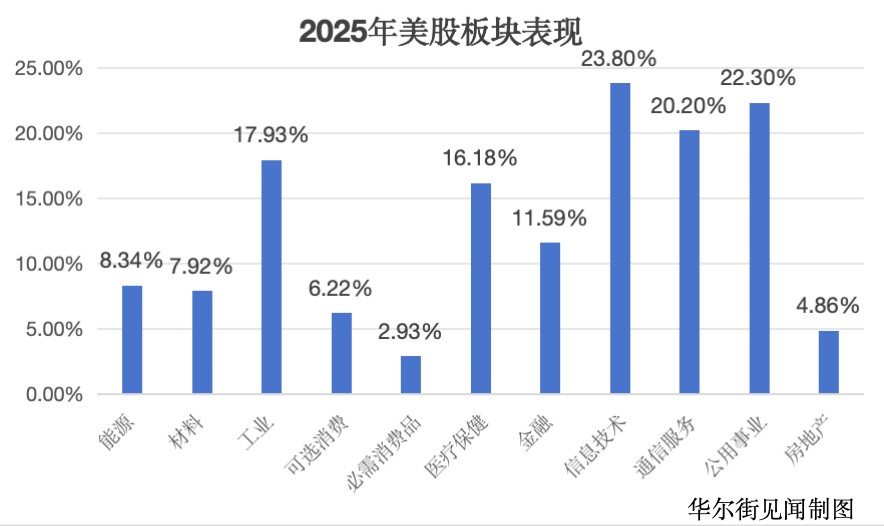
In 2025, the US stock market exhibited a clear structural differentiation, with the information technology and communication services sectors, driven by capital expenditure in artificial intelligence, leading the market. Together, they formed the main theme of technology throughout the year. Notably, the utilities sector emerged strongly, reflecting the market's reassessment of stable cash flow assets amid intertwined expectations of interest rates and economic uncertainty, as well as a long-term bet on infrastructure investment for the green energy transition.
In contrast, the cyclical and consumer sectors faced overall pressure. The energy and materials sectors saw moderate gains, while discretionary and staple consumer sectors lagged significantly, reflecting suppressed consumer spending willingness and capacity in a high-interest-rate environment. The real estate sector continued to be constrained by high financing costs, performing the weakest among all sectors.

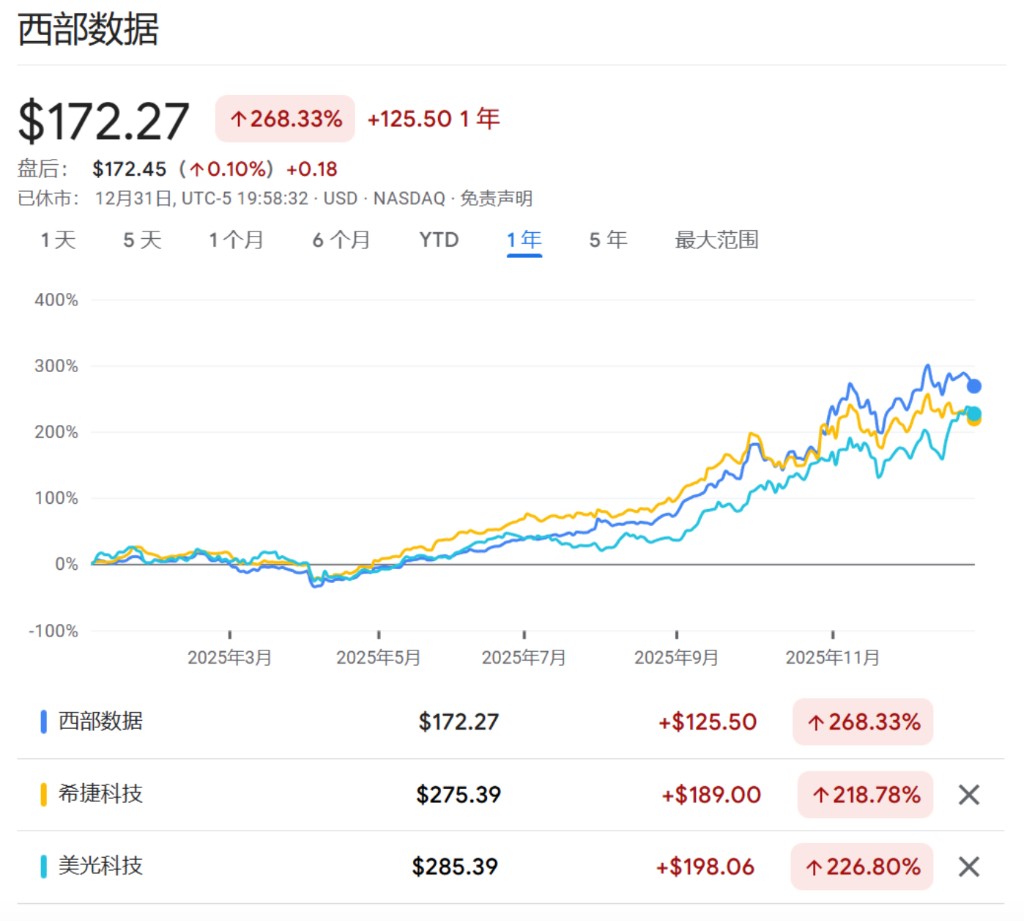
According to Wallstreetcn, data storage companies became the biggest winners in the S&P 500 index in 2025, with three of the top ten stocks by increase coming from this industry—Western Digital, Micron Technology, and Seagate Technology ranked first, second, and third in the index with increases of 268%, 227%, and 219%, respectively.
This performance marks a significant diffusion of the AI investment theme. Hyperscale cloud service providers have committed to investing over $440 billion in AI infrastructure over the next 12 months, with data storage and memory chip companies being direct beneficiaries of this spending frenzy. The massive capital expenditures from tech giants like Microsoft, Amazon, Google, and Meta have created unprecedented demand for storage device manufacturers.
Additionally, SanDisk, which was just included in the S&P 500 at the end of the year, saw an annual increase of 559%. Although it was not officially counted in the annual "best stocks" due to its late inclusion, its popularity in the capital market after being spun off from Western Digital further confirms the logic that "storage is an essential need for AI."

Google and Nvidia Lead Mag7
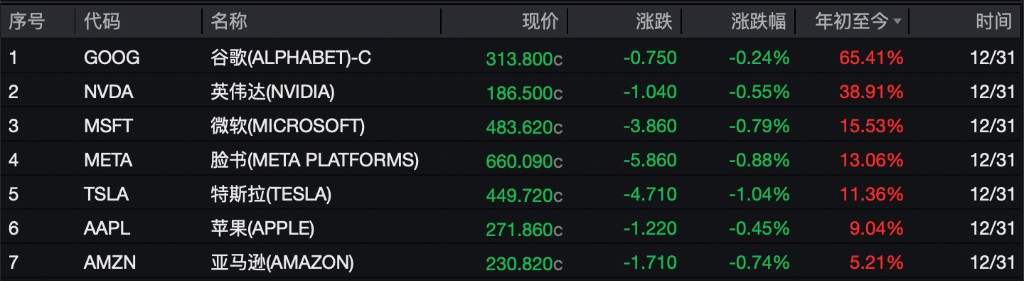
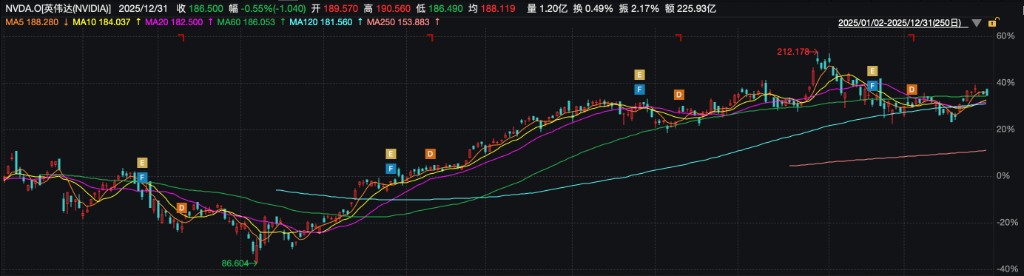
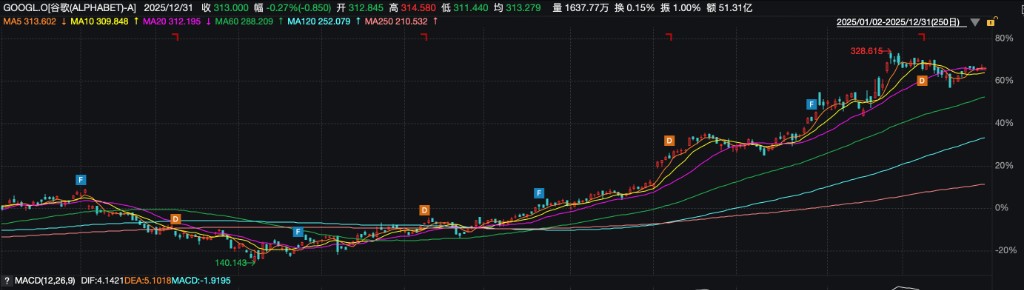
In 2025, the performance of the "Tech Seven Giants" showed significant differentiation. Besides Google (with a cumulative increase of about 66%) and Nvidia (with a cumulative increase of about 39%) significantly outperforming the market, the other five giants—Microsoft, Meta, Tesla, and others—saw increases between 11% and 15%, failing to surpass the annual increase of the S&P 500 index

The current market pricing logic for U.S. tech giants has undergone a key shift: from pricing based on the "conceptual potential" of AI to a comprehensive shift towards pricing based on "profit realization capability." This change has allowed companies that can clearly demonstrate AI-driven revenue growth, margin expansion, or cost advantages to command a premium, while those facing headwinds in their short-term business or with unclear AI monetization paths are relatively under pressure. This has led to significant divergence in the performance of the seven giants.
Nvidia's strong rise stems from its near-monopolistic position in the AI computing power supply chain being continuously validated. As an irreplaceable "arms dealer," its data center GPUs are in high demand in the training and inference markets, granting the company strong pricing power. Each quarter's performance has significantly exceeded market expectations, proving that the explosive demand is real and sustainable, while its CUDA ecosystem's deep moat further reinforces market confidence in its long-term position.

Google's upward momentum comes from its "TPU + Gemini + Cloud" vertical integration model demonstrating disruptive potential. By leveraging self-developed TPUs for extreme efficiency in inference tasks, the company is initiating a revolution in the cost structure of AI infrastructure, which not only enhances its own profit margins but also gives its cloud services a unique cost advantage and competitiveness.