


Delivering 4.6 million vehicles in 2025! BYD growth of 7.7% vs Tesla expected decline, firmly securing the title of "global electric vehicle leader"

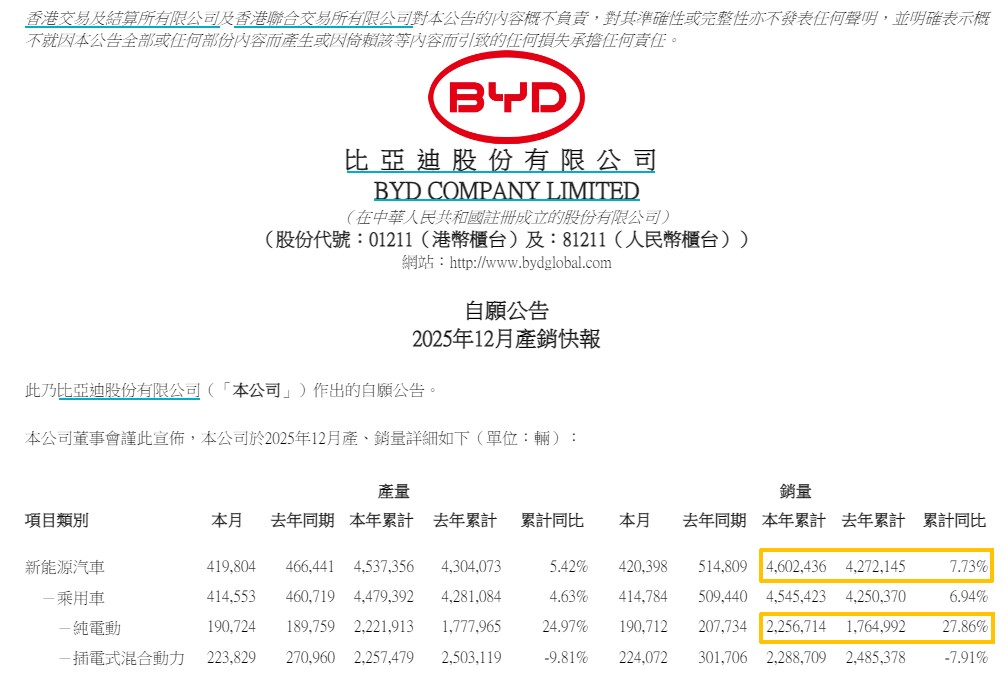
In 2025, BYD's pure electric vehicle sales will surpass Tesla for the first time. BYD announced on Thursday that its pure electric vehicle sales are expected to grow by 28% year-on-year, reaching 2.26 million units, surpassing Tesla (projected at 1.64 million units) to become the global leader. Last year, BYD intensified its efforts in the Latin American, Southeast Asian, and African markets, leveraging its cost advantages across the entire industry chain to replicate its success in China in price-sensitive emerging markets
In the recently concluded year of 2025, BYD not only crowned itself the global champion with an annual sales volume of 4.6 million vehicles but also achieved a historic reversal in the pure electric vehicle sector, which was once absolutely dominated by Tesla, with an overwhelming advantage of 2.26 million to 1.64 million (estimated).
Against the backdrop of Tesla facing consecutive declines in sales, BYD has firmly established itself as the "global leader in electric vehicles" with its dual-driven strategy of "pure electric + plug-in hybrid" and global layout.
Offensive and Defensive Shift: BYD's Pure Electric Sales Surpass Tesla for the First Time
Among the total sales of 4.602 million vehicles, the sales of battery electric vehicles (BEV) reached 2.26 million, a year-on-year increase of 28%. In comparison to Tesla, although the company has not disclosed its total electric vehicle sales for the year, its consensus forecast released on Monday indicates that its 2025 sales will decline by 8% year-on-year to 1.64 million.
In 2024, Tesla narrowly retained its position as the global sales leader with a slight advantage of just over 20,000 vehicles. In 2025, BYD seems to have surpassed Tesla by a considerable margin.
BYD's victory is largely attributed to its dual-driven strategy of "pure electric + plug-in hybrid" and its penetration into emerging markets.
As pure electric demand fluctuates due to range anxiety and insufficient infrastructure, BYD's extensive plug-in hybrid electric vehicle (PHEV) product line has become a protective moat. Additionally, despite intense competition in the domestic market, BYD has successfully hedged some risks through localized production and exports in countries like Brazil and Sri Lanka.
In contrast, Tesla's slowdown in 2025 is not only due to the aging of its product cycle but also a complex "political account."
As CEO, Musk's open embrace of right-wing politics and his high-profile support for Trump in the 2024 election, while making him the world's richest person, has triggered backlash among consumers, with some distancing themselves from the Tesla brand due to their aversion to Musk's political stance.
Ironically, after Trump took office, the cancellation of the $7,500 subsidy per vehicle and the reduction of regulatory support for electric vehicles directly weakened Tesla's price competitiveness in the U.S. market.
Currently, the capital market's expectations for Tesla have been significantly downgraded. Analysts predict that its fourth-quarter delivery volume for 2025 will be only 423,000 vehicles, a year-on-year drop of 16%. Regarding Musk's previous ambitious goal of "producing 4 million vehicles annually by 2027," the current market consensus is that Tesla may not reach the threshold of 3 million vehicles until 2029.
BYD's Hidden Concerns: Domestic "Involution" and Technological Homogeneity
Setting aside the halo of "surpassing Tesla," BYD's 2025 is not without its worries.
Segmented data shows that its growth engine is undergoing a structural shift.
In its domestic base, BYD is facing resistance. In December 2025, BYD's sales fell by 18.3% year-on-year, marking the fourth consecutive month of declining monthly deliveries, with the rate of decline showing an expanding trend BYD Chairman Wang Chuanfu recently admitted that the core reason for the pressure on domestic sales is the "decline in the stunningness of technological leadership" and the dilution of differentiated advantages due to industry homogenization competition. Under the siege of competitors like Geely and Xiaomi, China's new energy market has shifted from "incremental dividends" to a brutal "stock game."
In the face of the red ocean in the domestic market, BYD's solution is to accelerate "going overseas." The year 2025 will be a significant year for the realization of its globalization strategy, with overseas markets contributing key increments. Thanks to the production of its factory in Brazil and deep cultivation in markets like Sri Lanka and Southeast Asia, BYD has effectively avoided trade barriers through localized production.
2026 Outlook: Technological Premium and Globalization Game
For the global automotive industry, 2026 will no longer be a simple competition of sales volume, but a comprehensive test of survival resilience, global operational capability, and technological monetization ability.
As the growth curve shifts from steep to flat, BYD has officially entered the "defending territory" stage. Having secured its position as the "global leader," BYD must prove this year that it can not only win in scale but also win in the future.
Currently, BYD's strategy is "technology down, market out":
- On the technology front, it maintains barriers through technologies like the Super e-Platform, while leveraging high-end models like the Yangwang U9 (which set a record of 496.22 km/h) to enhance brand momentum and combat homogenization.
- On the market front, it continues to increase investments in Latin America, Southeast Asia, and Africa, utilizing the cost advantages of the entire industry chain to replicate its success in price-sensitive emerging markets.
Meanwhile, Tesla continues to gamble on "valuation logic."
Despite signs of fatigue in its vehicle manufacturing business, with sales being less than one-fifth of Toyota's, Tesla still maintains an astonishing valuation of $1.4 trillion—exceeding the total of the next 30 automotive manufacturers combined.
Supporting this valuation are shareholders' expectations of the "big picture" drawn by Musk in the fields of autonomous driving (FSD) and robotics. However, against the backdrop of deteriorating sales fundamentals, this high valuation is facing severe challenges
