


Tesla's Q4 deliveries are expected to drop by 15%, and Wall Street has significantly lowered its 2026 sales forecast to 1.8 million vehicles

According to Bloomberg data, Tesla is expected to deliver approximately 440,900 vehicles in the fourth quarter, a year-on-year decrease of 11%, which means the company's sales in the second half of the year will be lower than the same period last year. Additionally, according to data compiled by Bloomberg, Wall Street's delivery expectations for Tesla in 2026 have been significantly revised down from over 3 million vehicles to about 1.8 million vehicles
Tesla is facing a continuous decline in actual car sales while investors are enthusiastic about its autonomous driving vision.
Tesla is set to announce its fourth-quarter delivery data on Friday. According to Bloomberg data, Tesla is expected to deliver approximately 440,900 vehicles in the fourth quarter, a year-on-year decrease of 11%, indicating that the company's sales in the second half of the year will be lower than the same period last year.
Wall Street Insight previously mentioned that Tesla released a summary of analyst forecasts this week, which is more pessimistic, predicting Tesla's fourth-quarter deliveries to be 422,850 vehicles, a year-on-year decrease of 15%.
Additionally, according to data compiled by Bloomberg, Wall Street's delivery expectations for Tesla in 2026 have been significantly lowered from over 3 million to about 1.8 million.
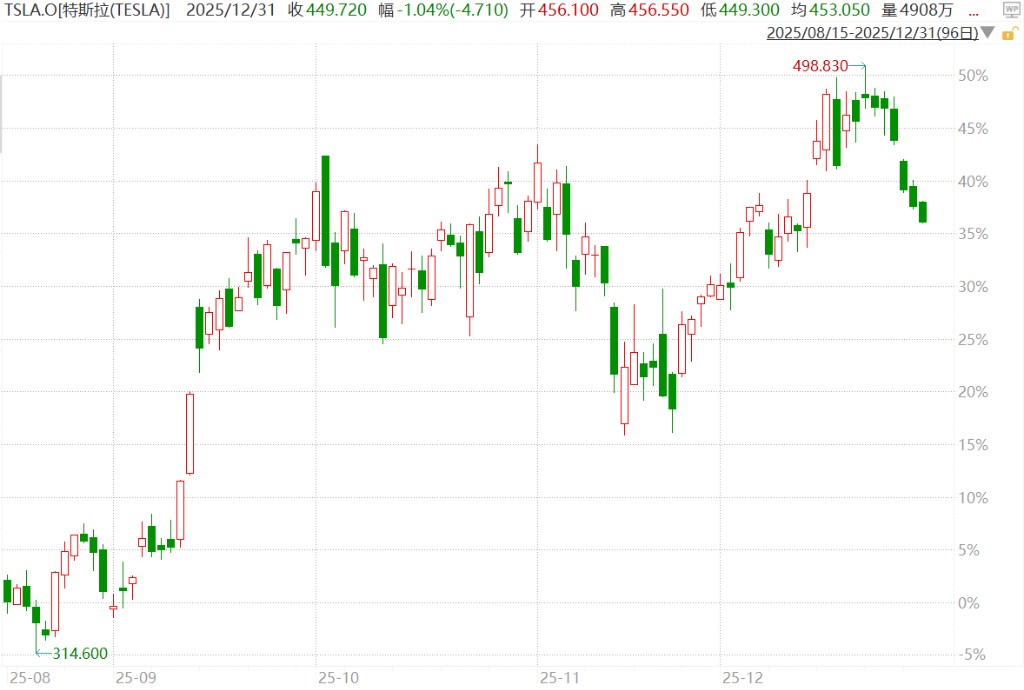
Although the company's stock price surged in the second half of 2025, the main driving force came from CEO Musk's promotion of advancements in artificial intelligence and robotics technology, rather than electric vehicle sales performance.

Analysts point out that investors are currently focusing on Tesla's development potential over the next 5 to 15 years, while neglecting short-term financial performance. However, with the cancellation of the U.S. federal electric vehicle tax credit, intensified global market competition, and obstacles in European regulatory approvals, this strategy is facing challenges.
Delivery Data Will Significantly Decline
Tesla expects fourth-quarter deliveries to be significantly lower than last year's 496,000 and the record 497,000 in the third quarter.
Tesla rarely published a summary of analyst forecasts on its website on Monday, with Future Fund Advisors co-founder Gary Black stating on social media:
This is very unusual. Clearly, someone at Tesla wants this consensus from the investor relations department to be spread as widely as possible.
He speculated that Tesla's deliveries could be around 420,000.
UBS analyst Joseph Spak has lowered his fourth-quarter delivery expectation from 429,000 to 415,000.
FactSet's consensus expectation is about 440,000, a significant decrease from the earlier expectation of about 460,000. This will mark the second consecutive year of annual sales decline for Tesla.
The weak sales in the fourth quarter are mainly attributed to the expiration of the U.S. federal electric vehicle tax credit in September last year, which previously provided buyers with a maximum discount of $7,500. The rush to purchase before the credit expired boosted third-quarter sales but also drained demand for the fourth quarter.
Additionally, Tesla's third-quarter deliveries far exceeded production at 447,450 vehicles, and this inventory consumption also puts pressure on fourth-quarter sales.
Robotaxi Vision Supports Valuation
Despite weak automotive sales, investors remain optimistic about Tesla's autonomous driving prospects.
In June last year, Tesla launched an invitation-only Robotaxi service in Austin, Texas, using Model Y vehicles equipped with safety drivers to transport passengers. Although these vehicles violated traffic regulations on their first day, triggering multiple investigations by federal regulators, investors were unfazed by safety concerns.
In September last year, Tesla's board proposed a new compensation plan for Musk, with a potential value of up to $1 trillion based on milestones that include delivering millions of robotaxis.
Since then, Tesla's stock price has rebounded sharply, reaching an all-time high on December 22 last year.
Gene Munster, managing partner at Deepwater Asset Management, stated:
Investors have fully embraced his vision for autonomous driving, which is timely, as Tesla's electric vehicle business may remain flat or grow by 5% next year.
He emphasized that Musk only needs the automotive business to stabilize over the next year to satisfy investors.
It is worth noting that Tesla currently has a price-to-earnings ratio of up to 300 times, which puts immense pressure on the timing and scale of the company's autonomous driving commitments.
CFRA Research stock analyst Garrett Nelson remarked, Tesla investors are focused on the company's prospects over the next 5, 10, and 15 years, while ignoring short-term performance. He questioned:
The issue is whether they can maintain this focus, especially as we believe the financial situation will face more headwinds
