Goldman Sachs comments on "Venezuela's changes": It's hard to say in the short term, but in the long term, it will further exacerbate the decline in oil prices

Trump stated that the United States will "deeply engage" in the future of Venezuela's oil industry, using American financial resources and industry technology to restore its former glory in oil production. Goldman Sachs believes that, considering the degree of infrastructure degradation, any recovery in output will be "gradual and localized." However, if Venezuela's output rises in the long term, combined with production increases from the United States and Russia, it will further increase the risk of declining oil prices in 2027 and beyond
The short-term oil supply outlook after the sudden change in Venezuela's political situation is filled with uncertainty, but Goldman Sachs analysts believe that the potential recovery of the country's oil production will exert significant downward pressure on global oil prices in the long term.
Over the weekend, the United States took military action against Venezuela and captured the country's leader, Maduro. According to Xinhua News Agency, President Trump subsequently stated that the U.S. would "deeply engage" in the future of Venezuela's oil industry. Trump claimed that U.S. companies would invest billions of dollars to rebuild the country's collapsed energy infrastructure, intending to leverage American financial resources and industry technology to restore its former oil production glory.
According to reports from the trading desk, Goldman Sachs analyst Daan Struyven warned in a report that given the degree of infrastructure degradation, any recovery in production will be "gradual and localized." However, if Venezuela's production rises in the long term, combined with production increases from the U.S. and Russia, it will further increase the risk of downward pressure on oil prices in 2027 and beyond.
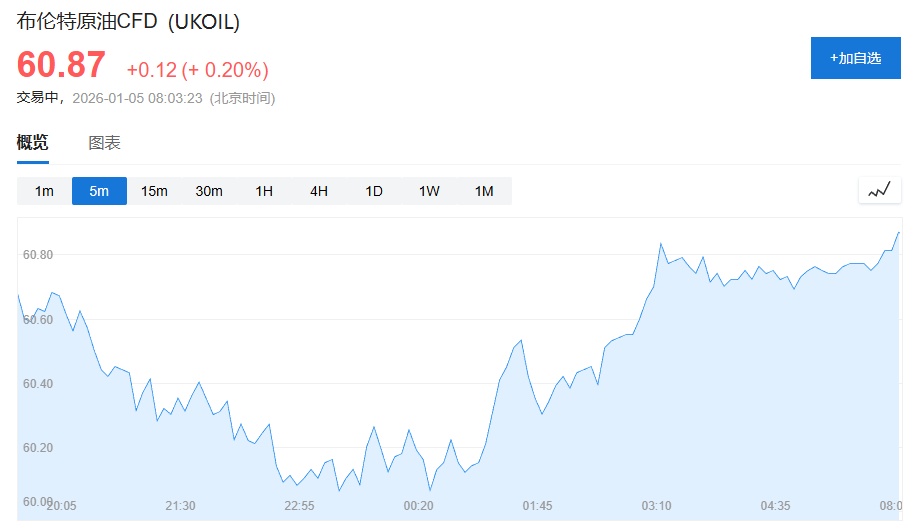
Despite the tense geopolitical situation, Goldman Sachs has not adjusted its oil price forecast for this year, maintaining its average price expectations of $56 per barrel for Brent crude and $52 per barrel for WTI crude. Oil futures opened lower on Monday, with Brent crude prices hovering around $61 per barrel.

Short-term Supply Risks Coexist
Goldman Sachs' report indicates that Venezuela's impact on oil prices in the short term is "ambiguous," depending on the evolution of U.S. sanctions policy.
On one hand, if the new government gains full sanctions exemptions with U.S. support, production could increase by 400,000 barrels per day by the end of 2026 through the import of diluents, repair of oil wells, and restarting damaged upgrading facilities. In this scenario, Goldman Sachs expects the average price of Brent crude in 2026 to drop to $54, below its baseline forecast of $56.
On the other hand, if Maduro's cabinet attempts to maintain control leading to increased chaos, or if production disruptions continue due to storage limitations, production could decrease by 400,000 barrels per day during the same period, pushing the average price of Brent crude up to $58. The current baseline scenario assumes production remains at 900,000 barrels per day.
In November last year, Venezuela's production was about 930,000 barrels per day, but due to recent U.S. interceptions of oil tankers leading to full local storage tanks, production may have further declined to around 800,000 barrels per day recently.
Long-term Recovery Pressures Oil Prices
Looking ahead to the long term, Goldman Sachs points out that Venezuela holds about one-fifth of the world's proven oil reserves and reached a production peak of about 3 million barrels per day in the mid-2000s. If the country's oil production can rebound to 2 million barrels per day by 2030 (higher than Goldman Sachs' baseline assumption of 900,000 barrels per day), it is expected to create $4 of downward space for oil prices in 2030 (baseline forecast of $80).The analyst team emphasized that this potential incremental increase, combined with the recent unexpected performance of Russian and American production, has intensified the downside risks to long-term oil price forecasts. Additionally, the gradual recovery of Venezuela's heavy crude oil production, which is rich in diesel components, may somewhat offset the structural positive outlook facing diesel margins.
Despite Trump's grand vision for reconstruction, Goldman Sachs maintains a cautious stance on the speed of recovery. The report points out that Venezuela's infrastructure has severely deteriorated, and improving the recovery rate of heavy oil requires significant financial and time investments in crude upgrading facilities.
Moreover, enhancements in operational efficiency, stability in power supply, and improvements in oil transportation infrastructure are also essential conditions. Analysts note that any substantial recovery will require strong incentives to attract large-scale upstream investments, meaning that the rebound in production is destined to be a slow and localized process.