激進押注 AI!三星計劃將搭載 Gemini 的移動設備數量翻番至 8 億台,全面迎戰蘋果

Samsung plans to increase the number of mobile devices equipped with Gemini AI from 400 million to 800 million by 2026, joining forces with Google to launch an "AI counterattack" against Apple. Meanwhile, with breakthroughs in HBM4 memory technology, Samsung is expected to return to the NVIDIA supply chain, with its stock price soaring 7% in a single day
Samsung Electronics plans to significantly expand its artificial intelligence strategy by 2026, doubling the production of mobile devices equipped with Google's Gemini large model to 800 million units.
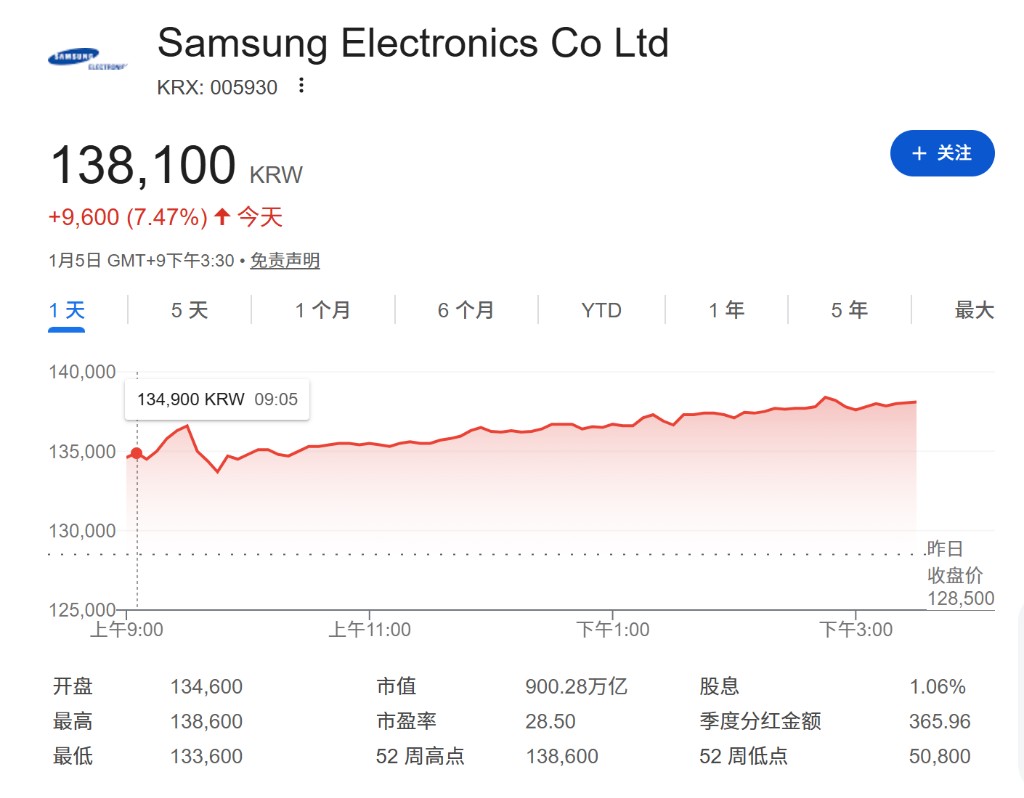
This aggressive expansion plan, coupled with its breakthrough advancements in high-bandwidth memory (HBM) technology, marks a comprehensive counterattack by the South Korean tech giant against Apple and competitors in the chip sector, driving its stock price up 7% on Monday.

According to Reuters, Samsung Electronics co-CEO TM Roh stated in an interview that the company plans to increase the number of mobile devices supporting Google Gemini AI features from 400 million units last year to 800 million units by 2026.
Roh emphasized that Samsung will apply AI to "all products, all functions, and all services" as quickly as possible. This move aims not only to consolidate Samsung's position as the world's largest supporter of the Android platform but also to significantly assist Google in gaining an advantage in the competition for consumer users against OpenAI.
Meanwhile, Wall Street Journal previously pointed out that Samsung Electronics co-CEO Choi Yong-hyun revealed in his New Year address that the company's HBM4 products have demonstrated "differentiated competitiveness" and received high praise from customers that "Samsung is back." Market analysts believe this statement greatly boosted investor confidence, with expectations that Samsung is gradually narrowing the gap with SK Hynix in the high-bandwidth memory market and is expected to re-enter NVIDIA's core supply chain with the next-generation HBM products by 2026.
Driven by dual benefits in consumer electronics and semiconductors, Samsung is attempting to reclaim the crown in the smartphone market from Apple through integrated AI services across products, while also fending off fierce competition from Chinese rivals in the fields of mobile phones, televisions, and home appliances. Roh anticipates that although there are still doubts about AI technology in the market, these technologies will become more widespread within the next six months to a year.
Deepening Alliance with Google, Betting on AI Popularization
As a core ally in Google's Android ecosystem, Samsung's aggressive device expansion plan will directly intensify the AI model competition in Silicon Valley. Alphabet's Google launched the latest version of Gemini 3 last November, leading in several industry metrics.
According to media reports, to respond to Gemini 3, OpenAI CEO Sam Altman issued an internal "red code" to pause non-core projects to accelerate development, subsequently launching the GPT-5.2 model.
TM Roh pointed out that a survey on the brand awareness of Galaxy AI showed that the data jumped from 30% to 80% in just one year, indicating that the adoption of AI is accelerating. While search remains the most frequently used AI feature on mobile phones, consumers are increasingly using image generation editing tools, productivity tools, as well as translation and summarization functions Samsung hopes to establish differentiated barriers in its competition with Apple by leveraging its leading advantages in these areas.
Full-scale Battle Against Apple and Chinese Competitors
According to market research firm Counterpoint, Apple became the world's largest smartphone manufacturer last year.
Samsung's strategy aims to regain lost market share through the comprehensive integration of AI features. In addition to smartphones, the television and home appliance sectors overseen by Roh are also facing significant pressure from Chinese competitors. Samsung plans to utilize a cross-category AI ecosystem to solidify its market position.
In the foldable smartphone sector, although Samsung pioneered the market in 2019 and held nearly two-thirds of the market share in the third quarter of 2025, Roh admits that the growth rate of this market has been lower than expected. He attributes this to engineering complexities and a lack of applications designed for compatible hardware. Nevertheless, Roh anticipates that foldable smartphones will become mainstream in the next two to three years and points out that the retention rate of foldable smartphone users is "very high."
Currently, Samsung is facing competition in this field from Chinese companies like Huawei, and Apple is also expected to launch its first foldable smartphone this year.
Storage Chip Shortages Squeeze Profit Margins
Although the global shortage of storage chips is a significant boon for Samsung's core semiconductor business, it simultaneously puts pressure on the profit margins of its second-largest revenue source—smartphone business.
Roh stated that this situation is "unprecedented," and no company is immune to the difficulties. This crisis not only affects smartphones but also impacts other consumer electronics such as televisions and home appliances.
Roh did not rule out the possibility of raising product prices, stating that some of the impacts from the soaring prices of storage chips are "inevitable."
As the world's largest television manufacturer, Samsung is working with partners to develop long-term strategies to minimize the impact. Market research firms, including IDC and Counterpoint, predict that due to the storage chip shortage potentially driving up smartphone prices, the global smartphone market size may shrink next year