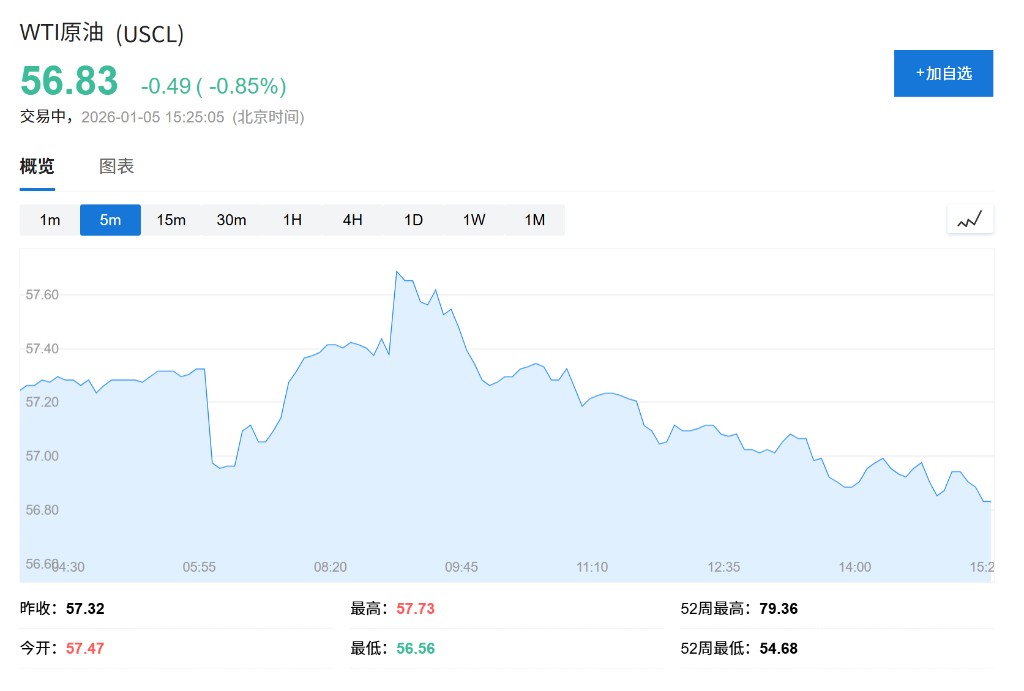
Why is the oil market unaffected by the sudden changes in Venezuela's political situation, while the global financial market remains calm?

Currently, Venezuela's oil production accounts for only 1% of the global total, and with an oversupply in the market, oil prices are responding tepidly. Investors are more focused on the fundamentals of AI and interest rate trends, with geopolitical risks only reflected in safe-haven assets like gold. Analysis indicates that unless supply chains are disrupted, the market has become accustomed to "decoupling" such isolated political shocks and instead focusing on the rotation of assets in global value gaps
The geopolitical shock of Venezuelan President Maduro being detained by the U.S. military has not stirred the expected waves in the global financial markets. This Latin American country, which once accounted for about 1% of global GDP and 8% of global oil production in the 1970s, now has a negligible impact on the global economy, allowing the market to keep this political storm at bay.
According to reports from Xinhua News Agency and CCTV News, at noon local time on January 3 (midnight Beijing time on January 4), U.S. President Trump and Defense Secretary Esper held a press conference at Mar-a-Lago in Florida regarding the U.S. military's actions against Venezuela, controlling President Maduro and facilitating his removal from the country.
Bloomberg columnist and senior market editor John Authers pointed out in his latest commentary that the sharp decline in Venezuela's economic significance is the core reason for the market's muted response. The country currently accounts for only 0.1% of global GDP, with a daily oil production of about 1 million barrels, representing just 1% of global supply, ranking 18th among oil-producing countries. Years of mismanagement have turned this country into "a mess," and even the most severe turmoil would have a very limited impact on the global economy.
The regime change triggered by the U.S. "absolute determination action" has had almost no impact on oil prices after the Asian markets opened. Meanwhile, global stock markets continued their upward trend, with the technology sector, centered on AI computing power and storage chips, operating independently of geopolitical issues, driven by strong fundamentals that pushed Asian stock markets and the semiconductor sector to new highs. The market reflects geopolitical risks more in safe-haven assets like gold rather than through large-scale sell-offs of risk assets.
The Disappearance of Venezuela's Economic Influence
Neil Shearing, Chief Economist at Capital Economics, summarized the trajectory of Venezuela's decline. Under the Chávez and Maduro regimes, mismanagement has led to a persistent crisis that triggered hyperinflation, with real GDP plummeting by 70%. A wave of Venezuelan migrants has surged into neighboring countries and the United States, while its oil production has fallen from an average of 3.5 million barrels per day in the 1970s to around 1 million barrels currently.
Rob Thummel of Tortoise Capital Management believes that the current global oil market is oversupplied, and the situation in Venezuela will not change this dynamic. Although the country's oil infrastructure appears to be intact, reducing the risk of production cuts, it will still take years to achieve significant increases in output. When Asian markets opened on Monday, the reaction in crude oil prices confirmed this assessment—rather than the usual rise, there was an unexpected decline.

Market Reaction: Rationality Over Panic
Despite the situation in Venezuela presenting new geopolitical risks for global investors, the market's initial response has been relatively calm. Stock markets rose, with strong performances in the technology and defense sectors, the dollar strengthened, and geopolitical risks were primarily reflected in safe-haven assets like precious metals. David Chao, Global Market Strategist at Invesco Asia Pacific, stated:
" Given Venezuela's relatively minor role in today's energy landscape, the developments over the weekend are unlikely to have any significant near-term impact on the global macro situation or markets. This is why oil prices, U.S. stock index futures, and other major macro assets did not experience significant volatility."
He added that the broader message is that geopolitical uncertainty has become a component of the macro environment, which should continue to support demand for precious metals.
Charu Chanana, Chief Investment Strategist at Saxo, summarized the current market characteristics as:
"We are in a regime where geopolitical factors have become a persistent feature rather than an anomaly. Unless it threatens broader supply chains, investors tend to downplay the initial shock and refocus on interest rates, earnings, and positions. Right now, this feels more like a geopolitical shock rather than an oil shock."
U.S. Strategic Intent and Market Expectations
President Trump stated last Saturday that the U.S. would "manage" Venezuela and would use "ground troops" if necessary. This statement was made while the markets were closed, avoiding a potential panic reaction. By the end of the weekend, Secretary of State Marco Rubio had fully downplayed any thoughts of an Iraq-style occupation, stating that the U.S. would leverage its influence over Venezuela's oil exports to maintain order in the country and was prepared to work with Maduro's Vice President Delcy Rodriguez.
This strategic choice significantly reduced market concerns. Authers noted that this is reminiscent of last year's decision to bomb Iranian nuclear facilities—an impressive military achievement, but Trump made it clear that he had no intention of escalating further, leading to a subsequent drop in oil prices Marko Papic from BCA Research commented on Trump's remarks about Cuba:
"Could Cuba be next? Yes, it's quite possible. But unless you're a commercial real estate developer (specifically in the hotel industry), we don't see any market impact."
The Reversal of American Exceptionalism and Market Rotation
Although the events in Venezuela have limited impact, the data for the entire year of 2025 reveals a more significant market trend: the relative performance of the U.S. market has seen a notable reversal. The S&P 500 index has lagged behind other global markets by 9.9% in dollar terms, marking its worst relative performance since 2009, roughly equivalent to the weakest performance since 1993.
Research by Andrew Lapthorne, Chief Quantitative Strategist at Société Générale, shows that a country's performance in 2024 is almost impossible to predict for 2025, but starting valuations matter significantly. Countries with lower price-to-earnings ratios at the beginning of 2025 tend to perform better.
Authers believes this phenomenon has multiple positive implications. First, if investors are already looking for cheaper stocks and countries, it's hard to argue that the world is in some sort of AI-driven "full bubble." The market still maintains a considerable degree of rationality. Second, since investors are starting to seek value opportunities, this trend has significant room for continuation, as most markets outside the U.S. remain cheap.
Tai Hui, Chief Market Strategist for J.P. Morgan Asset Management in the Asia-Pacific region, stated:
"The lack of response so far is due to two factors. Venezuela's oil production is relatively small compared to global output. Years of underinvestment mean it cannot quickly ramp up production and increase global supply."
Vishnu Varathan, Head of Macro Research at Mizuho Asia (excluding Japan), pointed out:
"We are reminded that geopolitical risks far outweigh certain trade numbers. Due to sanctions on Venezuela and its special reliance on oil exports, this means that regime change in Venezuela has limited and isolated effects through trade and investment channels. That's why you don't see massive sell-offs."