How can Oracle reverse the market narrative? UBS: OpenAI faith restoration and debt pressure prove controllable

Wallstreetcn
2026.01.05 09:39
portai
I'm PortAI, I can summarize articles.

UBS believes that the market's reaction to the sharp decline in Oracle's stock price is excessive, based on two key expectations: first, the substantial financing of OpenAI and the release of GPT-6 will eliminate customer risks; second, Oracle can alleviate capital expenditure pressure through financial techniques such as "off-balance-sheet financing." The report points out that its data center construction is progressing as planned, and the current valuation is overly pessimistic, with room for recovery

Since the peak in mid-September, Oracle's stock price has experienced a sharp correction of -41%. This is not just a technical correction, but a direct reflection of the market's collapse of confidence in the "OpenAI complex." Investors are currently extremely anxious: Can OpenAI deliver on its trillion-dollar promises? Will Oracle's net debt of up to $88 billion crush its balance sheet?

According to Wind Trading Desk, UBS provided a stark counterpoint in its latest research report on January 4, reiterating a "Buy" rating. UBS believes that the market has overvalued OpenAI's default risk and Oracle's financing pressure. As long as OpenAI completes a new round of financing, GPT-6 is released as scheduled in Q1, and Oracle alleviates capital expenditure pressure through "off-balance-sheet financing," the market narrative will fundamentally reverse in the first half of 2026.

For investors, Oracle's price-to-earnings ratio based on expected earnings in 2026 is 29 times, and only 11 times based on expected earnings in 2030, making the risk-reward ratio highly attractive.

Recharging Faith in OpenAI: Funding in Place and the "Redemption" of GPT-6

The sharp decline in Oracle's stock price is not entirely due to its own operations, but rather a collateral damage as a core power supplier for OpenAI. The market is concerned that OpenAI may not fulfill its commitments to suppliers. UBS points out that restoring this faith requires just two catalysts: money and technology.

  • $100 billion financing secured: Media reports indicate that OpenAI is raising $100 billion at a valuation of $830 billion, with SoftBank fully funding its $40 billion commitment, and Amazon is also negotiating a $10 billion investment. Once this massive capital is secured, OpenAI's performance risk to Oracle will be instantly eliminated.

  • GPT-6 is on the verge: Although the user growth of ChatGPT is slowing, OpenAI's CEO has hinted that a major model update (i.e., GPT-6) will be released in Q1. If the new model can demonstrate that computational investment leads to a qualitative leap, it will directly crush the competitive anxiety brought by Google's Gemini and end the market's panic over the AI bubble.

The Moat Remains: OpenAI is Still the King in the Enterprise Market, Gemini's Threat is Exaggerated

The release of Google's Gemini 3 triggered an internal "red code" crisis at OpenAI and led to investor concerns that OpenAI's growth in the consumer market had peaked. However, UBS's latest enterprise AI survey shows that these concerns are unnecessary in the B2B market.

  • Enterprise adoption rate steadily increasing: The production-level adoption rate of enterprise AI projects has risen from 14% in March 2025 to 17% in December. Although the growth rate is not fast, the trend is upward

  • OpenAI's dominance remains strong: Among enterprise users, OpenAI's models occupy three of the top five positions (first, third, and fifth). Although Google's Gemini has improved its ranking, OpenAI still leads significantly in enterprise-level productization.

Debt black hole or clever financial engineering? Off-balance sheet financing and BYOC will save the balance sheet

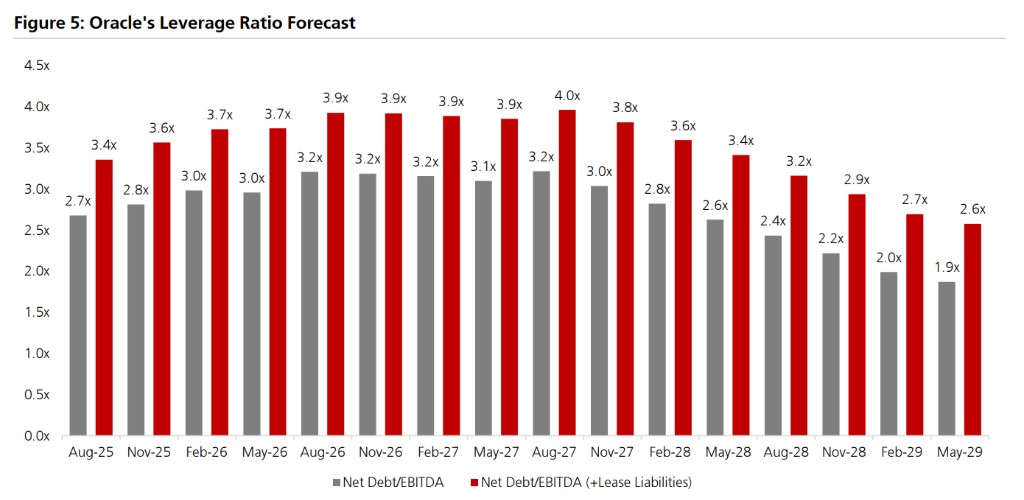
Aside from the risks associated with OpenAI, investors are most concerned about Oracle's own balance sheet. As of the end of the November 2025 quarter, Oracle's net debt reached $88.3 billion, with a net debt/EBITDA ratio of 2.8 times (if lease liabilities are included, it may approach 4 times from an S&P rating perspective). To maintain its investment-grade rating, Oracle must walk a tightrope between massive capital expenditures and debt.

UBS predicts that Oracle's average annual capital expenditure during FY26-FY30 will reach $72 billion. To fill the funding gap, Oracle is adopting aggressive financing strategies:

  • Off-balance sheet financing: By partnering with companies like Crusoe and Vantage to build data centers, Oracle acts merely as a tenant, moving substantial infrastructure costs off its balance sheet.

  • Bring Your Own Chip (BYOC): Oracle is exploring a new model where large clients (like OpenAI) can use their own contracts with NVIDIA to directly purchase chips, which are then installed in Oracle's data centers. This will significantly reduce Oracle's direct capital investment. UBS estimates that if 50% of the funding needs are met through such structures, Oracle's direct financing requirements over the next three years could drop from $80 billion to $40 billion, greatly alleviating credit pressure.

Infrastructure powerhouse: The Abilene data center has not been delayed, nearly 100,000 GB200 chips are in place

Rumors about delays in Oracle's data center construction have been rampant, but UBS has refuted this view through on-site research and data analysis.

  • Remarkable delivery speed: Oracle disclosed on a conference call that its supercluster in Abilene, Texas, has delivered over 96,000 NVIDIA GB200 chips as planned.

  • Revenue explosion imminent: UBS estimates that these 96,000 GPUs contributed only partially to revenue in the last quarter. As production ramps up to a peak of 400,000 GPUs, the Abilene project alone could generate annual revenue of $9.5 billion. UBS expects that driven by this, Oracle's cloud infrastructure (OCI) revenue growth will accelerate to over 87% in the February/May 2026 quarters.

Valuation bottom line: Risks are fully priced in, is it a good time to buy?

Despite facing numerous uncertainties, Oracle's growth story remains one of the most aggressive among tech giants. The company's guidance indicates that revenue growth from FY26 to FY28 will accelerate from 16% to 46% UBS conducted a stress test: even in a "disaster scenario" (where OpenAI's revenue contribution goes to zero in FY30), Oracle's current stock price corresponds to a FY30 price-to-earnings ratio of only 12.4 times. In the baseline scenario, the price-to-earnings ratio corresponding to the FY30 EPS (guidance of $21) is only 11 times. In contrast, Microsoft's forward price-to-earnings ratio is about 18 times.

UBS believes that a decline of over -36% in the stock price (relative to the average decline in the AI sector) has overly reflected financing and execution risks. As long as the funds are in place and infrastructure is delivered on schedule, Oracle will see significant valuation recovery.