


In the next two years, an average increase of 15% to 20%! Goldman Sachs shouts: Overweight Chinese stocks!

Goldman Sachs believes that the upward momentum of the Chinese stock market will mainly come from two aspects: first, benefiting from AI expansion and the "anti-involution" actions, corporate profits are expected to improve significantly, with profit growth rates projected to reach 14% and 12% in 2026 and 2027, respectively; second, the revaluation of the valuation system is expected to bring about a 10% increase in valuations, as Chinese stocks are currently still in a significantly undervalued state
The attractiveness of Chinese stocks is continuing to heat up.
Goldman Sachs' Hui Shan strategist team has issued a strong bullish signal for Chinese assets in their latest strategy report, recommending investors to "overweight" Chinese stocks in the regional context. The bank predicts that driven by both corporate earnings growth and valuation recovery, the Chinese stock market will experience a robust bull market in 2026 and 2027, with an expected annual increase of 15% to 20%. On January 5th, A-shares opened high and rose throughout the day, with the Shanghai Composite Index achieving a 12-day winning streak, setting the longest consecutive rise record since 1993, and returning above 4,000 points.
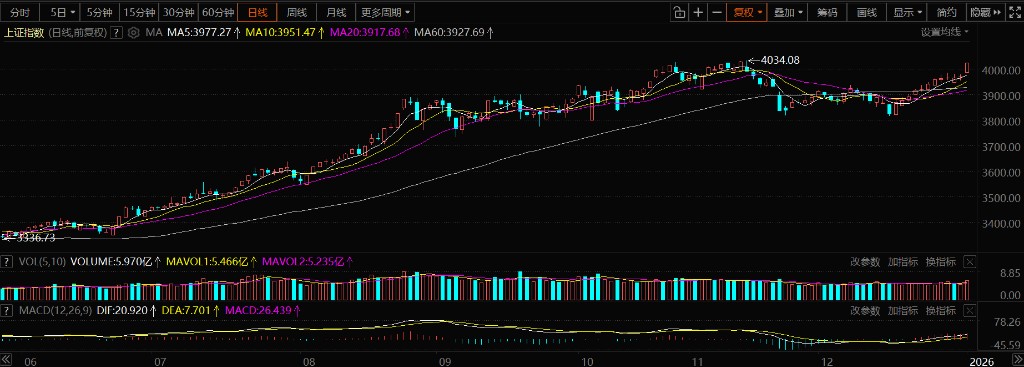
In the report titled "2026 China Outlook: Exploring New Growth Engines," Goldman Sachs maintains an "overweight" rating on A-shares and H-shares. Goldman Sachs believes that the upward momentum of the Chinese stock market will mainly come from two aspects: first, a substantial improvement in corporate earnings, with profit growth rates expected to reach 14% and 12% in 2026 and 2027, respectively; second, a revaluation of the valuation system, which is expected to bring about a 10% increase in valuations.
The report points out that key factors driving this round of accelerated profit growth include the widespread application of artificial intelligence (AI) technology, the trend of Chinese companies "going overseas," and policy measures aimed at curbing disorderly competition, referred to as "anti-involution." Goldman Sachs emphasizes that compared to similar global markets, Chinese stocks are still significantly undervalued, and this valuation advantage, combined with the strong diversification investment value that the Chinese market offers to both international and domestic investors, will further attract capital back.
Fundamentally, Goldman Sachs believes that the resilience of the export sector and policy support for the real economy provide macro support for the performance of the capital market. The bank believes that as market confidence in policy expectations and corporate profitability recovers, the allocation value of Chinese assets is significantly increasing.
Dual Drivers of Profit Recovery and Valuation Repair
The core view of Goldman Sachs' strategy team is based on expectations of improvements in corporate fundamentals. The report analyzes that the bull market in the Chinese stock market will continue at a more robust pace, rather than being a fleeting short-term speculation.
In addition to the aforementioned profit growth expectations of 14% and 12%, Goldman Sachs specifically mentions the positive impact of "anti-involution" policies on corporate profits. Since the second half of 2025, policies aimed at curbing disorderly price competition and overcapacity in certain industrial sectors have begun to take effect, which helps improve companies' pricing power and profit margins. Furthermore, the adoption of AI technology and the development of high-tech manufacturing are also seen as important long-term drivers for enhancing total factor productivity (TFP) and corporate profitability.
In terms of valuation, Goldman Sachs believes that the current valuation levels in the Chinese market do not fully reflect its growth potential. With improved investor sentiment and the reallocation of funds, a revaluation of approximately 10% will become an important force driving stock prices higher
Optimization of Export Structure and "Going Global" Dividends
Despite facing a complex external trade environment, Goldman Sachs remains optimistic about the competitiveness of China's export sector, which is one of the key reasons for its positive outlook on Chinese listed companies. The report points out that Chinese exporters have successfully diversified their markets, with emerging markets (EM) becoming an important growth point.
Goldman Sachs analyzes that China's strong manufacturing competitiveness, combined with exchange rate advantages, has significantly increased the import share of Chinese products in many countries (especially emerging markets). More importantly, the "going global" strategy of Chinese enterprises is shifting from mere product exports to global layout, with significant increases in the export of intermediate goods and capital goods, indicating that Chinese manufacturers are establishing factories and supply chains globally.
Goldman Sachs expects that export volume will maintain an annual growth rate of 5-6% in the coming years, and this structural export resilience will directly translate into performance support for related listed companies.
Policy Easing and Liquidity Environment
In terms of liquidity, Goldman Sachs expects China to maintain a relatively loose monetary policy environment, which will be beneficial for stock market performance. The report predicts that the People's Bank of China will adopt more flexible and moderate easing measures by 2026, including two 10 basis point cuts in policy interest rates.
Goldman Sachs anticipates that in order to support government bond issuance and economic growth, the central bank will maintain ample interbank liquidity, which will guide short-term interest rates downward. It is expected that by the end of 2026, the 7-day reverse repurchase rate will decrease from 1.4% at the end of 2025 to around 1.2%. Lower financing costs and abundant market liquidity are generally seen as favorable factors for the stock market. Additionally, the expansion of fiscal policy—Goldman Sachs expects the broad fiscal deficit to further widen—will also support the real economy and market sentiment.
Attractiveness of Renminbi Assets and Exchange Rate Appreciation
In addition to the potential rise of the stock market itself, exchange rate factors may also bring additional returns for foreign investors holding Chinese assets. Goldman Sachs' foreign exchange strategists believe that the renminbi is currently undervalued against the US dollar by about 25%, indicating room for appreciation.
The report predicts that supported by strong export growth and trade surpluses, the renminbi will gradually appreciate to 6.85 against the US dollar within the next 12 months. Goldman Sachs expects China's goods trade surplus to further expand to $1.4 trillion by 2026.
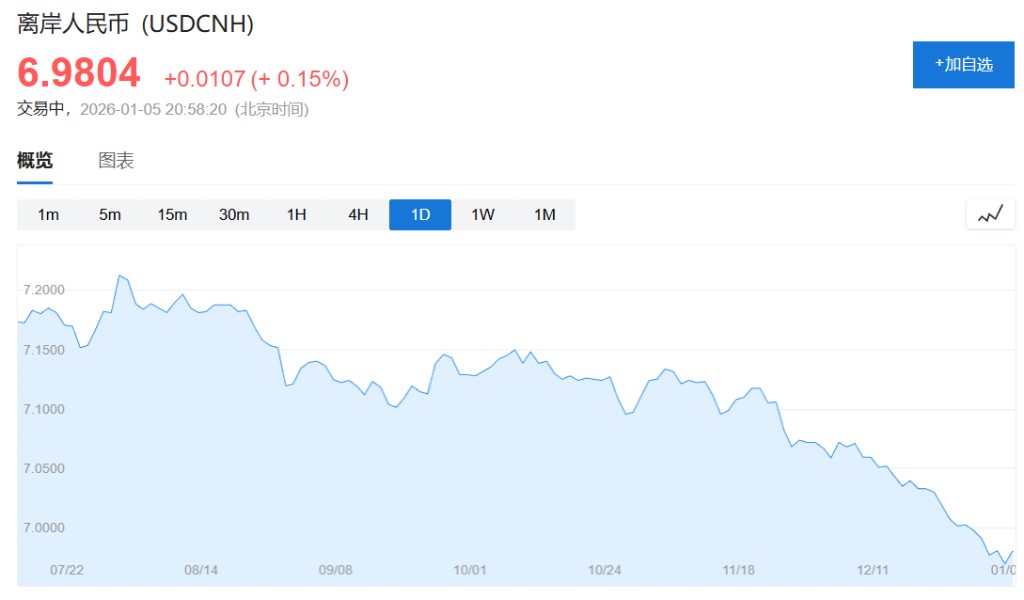
The increase in the current account surplus, the easing of US-China trade tensions, and policy support for the internationalization of the renminbi will all support the strengthening of the renminbi. For international investors priced in US dollars, the appreciation of the renminbi will further enhance the total return on investments in Chinese stocks
