


The computing power revolution behind "Yi Zhongtian's" continuous surge: Silicon photonics is no longer a substitute, but a new king to be established

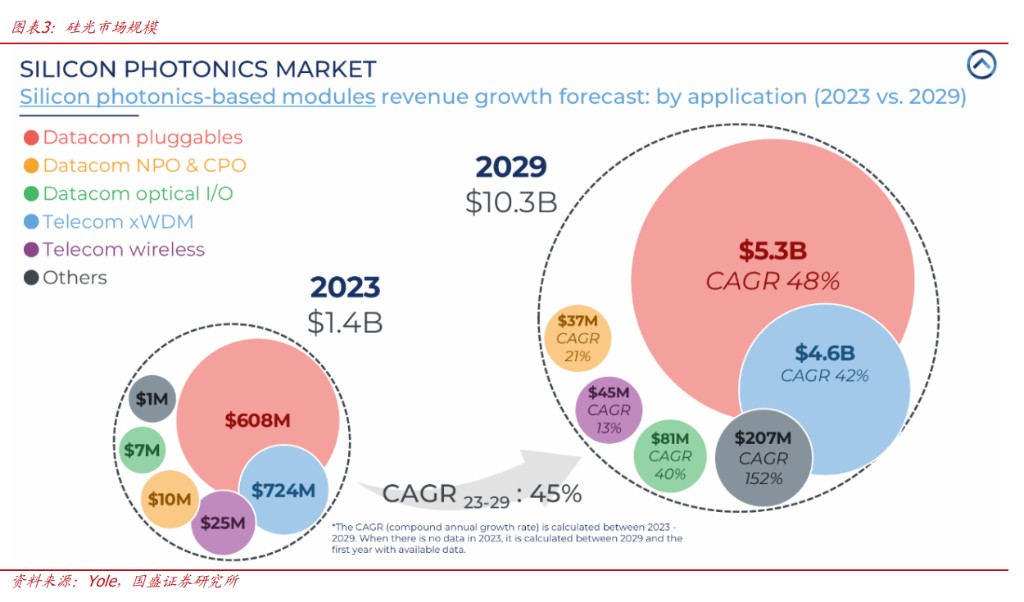
The optical communication industry is undergoing a revolution from quantitative change to qualitative change, with silicon photonics technology no longer being a backup but a key to computing power interconnection in the AI era. Guosheng Securities points out that the core of silicon photonics lies in the reconstruction of the value chain, with profits shifting from upstream optoelectronic chips to midstream PIC design. The silicon photonics module market is expected to grow from USD 1.4 billion in 2023 to USD 10.3 billion in 2029, with a CAGR of 45%. Silicon photonics technology reduces power consumption and size through high integration, changing the rules of value distribution in the industry chain and enhancing the voice of Chinese manufacturers
The optical communication industry is undergoing a revolution from "quantitative change" to "qualitative change." Silicon Photonics is no longer just a "backup" solution during the shortage of traditional EML chips, but the only answer for computing power interconnection in the AI era.
According to Guosheng Securities, the key to the silicon photonics "revolution" lies in the reconstruction of the value chain: previously, the majority of profits in the optical module industry chain were taken by overseas optoelectronic chip manufacturers, while Chinese manufacturers earned only assembly fees.
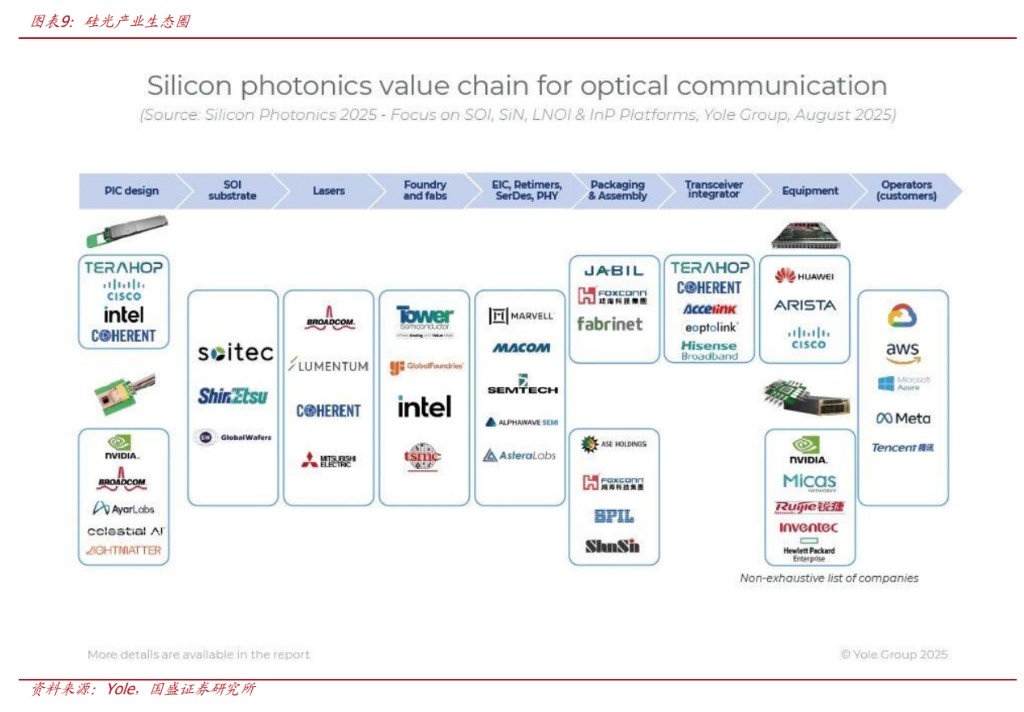
However, in the silicon photonics era, the value chain is undergoing a violent reconstruction. Core profits are shifting from upstream optoelectronic chips to midstream PIC design (silicon photonic chip design). Whoever masters PIC design and packaging capabilities will hold the pricing power. This represents a class leap from "worker" to "landlord."
This also explains the underlying logic of "Yizhongtian" continuously racing forward — they are not selling shovels, but reshaping the entire mine.
Silicon Photonics: The Demolition Expert of the Computing Power "Power Wall"
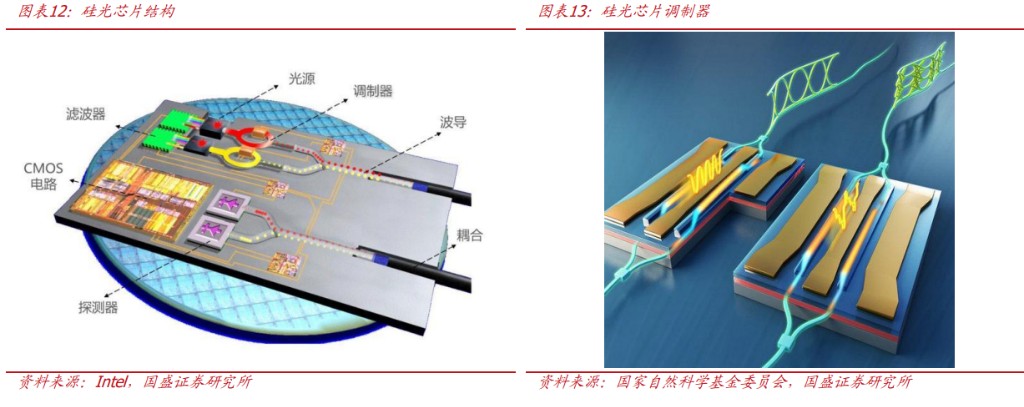
Guosheng Securities states that the essence of silicon photonics technology is to use semiconductor methods to create photons. It utilizes mature CMOS processes (90nm/45nm nodes) to combine the high bandwidth and low power consumption of photonics with the scalable manufacturing of semiconductors.
Yole predicts that the revenue of the silicon photonics module market will surge from $1.4 billion in 2023 to $10.3 billion in 2029, with a CAGR as high as 45%.
This explosion is not unfounded, but an inevitability at the physical level. Traditional optical modules face insurmountable "power walls" and "size walls" when moving towards 1.6T rates. Silicon photonics solutions, with their high integration, can reduce component size by about 30% and power consumption by about 40% (for example, the power consumption of an 800G module can be controlled around 14W, while traditional solutions often exceed 18W).
Value Chain Reconstruction: The Rise of Chinese Manufacturers' Voice
Guosheng Securities emphasizes that what excites investors most about silicon photonics technology is its rewriting of the rules of value distribution in the industry chain.
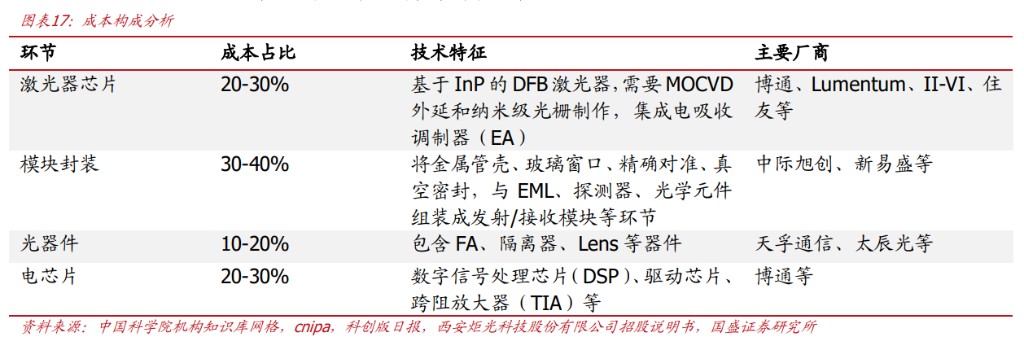
The traditional EML optical module industry chain follows "vertical division of labor," with value concentrated in upstream laser chips (InP, etc.) and electronic chips (DSP). Although the packaging stage has high costs, its added value is relatively low.
But silicon photonics changes all of this. Silicon photonics technology integrates core devices such as modulators and waveguides onto silicon-based chips, utilizing standardized processes from semiconductor fabs (such as TSMC, Tower, etc.) for manufacturing This shifts the value focus of the industrial chain from upstream III-V group optical chips to the silicon photonic chip design (PIC) stage.
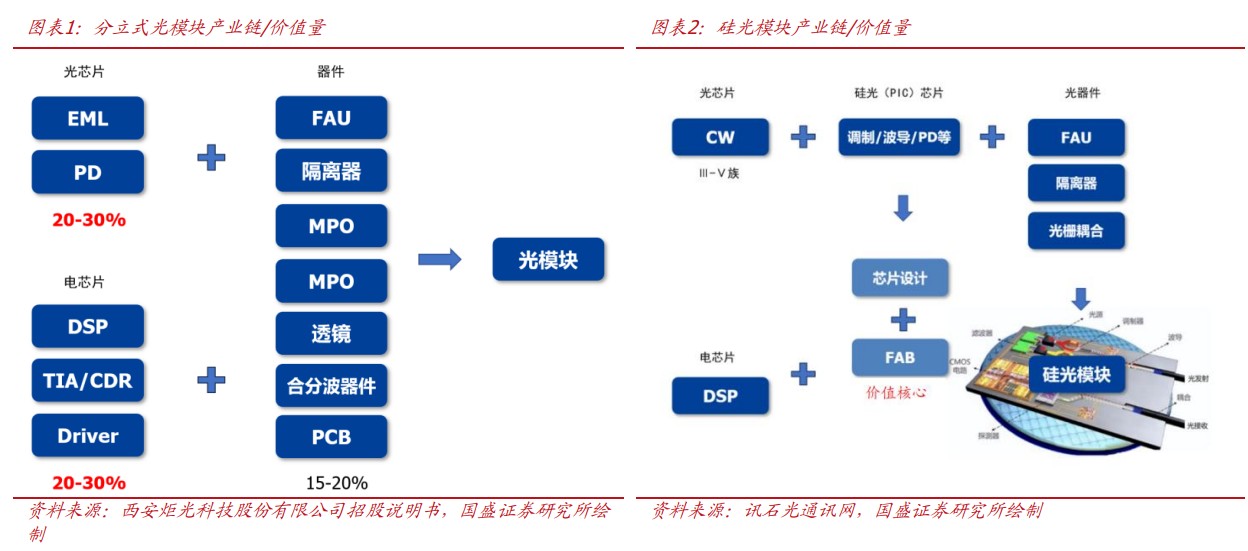
This means that optical module companies with independent PIC design capabilities will no longer be just "assembly plants," but will be upgraded to technology companies with core chip design capabilities. This value reconstruction will greatly enhance the profit levels and voice of Chinese optical communication manufacturers in the global industrial chain.
In the traditional model, core profits flow to overseas chip giants like Broadcom and Lumentum. However, in the silicon photonic model, manufacturers with PIC design capabilities (such as Zhongji Xuchuang and Eoptolink) will directly take the most lucrative profits in the industrial chain, significantly reducing dependence on expensive upstream optoelectronic chips.
Technical Bottlenecks and the Ultimate Form of CPO: Unlocking Scale-up Incremental Space
Guosheng Securities acknowledges that silicon photonics is not without its flaws, with its core challenge being that "silicon itself does not emit light."
The industrial chain must introduce external light sources, which has created a huge demand for continuous wave (CW) light sources, benefiting manufacturers with laser chip capabilities. Additionally, the coupling loss between optical fibers and micron-level silicon waveguides is also a technical difficulty, placing high demands on packaging technology.
Looking ahead, silicon photonics is the key to achieving CPO (Co-Packaged Optics). As AI clusters increase their requirements for interconnect density, optical modules will transition from "pluggable" to "optoelectronic co-packaging," directly packaging the optical engine next to the switching chip.
This technical path is particularly suitable for Scale-up (in-node expansion) scenarios, further breaking the density and distance limitations of electrical interconnects. CPO is not only a technological upgrade but also opens up an incremental market that is an order of magnitude larger than traditional optical modules. Giants like Broadcom and NVIDIA are accelerating their layouts, and if domestic manufacturers can position themselves in CPO, they will directly enter the core territory of computing hardware.
In-depth Analysis of the Entire Industrial Chain: Who is Swimming Naked, and Who is Leading?
Guosheng Securities believes that from the perspective of the industrial chain, silicon photonic chips and modules, as well as CW light sources, will become the core beneficiaries of this round of the silicon photonic revolution:
Silicon photonic chips and modules (core beneficiaries): Zhongji Xuchuang and Eoptolink are absolute leaders; they not only lead in traditional modules but have also built strong barriers in silicon photonic PIC design and packaging capabilities. Additionally, Accelink and Huagong Technology are also actively following.
Supporting devices and solutions for silicon photonics (core beneficiaries): Tianfu Communication, leveraging its advantages in optical engines and precision components, has become an indispensable "water seller" in the silicon photonic industrial chain, with its solutions directly benefiting from the improvement in silicon photonic integration
CW Light Source (Core Components): Silicon photonics cannot do without external light sources. SourceJ Technology and Shijia Photonics, as representatives of domestic laser chip manufacturers, are expected to share the dividends of the silicon photonics explosion in the CW light source field.
Risk Warning and Disclaimer
The market has risks, and investment requires caution. This article does not constitute personal investment advice and does not take into account the specific investment objectives, financial conditions, or needs of individual users. Users should consider whether any opinions, views, or conclusions in this article align with their specific circumstances. Investment based on this is at one's own risk
