Space Photovoltaics: Reliable Energy from Beyond Earth, Targeting a Trillion-Dollar Market

Dongxing Securities Co., Ltd. stated that the sharp decline in launch costs has driven an explosion in satellite deployment, with over 4,300 launches expected in 2025 and the number of filings exceeding 100,000. Large-scale deployment is boosting demand for space photovoltaics, with the Starlink V3 solar array area expanding by more than 10 times. Assuming an annual launch of 10,000 satellites, this could create a market of approximately 200 billion yuan. With the rise of space computing power, if a 10GW-level system is constructed, the solar array space could reach several trillion yuan
With the maturity of reusable rocket technology driving a dramatic decline in launch costs, commercial space is ushering in a "Moore's Law" moment, which in turn has triggered a huge demand for the core component of space infrastructure—space photovoltaics.
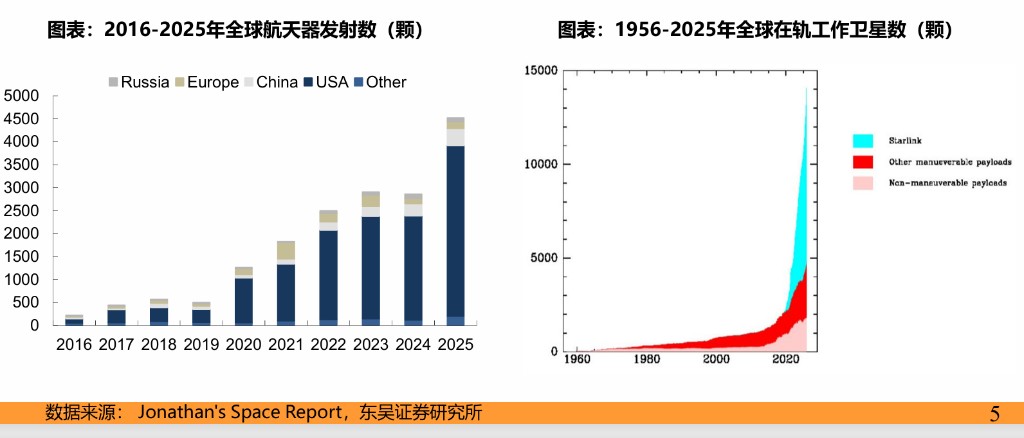
According to an industry deep report released on the 6th by the team led by Zeng Duohong from Soochow Securities, the number of global spacecraft launches is expected to exceed 4,300 by 2025, a year-on-year increase of over 50%, with a compound annual growth rate of 34% over the past decade. Driven by the International Telecommunication Union (ITU) rule of "first come, first served" for frequency resources, the deployment of global low-orbit satellites has entered an explosive period.

By the end of 2025, the number of registered satellites worldwide is expected to exceed 100,000, with the United States led by Starlink and China planning to declare over 51,000 satellites through projects like GW and Qianfan. The construction of large-scale constellations will directly translate into a rigid demand for high-performance photovoltaic cells. Assuming 10,000 satellites are launched annually, it is expected to create a market space of nearly 200 billion yuan for solar wings.
This trend is reshaping the technological path and market landscape of space photovoltaics. As low-orbit constellations evolve towards multifunctionality and heavy-duty designs, the power demand per satellite is surging sharply. For example, the solar wing area of SpaceX's Starlink V3 satellite has increased more than tenfold compared to earlier versions. Meanwhile, the vision of migrating AI computing power to space is opening up a long-term ceiling for the industry. The construction of "space data centers" utilizing the infinite energy and low-temperature cooling environment of space has become a new trend. If a 10 GW-level space computing power system is built in the future, the market size for solar wings could reach trillions of yuan.
Declining Launch Costs and Frequency Resource Competition
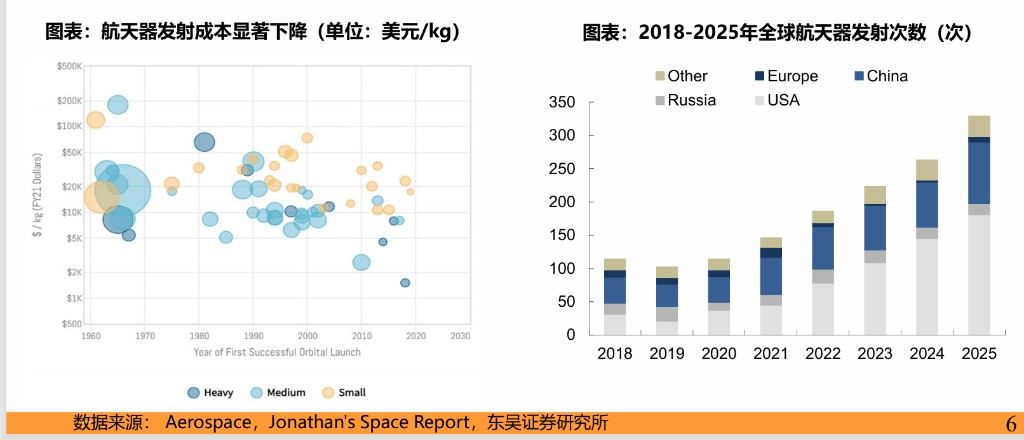
Soochow Securities stated that the rapid rise of commercial space is primarily driven by the exponential decrease in launch costs. The maturity of reusable rocket technology has completely broken the economic barriers to entering space. The launch cost of SpaceX's Falcon 9 has dropped to about $1,400 to $1,800 per kilogram, far lower than traditional space launches. The cost advantage is driving global space launch activities into an "exponential" growth cycle, with the number of global spacecraft launches expected to exceed 300 by 2025, doubling from 2021.

In addition to economic drivers, the scarcity of strategic resources is also a key factor accelerating deployment by various countries. Due to the "non-renewable" nature of near-Earth orbit frequency bands and positions, and the strict deadlines set by the ITU requiring the first satellite to be launched within 7 years of declaration and the entire constellation to be completed within 14 years, seizing orbital resources has become urgent. Currently, the United States dominates in both the number of launches and the number of satellites in orbit, while China is accelerating its catch-up. With the advancement of constellation plans like "Qianfan" and "GW," the launch of tens of thousands of satellites will become a certain trend in the industry
Photovoltaics: The "Energy Heart" of the Satellite Value Chain
In satellite systems, the power system occupies a crucial position. Data shows that the power system accounts for about 20%-30% of the total manufacturing cost of satellites, with solar wings (space solar arrays) as the core of power generation, accounting for 60%-80% of the value of the power system. This means that photovoltaic cells essentially determine the power supply capacity and power limit of the satellite.
Dongxing Securities Co., Ltd. stated that with the upgrade of satellite payloads, especially the increase in communication and computing power demands, the power requirements of spacecraft are steadily rising, driving solar wings to develop towards larger areas and higher power. Taking SpaceX's Starlink satellites as an example, their solar wing area has evolved from 22.68 square meters in version V1.5 to 256.94 square meters in version V3, achieving an order of magnitude increase. The upgrade of payloads is pushing the space photovoltaic industry from simple component manufacturing to a stage of "simultaneous increase in quantity and price," with large-area, high-efficiency solar wings becoming a key resource in commercial space competition.
Technical Route: The Game of Cost and Performance
Dongxing Securities Co., Ltd. indicated that the current technical routes for space photovoltaics show a diversified competitive landscape, with the core focus on balancing cost and performance.
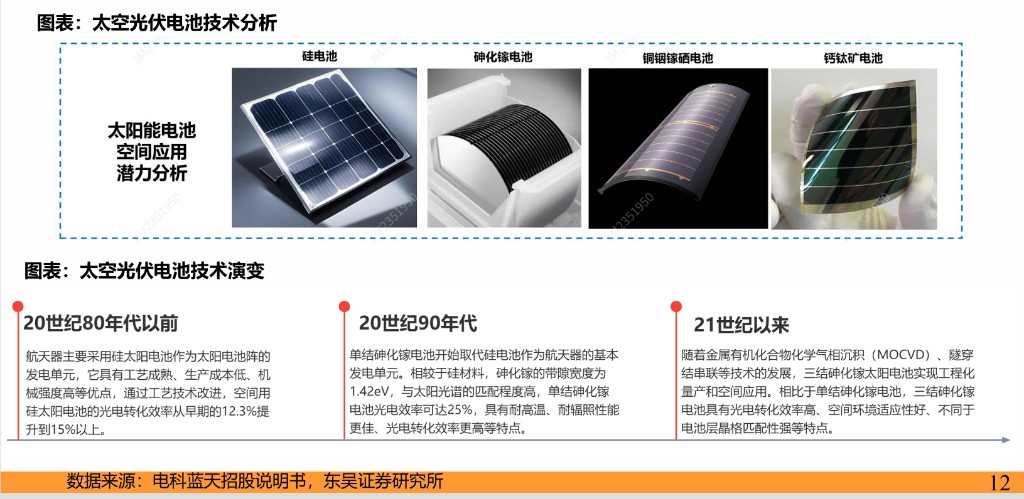
- Gallium Arsenide (GaAs): Currently the mainstream choice in China. Its advantages include high conversion efficiency (module efficiency can reach 30%+), strong radiation resistance, and good high-temperature stability, perfectly suited for long-life, high-reliability high-end missions. However, its disadvantages include high costs (approximately 200,000-400,000 yuan/square meter, estimated at about 1,200 yuan/W) and limited production capacity, making it difficult to support the low-cost explosive demand of large-scale constellations.
- Crystalline Silicon Cells: The choice of SpaceX. Thanks to extremely low launch costs, Starlink has adopted lower-cost ground-grade reinforced crystalline silicon cells, compensating for efficiency (about 20%) shortcomings by increasing the cell area. For entities with high launch costs, the lower energy-to-mass ratio (power-to-weight ratio) of crystalline silicon cells is a major constraint.
- Perovskite and Tandem Technology: Potential disruptors of the future. Perovskite has an extremely high energy-to-mass ratio (up to 30W/g), lightweight, and low-cost manufacturing potential. Although its stability in extreme space environments still needs verification, its tandem technology combined with crystalline silicon is expected to break through efficiency bottlenecks, becoming a better solution for space power supply.
Space Computing Power: Unlocking Trillion-Level Future Space
In addition to communication constellations, the space economy is extending towards computing power and data centers. Dongxing Securities Co., Ltd. stated that the surge in AI computing power demand has posed significant energy consumption and heat dissipation challenges for ground data centers, while space, with its natural vacuum heat dissipation environment and unlimited solar energy resources, is an ideal place to deploy high-performance computing nodes.
Currently, technology validations have been initiated for projects such as Beijing's "Chenguang No. 1," Zhijiang Laboratory's "Trisolaris Computing Constellation," and Guoxing Aerospace's "Star Computing Plan." Overseas, Musk has stated that Starship will achieve gigawatt-level infrastructure in orbit, and Starcloud has also proposed the idea of building a 5GW orbital data center The demand for energy from space computing power far exceeds that of traditional satellites. If a 10 GW-level deployment of space computing power is achieved in the future, the solar wing market size is expected to reach several trillion yuan based on the current pricing system.