


Geopolitics takes a back seat, the real driver of the U.S. stock market in 2026 is still "profit is king"

Earnings growth drives the performance of US stocks, with Goldman Sachs predicting that the S&P 500 will rise to 7,600 points by 2026, primarily due to a 12% increase in EPS. Goldman Sachs identified five major themes for the year, including the implementation of AI applications, the return of private equity and value investing, as well as three major risks such as the slowdown of AI growth impacting the economy
The U.S. stock market is showing a trend of concentration diversification at the beginning of 2026, with earnings growth becoming the core driving force behind the market's rise. Goldman Sachs expects the S&P 500 index to rise to 7,600 points in 2026, primarily driven by a 12% growth in earnings.
The market structure is undergoing significant changes. Since the beginning of 2026, the "Magnificent Seven" tech giants, including Nvidia, Apple, Microsoft, Alphabet (Google's parent company), Amazon, Tesla, and Meta, have collectively declined by about 0.5%, while the remaining 493 components of the S&P 500 index have collectively risen by 2.5%. As investors reallocate assets at the start of the year, the industrial, healthcare, and technology sectors have performed outstandingly in the first three trading days.
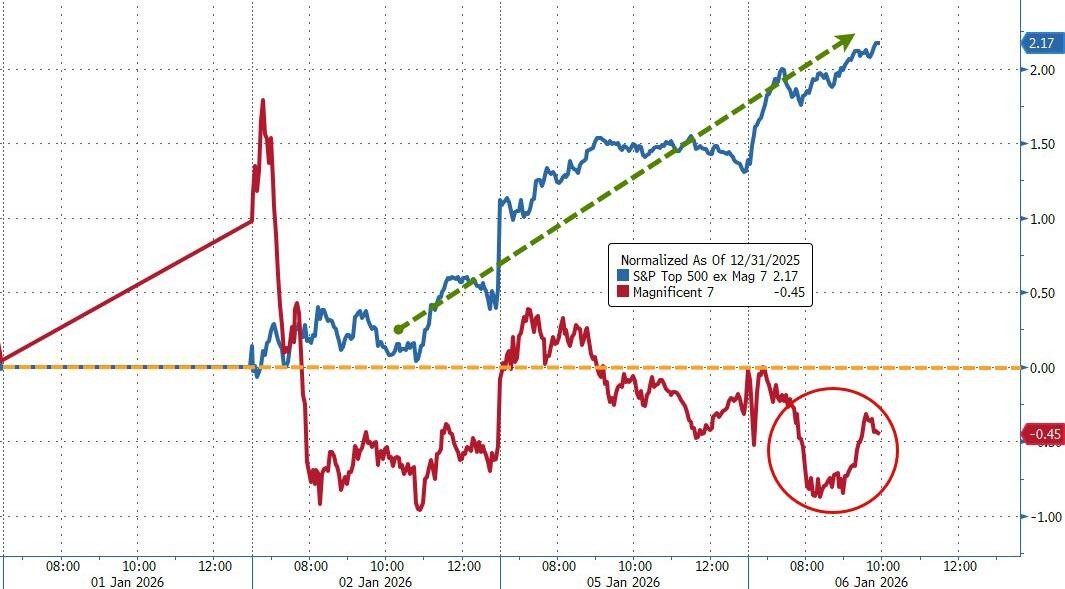
Chris Hussey, Managing Director at Goldman Sachs, pointed out that the acceleration of U.S. economic growth combined with loose monetary policy will drive the rise of cyclical sectors in early 2026, including small-cap stocks, stocks aimed at middle-income consumers, and companies related to the non-residential construction cycle.
Ben Snider, Senior Portfolio Strategist at Goldman Sachs, emphasized that earnings growth contributed 14 percentage points to the 16% price return of the S&P 500 index in 2025, accounting for 8 percentage points of the index's 9% annualized growth since 1990. Against the backdrop of healthy economic growth and the Federal Reserve's continued easing, Goldman Sachs expects the earnings per share (EPS) of S&P 500 constituents to grow by 12% in 2026 and by 10% in 2027.
Five Major Investment Themes Leading the Market
Chris Hussey proposed five key themes for the U.S. stock market in 2026. The first is the acceleration of the mid-cycle, recommending an increase in cyclical stocks, including industrial cyclical stocks, power, and residential HVAC-related stocks.
The second theme is "massive re-leveraging." As companies increase borrowing to invest in the future, financial stocks will benefit, and companies that can maintain strong free cash flow and return cash to shareholders are also worth noting.
The third theme focuses on the application of artificial intelligence (AI). Investment opportunities will arise in companies deploying AI solutions to reduce costs and in select software stocks capable of delivering new applications.
The fourth theme is "the art of recovery," driven by a rebound in IPO sizes, a surge in M&A activity, and a sustained rise in the stock market, private equity will see a recovery in exits, distributions, and fundraising in 2026. This should help the stock valuations of alternative asset management companies rebound after the volatility of 2025.
Finally, there are value investment opportunities. After unexpectedly strong performance in 2025, the wider valuation gap and favorable macroeconomic outlook suggest that the value factor will continue to perform well in early 2026. The healthcare sector should be a rich source of value stocks.
Three Major Risks to Watch Out For
Goldman Sachs also pointed out three key risks. The first is the risk of economic recession triggered by worsening employment; the second is the potential impact of slowing AI growth on the overall economy; and the third is interest rate risk Although Goldman Sachs' interest rate strategists predict that the yield on the 10-year U.S. Treasury will remain moderately volatile over the next year, an acceleration in GDP growth typically accompanies an increase in the 10-year yield. If this factor materializes, it could pose a headwind for the stock market.
Supported by healthy U.S. economic growth and the Federal Reserve's continued accommodative policies, earnings growth rather than geopolitical factors is becoming the fundamental driving force determining the direction of the stock market
