


Involving 46 countries! Nestlé announces a global large-scale recall of infant formula, potentially facing a sales loss of 1.2 billion Swiss francs

Nestlé has launched a large-scale recall in 46 countries due to the potential contamination of infant formula ingredients with harmful bacteria, involving multiple core brands. This move is expected to result in sales losses of up to CHF 1.2 billion and poses a serious impact on its brand reputation in the infant nutrition market and the execution capabilities of its new management team, highlighting the company's shortcomings in quality control and crisis response
Nestlé's large-scale recall of infant formula initiated globally is rapidly evolving into a serious crisis of trust and financial challenge.
The recall affects 46 countries worldwide, involving several core brands such as NAN and BEBA. Analysts estimate that this move could lead to sales losses of up to 1.2 billion Swiss francs (approximately 1.35 billion USD) for the company. This figure not only directly impacts Nestlé's short-term revenue but also poses a severe test to its long-term reputation in the sensitive infant nutrition market.
The incident began on Monday when Nestlé initially announced the recall of certain batches of products in Europe due to concerns that the products may be contaminated with toxins produced by Bacillus cereus, which could cause nausea and vomiting. Subsequently, the recall scope rapidly expanded within the week to Asia, Latin America, the Middle East, and Africa, ultimately covering 46 markets. According to CCTV News, the State Council's Food Safety Office and the Market Supervision Administration of China have promptly urged Nestlé (China) Co., Ltd. to fulfill its primary responsibility, and the company has already implemented the recall of the relevant batches of products in China as required.
Although Nestlé has stated that there have been no reports of illnesses related to the affected products and insists that the recalled products account for "far less than 0.5%" of its annual sales, the financial impact is expected to be insignificant. However, market reactions have not calmed down; analysts at Jefferies estimate that about 1.3% of the group's sales could be affected, with a risk exposure of up to 1.2 billion Swiss francs. Barclays analyst Warren Ackerman also provided a similar forecast, estimating that the total risk accounts for approximately 0.8% to 1.5% of the group's sales. Since the beginning of this year, Nestlé's stock price has already fallen by 5.07%.
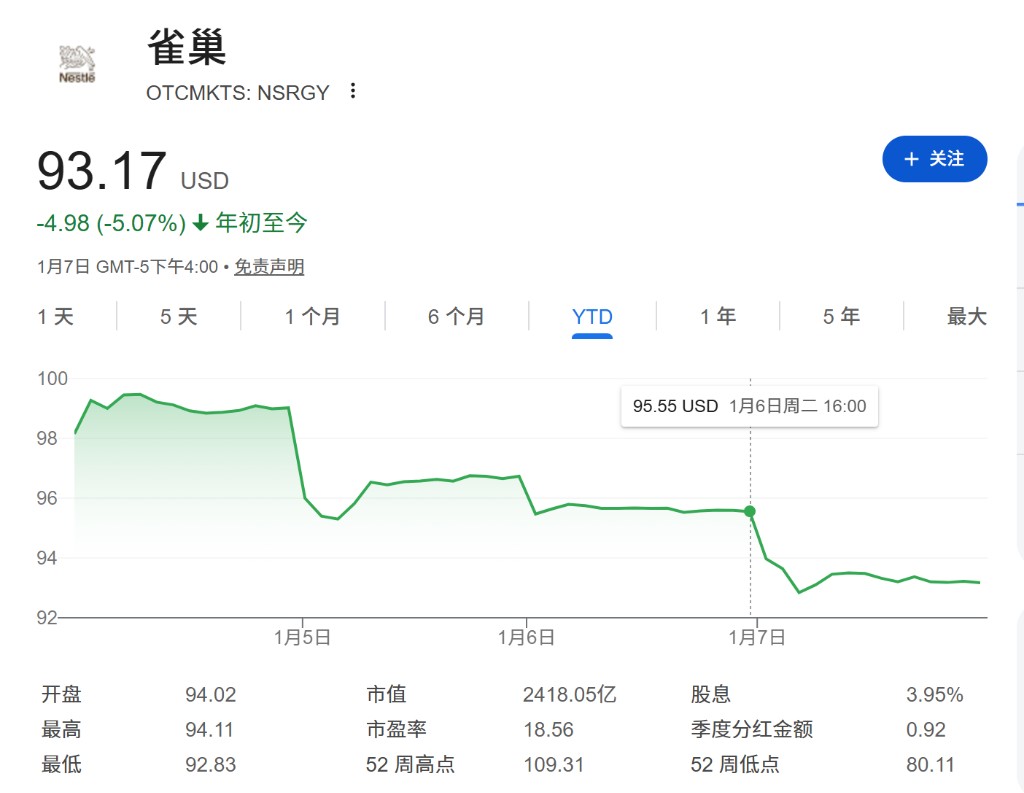
This recall incident is a significant setback for Nestlé's newly appointed CEO Philipp Navratil. Navratil took over in September last year after the dismissal of his predecessor Laurent Freixe for "failing to disclose a romantic relationship with a subordinate." He has been working to rebuild investor trust, restore growth, and reduce debt, including plans to cut 16,000 jobs over the next two years. However, the ongoing operational issues are eroding investor patience, and this recall undoubtedly exacerbates market concerns about the Swiss food giant's execution capability and internal control.
Analysts Warn: Reputation Damage Greater than Financial Impact
Compared to direct sales losses, market analysts are more concerned about the lasting damage this incident could inflict on Nestlé's brand reputation.
Vontobel analyst Jean-Philippe Bertschy pointed out that reputational risk is a greater hidden danger than financial impact. He stated:
This incident has left people disappointed with Nestlé's execution and communication abilities, which are supposed to be key priorities for the new leadership. For investors, this is far from a reassuring signal and has reignited concerns about management capabilities in this highly reputation-sensitive category.
Previously, Nestlé has faced pressure due to a series of compliance and operational issues. In July last year, French authorities raided Nestlé's offices to investigate allegations of unauthorized filtration methods used in bottled mineral water. Additionally, the company was forced to recall frozen meals in the U.S. last year due to contamination concerns. This series of events has further intensified doubts about its corporate governance standards.
Contamination Originates from Raw Materials, Market Reactions Vary by Country
Regarding the specific cause of the contamination, Nestlé explained that a quality issue was found with an ingredient—arachidonic acid oil—in the formula milk during routine testing. The recall involves well-known product lines including NAN, BEBA, Guigoz, SMA, and Alfamino.
Analysts believe that consumer reactions to future market recovery will vary significantly by country. Jefferies analyst David Hayes specifically pointed out the potential risks in the Chinese market, citing the recall incident of Danone's Dumex brand in 2013, which led to an €800 million loss in sales for Danone in China.
In contrast, the recovery capability of the U.S. market seems stronger; Abbott regained lost market share within a year after recalling Similac formula milk in 2022. Whether Nestlé can quickly control losses globally will depend on its subsequent response efficiency and transparency
