


Morgan Stanley: China has a unique advantage in the AI competition, Alibaba is the "best enabler," and Tencent has the "highest 2C monetization potential."

Morgan Stanley pointed out that China's AI industry is following a unique path of countering the global "closed" system with an "open model" strategy and accelerating monetization at the application level. Platform giants represented by Alibaba and Tencent are taking the lead in transforming AI technology into high-return commercial value, leveraging their cloud computing integration capabilities, super application ecosystems, and private data advantages, guiding the capital market from speculation on computing power to a pricing logic based on application implementation
Morgan Stanley believes that the market is undergoing a structural transformation: despite the global AI race being highly publicized, China is following a unique path—an "open" model strategy to counter the world's "closed" systems.
According to the Chasing Wind Trading Desk, on January 8th, Morgan Stanley's latest research report shows that China occupies half of the global top 10 SOTA (state-of-the-art) models. Morgan Stanley expects that by 2027, the total addressable market (TAM) for cloud AI in China will reach $50 billion. This indicates that although the external environment is complex, the resilience of China's local computing power supply chain is strengthening, providing foundational support for the explosion of upper-level applications.
For investors, the focus should not only be on the arms race in infrastructure but should also shift towards the monetization capabilities and ecological barriers at the application level.
The report clearly points out that China has significant comparative advantages in data volume, power supply, and engineer dividends. In terms of specific target selection, Morgan Stanley believes that Alibaba, with its combination of cloud computing and model capabilities, has become the "best enabler" for AI development in China; while Tencent, relying on the WeChat ecosystem, possesses the highest consumer-side (2C) monetization potential and high return on investment (ROI). This judgment means that the pricing logic in the capital market will shift from pure computing power speculation to platform giants with a large user base, private data accumulation, and the ability to implement AI applications substantively.
Parallel Development of Super Apps and AI-Native Applications
At the application level, the Chinese market presents a unique landscape of the evolution of "super apps" and the explosion of "AI-native applications."
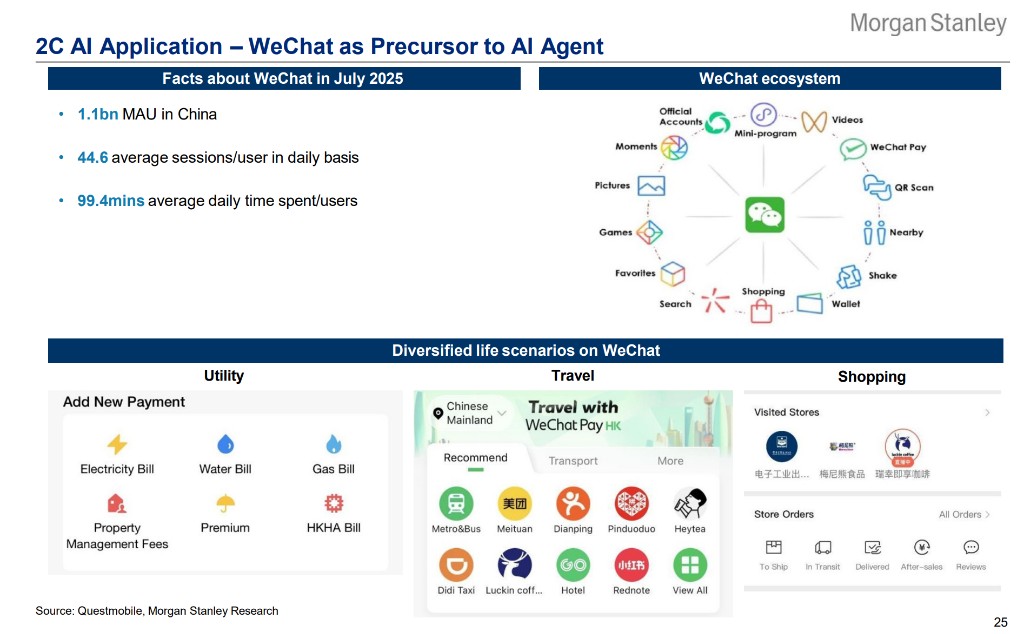
Morgan Stanley particularly emphasizes the enormous potential of WeChat as a pioneer of AI Agents. By July 2025, WeChat is expected to have 1.1 billion monthly active users (MAU), with an average daily user duration of 99.4 minutes and an average daily conversation frequency of 44.6 times. This high-frequency, deep user engagement provides a perfect soil for the integration of AI Agents, allowing them to seamlessly connect with various scenarios such as life, shopping, and travel.
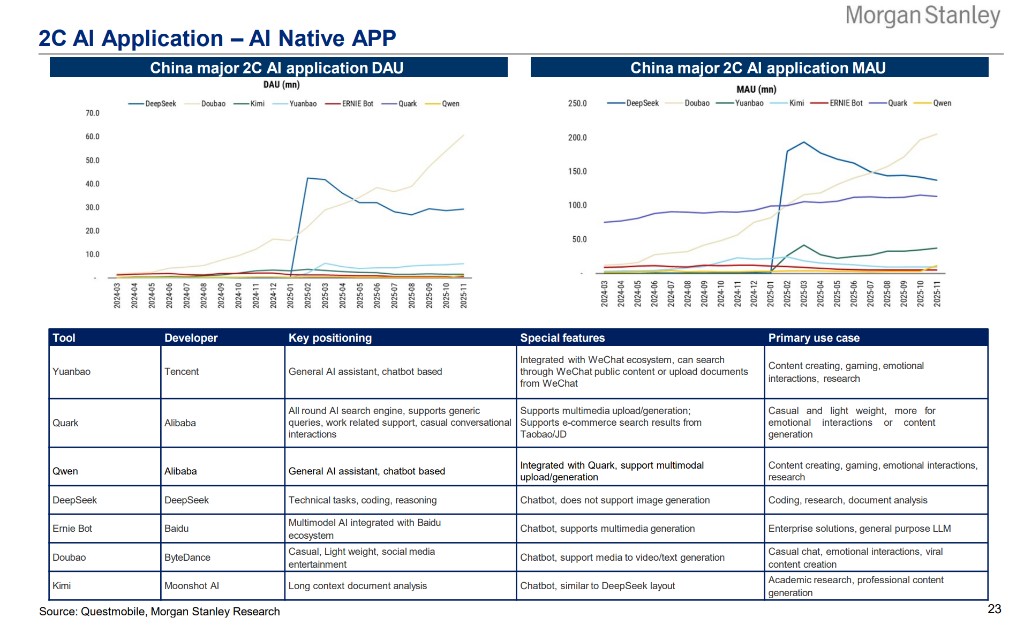
At the same time, AI-native applications such as Doubao from ByteDance, Wenxin Yiyan from Baidu, and Quark and Yuanbao from Alibaba are rapidly competing for user time. Data shows that these applications are evolving from simple chatbots to emotional interactions, content creation, and even all-purpose AI assistants. For investors, this means that companies with high user retention and rich scenario data will be the first to enjoy the traffic dividends brought by AI.
Penetration in the Enterprise Sector (2B) and Industry Restructuring
In addition to the excitement on the consumer side, the penetration of AI in the enterprise sector (2B) is quietly changing the industry landscape.
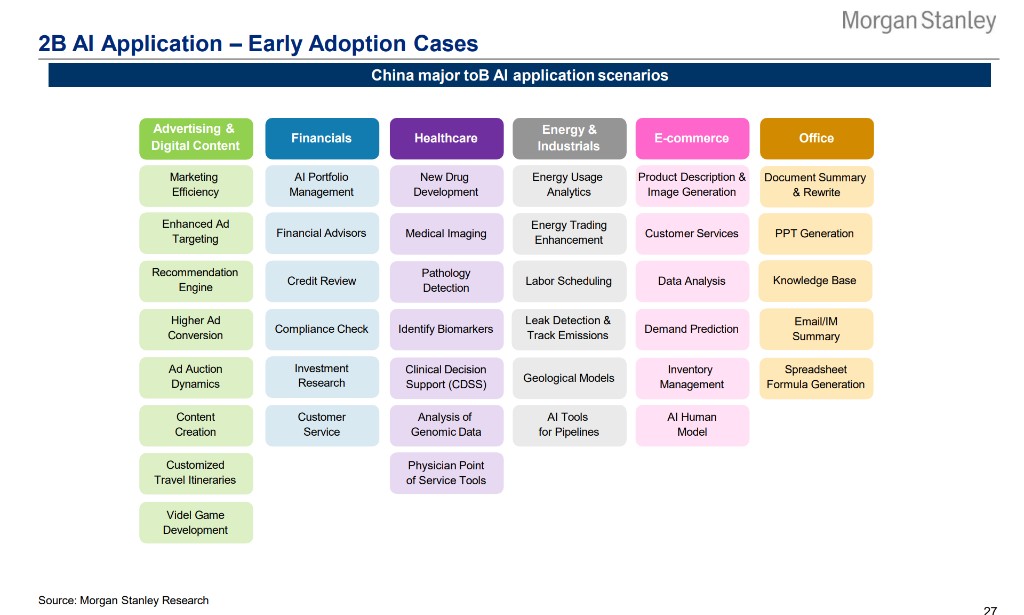
Morgan Stanley's CIO survey for the second half of 2025 shows that companies have a strong willingness to deploy GenAI (generative AI), shifting from early experimentation to substantial productivity improvements. In vertical fields such as advertising, healthcare, finance, and energy, AI application scenarios are rapidly taking shape. For example, in the advertising sector, AI is reshaping delivery efficiency and content generation; in healthcare, AI image analysis and new drug development have become key focuses.
The survey also pointed out that a significant proportion of working hours will be replaced by GenAI in the next three years, indicating that corporate IT spending will shift towards AI-related infrastructure. In the SaaS sector, companies like Beisen are reshaping the human capital management market through features like AI interviewers and employee assistants; Kingsoft Office, through WPS AI, has not only improved user payment rates but also solidified its position in the office software market.
Giant Rivalry: Differentiated Positioning of Alibaba, Tencent, and ByteDance
In the analysis of specific investment targets, Morgan Stanley has made precise differentiated positioning of several internet giants.
Alibaba is seen as "China's best AI enabler." The core logic is that Alibaba not only possesses a powerful Tongyi Qianwen (Qwen) large model but, more importantly, its deep integration of Alibaba Cloud infrastructure with e-commerce, DingTalk, and other business scenarios allows it to capture the full-chain value from computing power to underlying models to application layers.
Tencent is rated by Morgan Stanley as having the "highest 2C monetization potential." Morgan Stanley pointed out that Tencent's AI strategy, through the integration of the WeChat ecosystem, can achieve commercialization with a very high return on invested capital (ROIC). Yuanbao, as its general AI assistant, is deeply integrated with WeChat public account content and search capabilities, giving it a natural barrier in the content ecosystem.
In contrast, ByteDance is defined as a "full-stack AI leader," with the most comprehensive layout from the underlying Volcano Engine, the intermediate model layer (Doubao, Seedance), to various AI-native applications (such as Dream, Button, etc.) and even AI hardware. Although Baidu started its AI transformation the earliest, Morgan Stanley pointed out that its core advertising business is facing pressure from the transformation brought by AI search.
Therefore, investors should closely monitor the speed at which these giants implement AI in their respective areas of advantage, especially those who can convert AI technology into actual revenue and profits as "doers."
