Tariff Ruling Trading Guide: If the Supreme Court says "no," what cards does Trump have left?

Wallstreetcn
2026.01.09 11:35
portai
I'm PortAI, I can summarize articles.

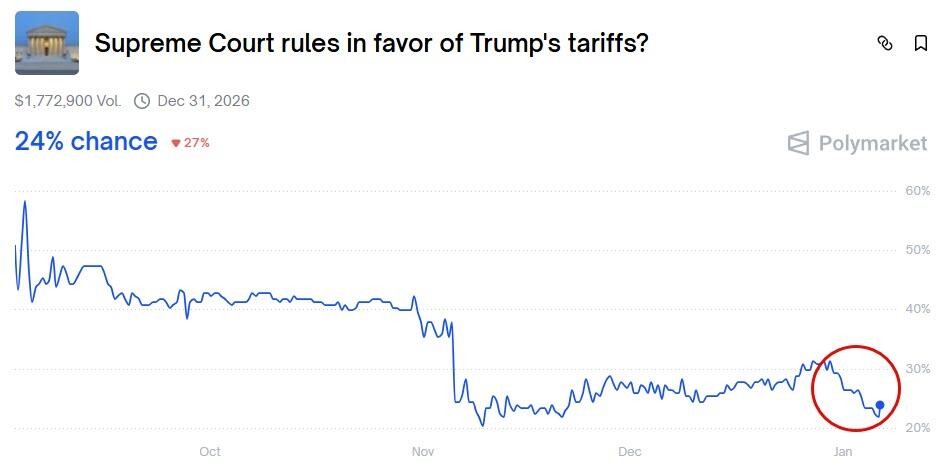
The U.S. Supreme Court will make a ruling on tariff issues on January 9, with the market expecting a decision unfavorable to Trump, which may boost the stock market in the short term. Analysts believe that if the tariffs are overturned but alternative measures are in place, the S&P 500 may experience a brief rebound before falling back. The probability of Trump's tariff policy being maintained is only 24%, and the justices have expressed skepticism about his authority. The Treasury Secretary stated that the government has alternative legal avenues to maintain the trade agenda, and the market scenario may shift from a "relief rally" to "buying the fact."

According to CCTV News, on January 6 local time, the U.S. Supreme Court announced that it would make a ruling on tariff issues this Friday (January 9). Although the market generally expects this ruling, which is unfavorable to Trump, to boost the stock market in the short term and put pressure on the bond market, investors' focus has quickly shifted to the potential follow-up measures that the White House may take.

According to a previous article from Wall Street Insight, the outcome of the U.S. Supreme Court's ruling will profoundly affect market direction. According to analysis from JP Morgan, if the tariffs are overturned but immediately replaced—considered the most likely scenario—the S&P 500 index may briefly rebound on that day before falling back. Conversely, if the tariffs are completely removed, it would directly benefit consumer and financial stocks that rely on imports, but it could also reignite concerns about the fiscal deficit, complicating the Federal Reserve's interest rate cut path and putting pressure on U.S. Treasuries.

Current prediction market data shows that the probability of Trump's tariff policy being maintained is only 24%. The hearing on November 5 indicated that the justices were skeptical about whether Trump had the authority to impose tariffs under the 1977 Emergency Powers Act. Analysts expect the ruling may oppose the tariffs by a majority of 7:2 or 6:3.

For traders, the key issue is not only whether the current tariffs remain in place but also the speed and effectiveness of the White House's implementation of the "Plan B." Yesterday, Treasury Secretary Besant stated that regardless of the Supreme Court's ruling, the government has alternative legal avenues to maintain its trade agenda. He cited several provisions in the Trade Act of 1962 that grant the president broad powers over import tariffs:

"We can rebuild the exact same tariff structure using Section 301, Section 232, and Section 122."

Market Scenario: From "Relief Rally" to "Buy the Fact"

For stock market bulls, the overturning of tariffs is a clear positive signal. Wells Fargo's Chief Equity Strategist Ohsung Kwon previously estimated that if the tariffs are canceled, the EBITDA of S&P 500 constituent companies in 2026 will increase by 2.4% compared to last year's levels. James St. Aubin, Chief Investment Officer of Ocean Park Asset Management, believes this will become a "catalyst for a slight rebound."

JP Morgan's Delta-One division detailed several possible market reaction scenarios:

  • Tariffs are overturned and immediately replaced (probability 66%): This is the base case scenario. The S&P 500 index may rise by 0.75% to 1% on the day the news is announced, but as investors realize that the government will use other legal provisions to restart tariffs, the gains will be reversed, and it will ultimately close with only a slight increase
  • Tariffs Maintained (Probability 24%): This status quo outcome could lead to a decline of 30 to 50 basis points in the S&P 500 index on that day.
  • Tariffs Overturned with No Replacement (Probability 1%): This is the most favorable scenario for the stock market, with the S&P 500 index expected to rise by 1.5% to 2%.

In the bond market, according to a report by JP Morgan strategist Jay Barry and others, the cancellation of tariffs could "reignite fiscal concerns," leading to an increase in long-term yields and a steeper yield curve. However, this impact is expected to be limited, as the market anticipates that the Trump administration will seek other legal avenues to restore tariffs. The report from the JP Morgan team, including Martin Tobias and Matthew Hornbach, indicates that since Wall Street has partially priced in the risks, the bond market sell-off may be temporary, and investors may subsequently "buy the fact," pushing yields back down.

Sector Watch: Who are the Winners and Losers

If the tariff threat is lifted, some sectors will benefit more than others. Market analysis suggests that companies reliant on imported goods, especially those catering to American consumers, will gain the most breathing room:

  • Consumer and Retail: Apparel and toy companies are seen as clear winners, as they heavily depend on imports from Asia. Stocks like Nike, Mattel, American Eagle Outfitters Inc., and Crocs Inc., which have been troubled by tariff uncertainties, are worth watching. Additionally, consumer staples stocks like Costco have begun to react to this expectation.
  • Financials and Technology: Major banks like JP Morgan and Goldman Sachs may benefit from increased consumer confidence. Fintech companies like Affirm Holdings Inc. may also experience significant volatility.
  • Transportation and Industrials: Hedge fund Hedgeye believes that if tariffs are lifted in conjunction with tax cuts to boost the economy, transportation stocks like United Parcel Service and FedEx will be uplifted. Caterpillar and Deere & Company are also expected to benefit from tariff refunds.

Conversely, Haris Khurshid, Chief Investment Officer of Karobaar Capital, points out that those benefiting from protectionist policies, such as raw materials, commodities, and domestic producers, may underperform.

Trump's Toolbox: A Complex Legal "Plan B"

Even if the Supreme Court rules that the International Emergency Economic Powers Act (IEEPA) used by Trump lacks sufficient basis, the Trump administration still has several alternative options, although most of these options have clear legal or enforcement flaws.

According to Bessent's public statements, the government could utilize provisions from the Trade Expansion Act of 1962, Section 232, and the Trade Act of 1974, Section 301, to "rebuild the exact same tariff structure." However, analysts believe these alternatives face numerous challenges:

  • Section 232 of the Trade Expansion Act of 1962: This provision allows for tariffs to be imposed on the grounds of "national security," which has previously been used for steel and aluminum. While the Trump administration may attempt to broaden the definition of "national security," including items such as toys, coffee, or T-shirts could appear absurd legally and in public opinion, potentially leading to new lawsuits.
  • Section 122 of the Trade Act of 1974: This provision targets countries with large surpluses in their balance of payments, but its restrictions are strict: the maximum tariff is only 15%, and the duration is limited to a maximum of 150 days.
  • Sections 201 and 301 of the Trade Act of 1974: Activating these provisions typically requires a lengthy investigation period (such as 150 days) and often necessitates cooperation from the U.S. International Trade Commission (ITC). Currently, there are vacancies in the ITC, which is bipartisan in nature, and may not fully align with the president's intentions.

Analyst Mike Shedlock from MishTalk.com summarizes that the seven alternative options Trump may attempt all have serious issues. This means that if the Supreme Court makes an unfavorable ruling, the market will have to face a more complex and legally contentious long-term trade environment after experiencing an initial knee-jerk reaction.

Risk Warning and Disclaimer

The market carries risks, and investment should be approached with caution. This article does not constitute personal investment advice and does not take into account the individual user's specific investment objectives, financial situation, or needs. Users should consider whether any opinions, views, or conclusions in this article are suitable for their specific circumstances. Investment based on this is at one's own risk