The Cost of $50 Oil: Can Trump's Energy Ambitions Avoid the Squeeze from Saudi Arabia and Shale Oil?

Analysis suggests that the $50 oil price strongly advocated by Trump may be feasible in the short term, but the cost is the simultaneous triggering of countermeasures from Saudi Arabia and U.S. shale oil. If Venezuela quickly increases production by 400,000 barrels, it could lower oil prices, but the fiscal red line of OPEC+ will force Saudi Arabia to reassess production cuts; if oil prices fall below $55, U.S. shale oil producers may be forced to cut investments, weakening future supply stability
The target oil price of $50 per barrel promoted by the Trump administration is not unattainable, but achieving and maintaining this ambition will face complex market dynamics and potential supply-side rebound risks.
Before the news of Venezuelan President Maduro being controlled by the U.S. emerged, U.S. benchmark crude oil futures prices had been hovering around $57 per barrel, even briefly falling below the $60 mark. The market was already under pressure from oversupply due to strong production in Brazil, Guyana, and Canada. The U.S. Energy Information Administration (EIA) had previously indicated in its December forecast that global oil inventory would increase by more than 2 million barrels per day by 2026. Against this backdrop, Venezuela's potential production recovery would further push prices downward.
Goldman Sachs predicts that if Venezuela's daily production can increase by 400,000 barrels, the average oil price this year could drop to $50 per barrel. Although Venezuela currently accounts for less than 1% of global crude oil production, this increase would be sufficient to exert substantial downward pressure on market pricing.
However, this low oil price environment faces severe challenges from two major global supply forces—OPEC+ and U.S. domestic producers, which together account for about half and one-fifth of global supply, respectively.
Venezuela: Feasible Path for Short-term Production Increase
According to a previous article by Jianwen, on January 7 local time, Trump and his advisors are planning to dominate the Venezuelan oil industry in the coming years. The president told aides that he believes his efforts can help bring oil prices down to his desired level of $50 per barrel.
Currently, the country's daily production is about 900,000 barrels. Goldman Sachs points out that through relatively short-term remedial measures, such as providing more light diluents for blending heavy crude oil, repairing damaged oil wells and upgrading crude oil facilities, and lifting sanctions, Venezuela is expected to enhance its production capacity in the short term.
According to Robert Auers, an analyst at energy consulting firm RBN Energy, although increasing daily production by hundreds of thousands of barrels may seem modest, it is enough to "substantially push prices downward." For example, a potential increase of 400,000 barrels accounts for about half of the International Energy Agency (IEA)'s projected increase in global oil demand by 2026.
Gary Ross, CEO of Black Gold Investors, further points out that if sanctions are lifted, the U.S. will obtain Venezuelan crude oil faster than other regions of the world. This not only helps to lower benchmark prices but also alleviates the shortage of heavy crude oil faced by U.S. refineries. John Auers, managing director of RBN Energy, analyzes that due to the long-term decline in Mexican production and more Canadian crude flowing to the West Coast market after pipeline expansions in 2024, U.S. refineries urgently need this cheap heavy crude oil from Venezuela to fill the gap. This means that even if benchmark oil prices do not fully drop to $50, they can effectively reduce gasoline costs for U.S. consumers
The Fiscal Red Line and Response of OPEC+
The low oil price environment will undoubtedly touch the sensitive nerves of core OPEC+ member countries such as Saudi Arabia.
Gary Ross believes that Saudi Arabia will not be satisfied with Brent oil prices above $50. The International Monetary Fund (IMF) estimates that Saudi Arabia's fiscal breakeven oil price will reach as high as $86.60 per barrel by 2026. Most OPEC member countries also need oil prices to remain above $60 to balance their budgets.
Although OPEC+ recently confirmed it would maintain stable production levels until the end of March, and Saudi Arabia may be reluctant to publicly clash with the Trump administration, the possibility of OPEC deciding to cut production is not zero when the fiscal pain caused by low oil prices intensifies. It is worth noting that Saudi Arabia's decision-making logic is often unpredictable. In past periods of low oil prices, Saudi Arabia sometimes did not cut production but instead chose to increase it to defend market share, adding uncertainty to future market trends.
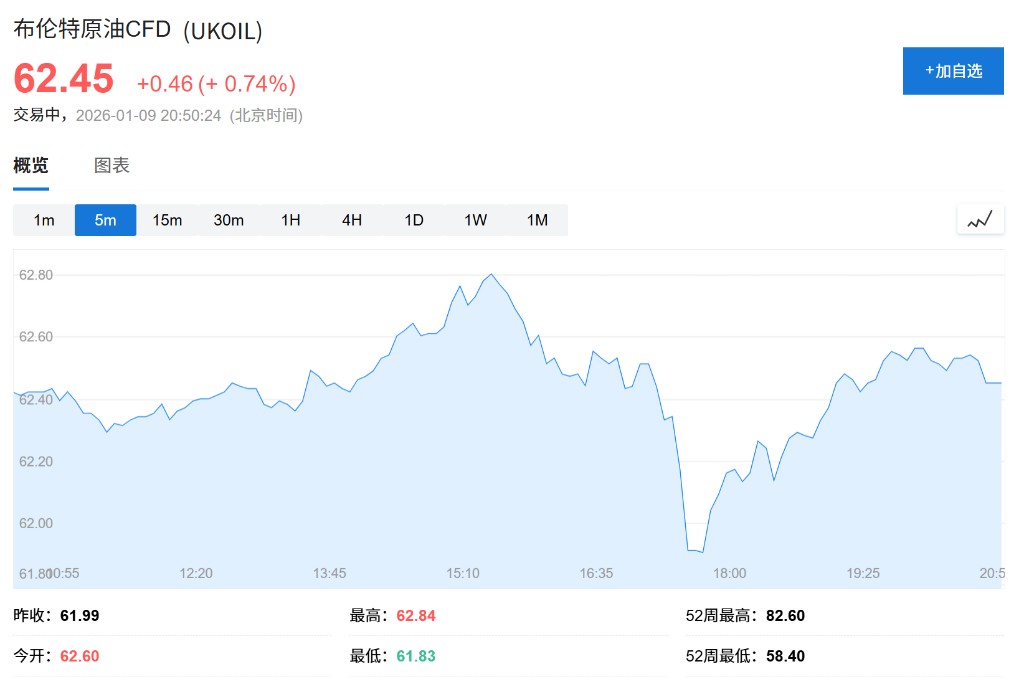
Currently, Brent crude oil prices are up 0.74%, maintaining around $62.

The Breakeven Point for U.S. Shale Oil Producers
In addition to OPEC+, U.S. shale oil producers are also facing survival challenges. Dan Pickering, Chief Investment Officer of Pickering Energy Partners, pointed out that the oil price range of $55 to $60 has not triggered large-scale production cuts, but if it falls below $55, the situation may change. A survey by the Dallas Federal Reserve last year showed that oil producers in the Permian Basin generally believe that West Texas Intermediate (WTI) prices need to remain around $61 to $62 for new drilling to be profitable.
As one of the largest independent producers in the Permian Basin, Diamondback Energy clearly stated in last year's earnings call that if oil prices remain at the "low $50s" for a month, the company may have to consider cutting investments. This means that overly aggressive price suppression could stifle domestic capacity in the U.S., thereby weakening the stability of the supply side in the medium to long term.
For the White House, as the midterm elections approach, lowering oil prices is certainly a core agenda, but maintaining oil prices slightly above $50 may be the best balance to appease American drivers while ensuring the survival of large oil producers