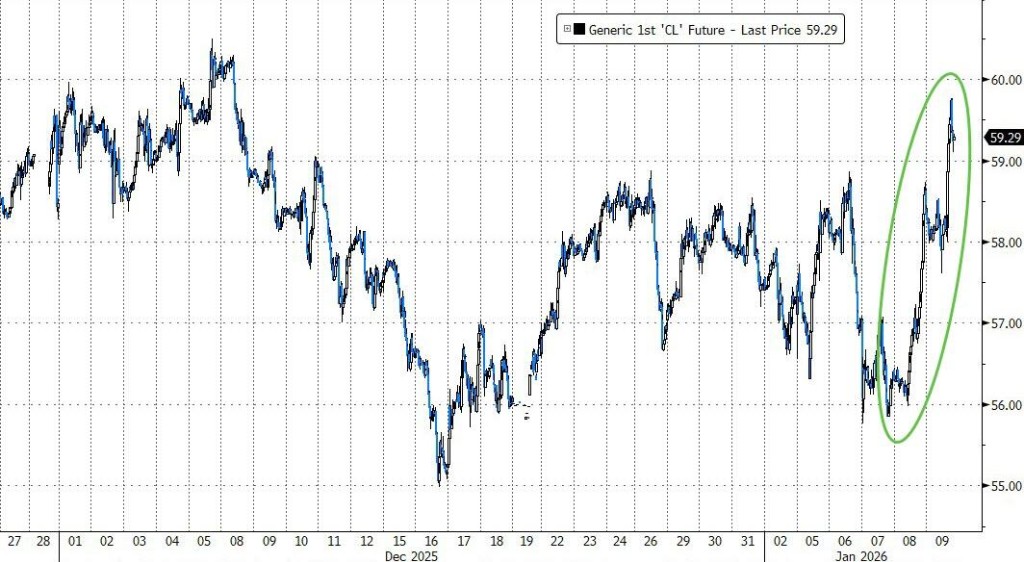
The geopolitical situation is delicate, and oil prices have risen for three consecutive weeks

Despite the weak fundamentals of crude oil and the strong long-term bearish sentiment among investors, ongoing unrest in Iran has led to a geopolitical risk premium that drives oil prices up. Market focus has shifted from Venezuela to the oil-producing giant Iran, with WTI crude oil rising more than 5% over two days, marking the longest weekly gain since June of last year. It is worth noting that oil traders have maintained a large short interest, and if these positions are unwound, a sharp reversal may occur
Geopolitical risk premium returns to the energy market, with crude oil prices recording the longest weekly consecutive increase since June of last year.
According to Global Times, the unrest in Iran has lasted for several days, with Iran's Supreme National Security Council accusing the United States and Israel of orchestrating the turmoil. Iran's Supreme Leader Khamenei stated that the rioters aim to please the president of another country by destroying public property.
U.S. President Trump warned that if Iran is directly responsible for the deaths of relevant personnel, "they will pay a heavy price." He also stated that if there are more deaths, the U.S. will take "severe action" against Iran.
Market focus has shifted from Venezuela to Iran. The former caused a brief drop in oil prices after Trump announced the cancellation of further actions, but Iran, as a larger oil-producing and exporting country, has a potential supply disruption impact that far exceeds that of Venezuela.
On Friday, WTI crude oil futures prices rose more than 3%, and although the gains receded at the end of the trading session, they accumulated over 5% in the past two trading days, marking three consecutive weeks of increases and setting the longest weekly consecutive increase since June of last year.
(WTI crude oil futures prices performed strongly this week)
Additionally, the options market also reflects a shift in risk appetite, with the skew of call options reaching the highest level for U.S. crude oil futures since July, as traders are paying the highest insurance premiums since last summer's clashes between Israel and Iran to hedge against potential price surges.
Despite rising prices, fundamental pressures remain, with Goldman Sachs noting that its clients' bearish sentiment towards oil prices is at a ten-year high. However, this extreme bearish sentiment combined with sudden geopolitical risks may force short positions to be unwound, leading to a sharp market reversal.
Shift in Geopolitical Risk Focus
According to CCTV, on January 9 local time, U.S. President Trump held a meeting at the White House with executives from some of the world's largest oil companies.
Trump stated that large oil companies will spend at least $100 billion to rebuild the necessary capacity and infrastructure of Venezuela's oil industry. Trump also promised that U.S. oil companies would receive security assurances.
Reports indicate that Venezuela's acting president Delcy Rodríguez, while accusing the U.S. of "illegal aggression," also expressed a willingness to seek diplomatic avenues and "common interests."
The easing of the situation in Venezuela has led the market to focus more on the supply risks from Iran. According to Trafigura's global oil chief speaking to Bloomberg Television, the "bullish uncertainty" currently concerning the oil market is Iran, not Venezuela Due to U.S. sanctions and outdated infrastructure, Venezuela's role as a supplier has significantly shrunk in recent years. Meanwhile, Iran not only produces over 3 million barrels of crude oil per day, but its export volume in October and November remains around 2 million barrels per day.
Rapidan Energy Group currently believes that if there are significant civilian casualties in Iran, the likelihood of U.S. intervention is 70%, with possible measures including tightening economic restrictions on Iran or cyber warfare.
Arne Lohmann Rasmussen, chief analyst at A/S, pointed out that the market is increasingly concerned that the U.S. may attempt to overthrow the Iranian regime amid this chaos.
Short Covering and Capital Flows
Analysts believe that the amplification of Iranian risks is primarily due to oil traders holding large bearish bets previously.
If geopolitical tensions force these positions to be unwound, the market could face a sharp reversal. Capital flow data indicates that bullish momentum is building.
According to James Taylor, head of quantitative services at Energy Aspects, trend-following commodity trading advisors (CTAs) have been buying crude oil on Thursday, and if prices stabilize, they will continue to buy in the coming days.
Meanwhile, the options market has seen an influx of bullish capital, with over 750,000 Brent crude oil call options traded this week, the highest since October, including a large number of call options with a strike price of $80, which market participants believe is a hedge against price surges.
Additionally, RBC estimates that over $6 billion will flow into the market in the coming days due to annual rebalancing, primarily from commodity index funds. James Taylor noted that funds from CTAs, index funds, and options traders are forming a financial momentum.
Inventory and Price Game
Despite rising geopolitical risks, macro-level expectations of oversupply still limit the upside potential for oil prices.
Robert Rennie, head of commodity research at Westpac Banking, believes that crude oil remains caught in a "complex dance" between escalating geopolitical risks and rising inventories.
Rennie added:
The increase in Venezuelan supply and rising production from other regions may keep oil prices trading in the range of around $50 in the first quarter.
Historical experience also shows that price surges triggered by geopolitical events may be short-lived; for instance, when the U.S. bombed Iranian nuclear facilities last year, oil prices spiked but quickly fell back once it was clear that production was unaffected