


The "two-year consecutive decline" of the US dollar is a "historical pattern," with 1995 being the best comparison to this year

Historical data shows that significant declines in the US dollar often occur over consecutive years. By 2025, the dollar has fallen over 9%, and quantitative models indicate it may drop another 8% in 2026. Among various historical references, 1995, due to its "technology-driven soft landing + Federal Reserve interest rate cuts" macro backdrop, is considered the best comparison for 2026, suggesting that the dollar index will fall to around 95. Unless the Federal Reserve unexpectedly raises interest rates and the overseas economy suffers a shock, the dollar is unlikely to change its downward trend
History may not repeat itself simply, but it often rhymes — for the US dollar, which has just experienced a significant drop in 2025, the implications of historical data are unsettling: the pain may just be beginning.
According to news from the Chase Trading Desk, the latest research report released by the Bank of America Merrill Lynch Global Rates and Currencies Research team analyzes that significant sell-offs of the US dollar often occur over consecutive years. In the recently concluded year of 2025, the US Dollar Index (DXY) fell by 9.4% against G10 currencies, marking the second-largest annual decline in the past twenty years. Standing at the starting point of 2026, the most pressing question for investors is: will this downward trend continue?
Bank of America strategist Howard Du and his team pointed out through quantitative analysis that if history is any guide, the answer is affirmative.
Historical Backtesting: The Dollar Typically "Falls for Two Consecutive Years"
The Bank of America team reviewed data since 1975 to find the historical years most correlated with the dollar's performance in 2025. The results showed that in the top 5 historical reference years with the highest correlation, the dollar continued to decline in 4 of the following years.
-
Extremely High Correlation: The average correlation of these top 5 historical reference years with the dollar's price movement in 2025 is as high as 81%.
-
Decline Prediction: In the second year of these reference years, the dollar further declined by an average of 8.3%. Even when expanding the scope to the top 10 reference years, the probability of the dollar declining in the second year remains high at 70%, with an average decline of 5.5%.**
This quantitative finding supports Bank of America's baseline foreign exchange view for 2026: that under the backdrop of convergence of US/global interest rates after Federal Reserve Chairman Jerome Powell, stimulus measures in the Eurozone/China, and increased foreign exchange hedging against dollar assets, the dollar will weaken further.
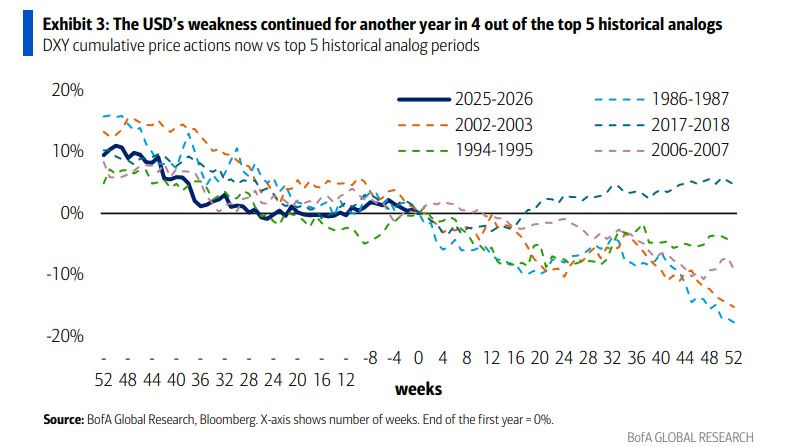
1995 — The Most Perfect Macro Mirror, Will the Dollar Drop Another 4.2% This Year?
Among all historical reference years (1987, 1995, 2003, 2007, and 2018), Bank of America believes that 1995 is the most valuable reference for 2026.
-
Similar Macro Background: In 1995, technology-driven growth allowed the US economy to achieve a soft landing rather than fall into recession; despite inflation being close to 3% instead of 2%, the Federal Reserve still cut interest rates in the second half of the year.
-
2026 Outlook: Bank of America expects the US economy to "muddle through" in 2026 after experiencing weakness in the fourth quarter of 2025 due to a government shutdown, and the Federal Reserve will further cut interest rates after mid-year.
-
Price Implication: Based solely on the trends of 1995, it suggests that the dollar will have a 4.2% downside in 2026. This aligns with Bank of America's prediction that the DXY index will drop to around 95 in 2026. In contrast, the macroeconomic background of other reference years differs significantly from the current one. For example, in both 1987 and 2018, the Federal Reserve ultimately raised interest rates, but this is not included in the current predictions of Bank of America or the Federal Reserve; 1987, 2007, and 2018 all ended with market shocks. While investors are concerned about the "AI bubble bursting" as a tail risk for 2026, this is not the baseline scenario.
Threshold for Reversing the Downtrend: Federal Reserve Rate Hike + External Growth Shock
Notably, the report indicates that 2018 is the only "exception" among the top five reference years, as the dollar reversed its downtrend from 2017 and rebounded by 4.7%.
However, Bank of America points out that replicating the reversal of 2018 requires extremely stringent conditions:
-
Federal Reserve Resuming Rate Hikes: The Federal Reserve raised rates in 2018.
-
External Growth Shock: In 2018, major economies such as the Eurozone and China faced growth shocks. At that time, the German economy fell into recession, and the U.S.-China trade conflict escalated.
Looking ahead to 2026, however, Bank of America's expectations are quite the opposite: it anticipates that Eurozone growth will further recover, and with the easing of the U.S.-China trade war, the growth outlook for Asia has also been upgraded. Therefore, the dollar lacks fundamental support for reversing its downtrend.
Stock Market Signals: Global Stock Markets Outperforming U.S. Stocks is a Key "Bear Market Driver"
In addition to interest rates and macroeconomics, the flow of funds in the stock market has also sent unfavorable signals for the dollar.
Although U.S. stocks reached a historic high at the beginning of 2026, their gains lagged behind most global stock markets. Bank of America notes that as the global central bank rate-cutting cycle approaches its end, the driving logic of the foreign exchange market is gradually shifting from the "pure interest rate-driven" model of 2022-2024 to a "stock market-driven" model.
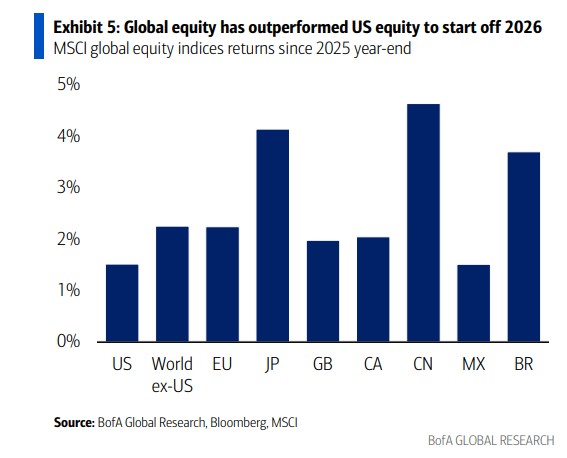
Currently, the dollar against G10 currencies remains in a broad downtrend. Bank of America emphasizes that if the observed trend of "global stock markets outperforming U.S. stocks" continues into early 2026, this cross-border stock performance disparity will become the main driver for shorting the dollar in 2026.
The above exciting content comes from [Chasing Wind Trading Platform](https://mp.weixin.qq.com/s/uua05g5qk-N2J7h91pyqxQ).
For more detailed interpretations, including real-time analysis and frontline research, please join the【 [Chasing Wind Trading Platform ▪ Annual Membership](https://wallstreetcn.com/shop/item/1000309)】
[](https://wallstreetcn.com/shop/item/1000309)