SanDisk: Price increase, and full payment is required!

Wallstreetcn
2026.01.10 12:07
portai
I'm PortAI, I can summarize articles.

Driven by the explosive demand for AI servers and the production capacity tilt of original manufacturers, the storage market has entered a severely short-supplied seller's cycle. According to reports, SanDisk recently plans to raise enterprise-grade NAND prices by more than 100% month-on-month in March, and has broken industry norms by requiring customers to pay a 100% cash prepayment to secure long-term contracts. Tech giants like Google and Meta are being forced to restructure their procurement teams to compete for supplies

The storage chip market is undergoing a supply-side upheaval triggered by the AI wave, with the strong return of a seller's market forcing buyers to accept unprecedented harsh terms.

According to multiple sources, including technology media Digitimes, insiders in the supply chain revealed that SanDisk has proposed a contract form referred to as "unprecedented" in the industry: requiring customers to pay full cash in advance to secure supply quotas for the next 1 to 3 years.

Despite the stringent terms, facing the rigid demand for storage devices driven by AI infrastructure construction, some cloud service providers (CSPs) are considering accepting this condition to avoid future supply risks.

Meanwhile, drastic price fluctuations are imminent. According to a client report released by Nomura Securities, SanDisk plans to increase the price of its high-capacity 3D NAND flash memory chips used for enterprise-grade solid-state drives (SSDs) by more than 100% month-on-month during March. Nomura Securities pointed out that this price increase plan is attributed to short-term supply shortages and the mid-term demand growth for server-grade storage in the AI field.

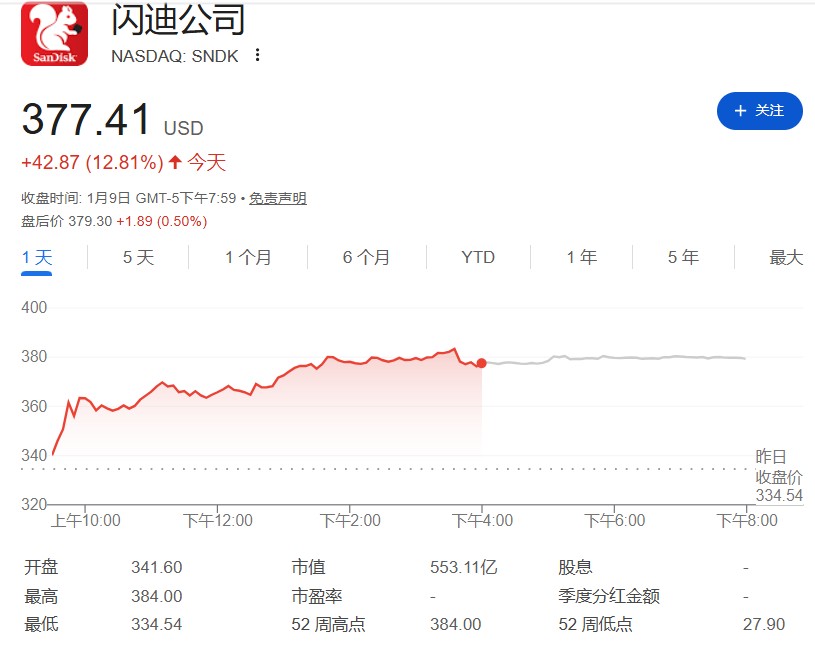
This Friday, SanDisk's stock price surged again by 13%, setting a new historical high.

Cash is King: Unprecedented Full Cash Prepayment System

According to reports, since 2025, NAND giant SanDisk has frequently launched price hikes, and the recent "lock-in" requirement has broken industry conventions. Insiders in the supply chain stated that the "100% cash prepayment" clause proposed by SanDisk aims to exchange for 1 to 3 years of supply assurance.

This unconventional contract form has caused significant upheaval in the industry. Typically, supply chain collaborations adopt installment payments or credit terms, and full cash prepayment poses a huge challenge to buyers' cash flow.

However, reports indicate that due to the continuous growth in AI demand and the time required for storage manufacturers to expand production, some cloud service providers urgently needing to expand computing power have no choice but to consider accepting this clause. Additionally, SanDisk has also expanded the scope of such contract negotiations to PC, smartphone, and module manufacturers.

Prices Doubling: Enterprise Storage Leading the Surge

While requiring full payment, product quotes are also skyrocketing. Nomura Securities' channel survey shows that several storage suppliers continue to raise prices, with enterprise-grade NAND facing the most aggressive increases. Nomura Securities explicitly stated in the report: “The NAND quotes for SanDisk's enterprise-grade SSDs may increase by more than 100% month-on-month during March.”

Nomura Securities analyzes that NVIDIA's inference context memory storage (ICMS) platform is one of the key factors driving enterprise storage demand this year. This platform is based on the BlueField-4 DPU and is equipped with a 512 GB SSD. It is estimated that if NVIDIA ships 50,000 VR NVL144 racks annually, this alone would require approximately 0.439 EB of 3D NAND Although it is currently unclear to what extent the doubling of enterprise-level product prices will affect the consumer market, Nomura Securities warns that, since the 3D NAND used in smartphones and PCs is produced in the same fabs as enterprise-level chips, consumer product prices typically follow the rise in enterprise-level product prices.

Capacity Squeeze: Supply Crisis Under AI Priority

The fundamental reason for the current situation lies in the fundamental shift in the capacity allocation strategies of the three major global memory manufacturers (Samsung, SK Hynix, Micron). According to relevant analysis, these manufacturers have tilted most of their capacity towards HBM (High Bandwidth Memory), which is more profitable and primarily used in the AI market, resulting in a significant reduction in the capacity originally used for producing standard DDR4/DDR5 and NAND.

This structural shortage has triggered chaos and panic in the supply chain:

  • Tech Giants Hoarding Supplies: Reports indicate that Google's TPU is heavily reliant on HBM, and when seeking additional capacity from SK Hynix and Micron, they received responses of "impossible." As a result, Google even fired a procurement manager responsible for storage supply and is hiring a dedicated global storage commodity manager. Meta also plans to hire a dedicated "Global Procurement Manager for Storage" to strengthen direct ties with upstream fabs.

  • Panic Stockpiling: To avoid price increases and shortages, PC brands like Lenovo have begun actively stockpiling inventory, even placing advance orders for their entire 2026 demand.

  • Disorderly Conduct: There are reports that Samsung's headquarters discreetly sent personnel to Taiwan to investigate suspected bribery issues involving employees and agents, indicating that in the face of extreme shortages, irregular profit-seeking behaviors have emerged in the market.

Currently, buyers with greater capital strength have begun to abandon traditional long-term contract models in favor of accepting short contracts and high prices, with even instances of "not asking for prices, just buying if there is stock."