Bank of America Hartnett discusses "Q1 Strategy": Trump to "suppress inflation and lower interest rates" for the midterm elections, investors to "go long on economic prosperity and short on the AI bubble"

Bank of America believes that the Trump administration is making every effort to lower inflation and reduce funding costs in order to win the midterm elections, which forces investors to adopt a strategy of "long on economic prosperity (Long Boom) and short on asset bubbles (Short Bubble)." The correct strategy for the first quarter is "rotation rather than retreat." Investors should reduce their exposure to the overheated AI concepts in 2025 (especially AI derivatives and bonds related to high capital expenditures) and instead increase their holdings in value cyclical stocks
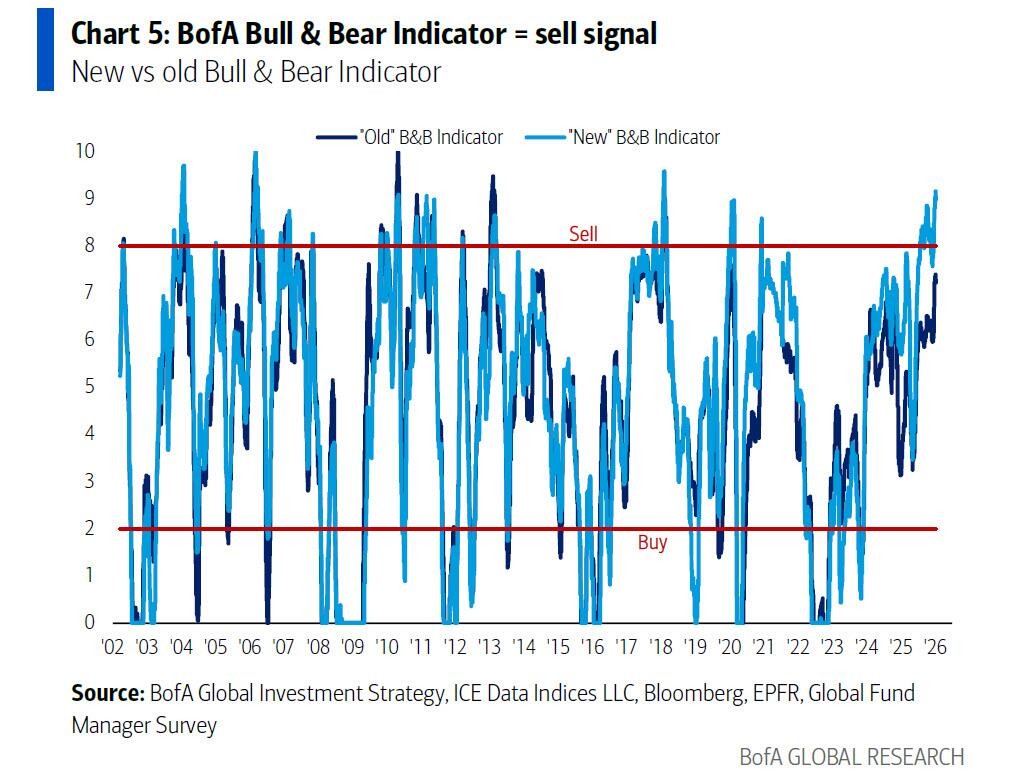
Bank of America strategist Michael Hartnett stated in the first Flow Show report of the new year that although Bank of America's "Bull-Bear Indicator" has reached a "sell signal" high of 9.0, and the market typically should take profits at this moment, this time is different. The Trump administration is making every effort to lower inflation and reduce funding costs to win the midterm elections, forcing investors to adopt a strategy of "long on economic prosperity (Long Boom) and short on asset bubbles (Short Bubble)."
Hartnett believes that the correct strategy for the first quarter of 2026 is "rotation rather than retreat." Despite capital outflows from technology stocks, the breadth of the global stock market is very strong (98% of country indices are above the 200-day moving average), and the cash position in Bank of America's Global Fund Manager Survey (FMS) is at a record low of 3.3%. Against this backdrop, investors should reduce exposure to the overheated AI concepts in 2025 (especially AI derivatives and bonds related to high capital expenditures) and instead increase holdings in value cyclical stocks. In short, this is a "prosperity without a bond crash," and the performance of market breadth will outperform concentration.
For the core allocation in 2026, Hartnett proposed the framework of "Long BIG, Trading MID": that is, to be long on bonds, international stocks, and gold for the long term; and to trade by going long on mid-cap stocks while shorting investment-grade bonds (IG) and the US dollar.
Political Necessity: Trump "intervenes" in prices for the midterm elections
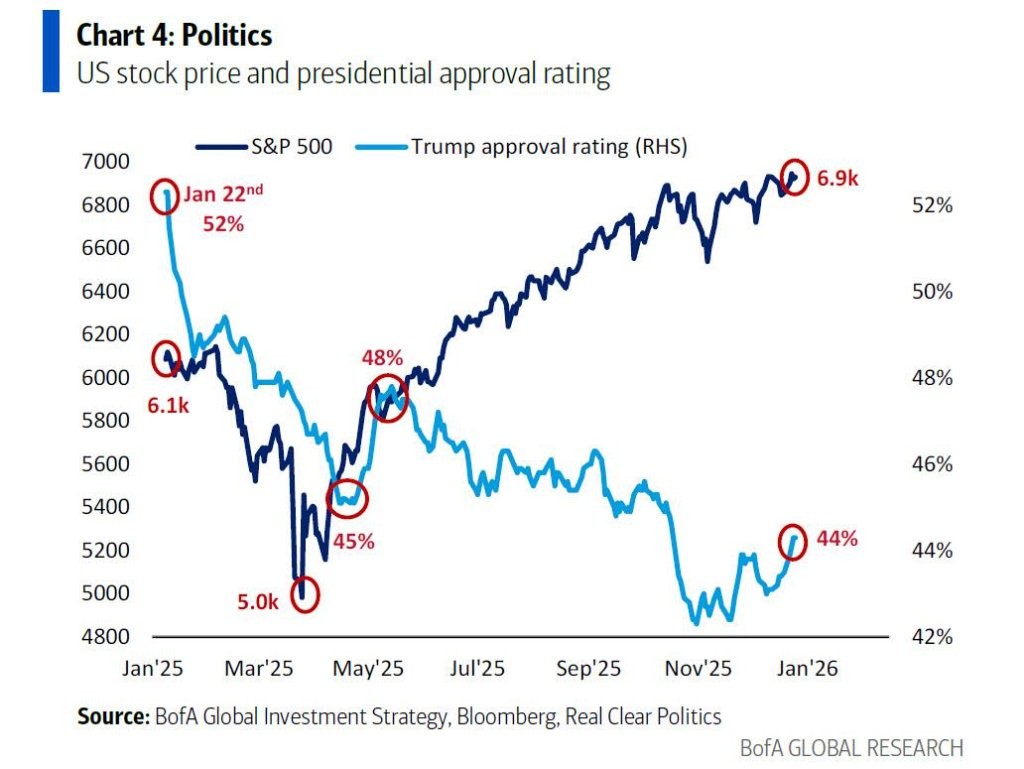
The current macro backdrop is heavily driven by domestic politics in the United States. Hartnett pointed out that Trump's approval rating is at a low of 43%, with an economic approval rating of 41%, and support for handling inflation as low as 36%. To gain an advantage before the midterm elections, the Trump administration must lower inflation.

This explains why current monetary policy aims to lower funding prices (through the Federal Reserve's QE of Treasury bonds and Trump's QE targeting MBS), geopolitical policy aims to lower oil prices, trade policy shifts to reduce tariffs, and industrial policy intervenes in the prices of medicine, housing, insurance, and electricity. It is this policy shift that encourages investors to bet on "economic prosperity" and "risk parity bull markets," and to go long on market breadth.
Abnormal Capital Flows: Record Cash Inflows and "Sell Signals"
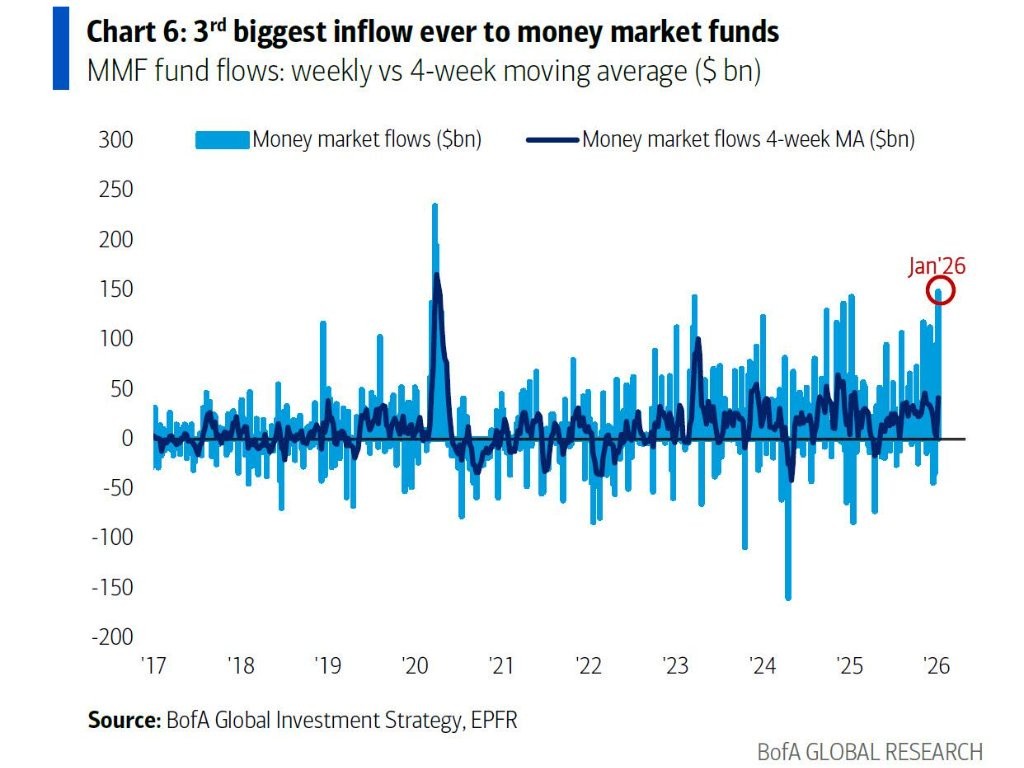
Capital flow data shows extreme market sentiment. In the first week of 2026, money market funds saw an astonishing inflow of $148.5 billion, marking the third-largest single-week inflow in history

At the same time, Bank of America Private Wealth Management clients (with assets under management of $4.3 trillion) show that equities account for 64.2%, bonds account for 17.6%, and cash accounts for 11%.
It is noteworthy that the "Magnificent Seven" stocks account for 17% of their assets under management. However, over the past four weeks, private clients have been buying high-dividend stocks, municipal bonds, and real estate investment trusts (REITs), while selling bank loans, investment-grade bonds, and technology stocks. Additionally, U.S. household equity wealth is expected to surge by approximately $9 trillion in 2025, continuing the trend of $9 trillion growth in 2024 and $8 trillion growth in 2023.
Bank of America's bull-bear indicator reached an "extremely bullish" level of 9.0 on December 31 (triggering a contrarian sell signal), but this was offset by the strong breadth of global stock markets and hedge funds increasing long positions in the S&P 500 through futures.
Q1 Trading Guide: Buy Cyclical Stocks, Short AI Bubble Outskirts
Based on the above context, Hartnett provided clear asset allocation recommendations for the first quarter. The current rotation strategy should be further deepened:
Increase exposure to value cyclical stocks: Focus on banks, real estate, materials, industrials, and small-cap stocks.
Maintain but no longer increase holdings in the "Magnificent Seven": Since the elections on October 29 and November, these defensive large tech stocks have actually declined.
Cut bubble assets: Firmly reduce those belonging to "second derivatives" or "unable to bear capital expenditures" in the 2025 AI trades, such as shorting bonds of AI hyperscaler companies.
Contrarian Investment Logic: Why Bonds and Gold are Key
In Hartnett's recent London roadshow, clients believed that "going long on bonds" is the most contrarian view. In response, Hartnett's rebuttal logic is very clear:
Debt pressure forces QE: U.S. Treasury debt will increase by $1 trillion in the next 100 days. To maintain buying in the bond market and prevent the market from testing the new Federal Reserve Chair (since 1970, yields have risen within three months of seven nominations), the Trump administration must implement quantitative easing (QE).
Dual constraints of employment and inflation: Trump needs to lower the CPI to win votes, while the Federal Reserve needs to cut interest rates to prevent the unemployment rate from rising above 5% (the youth unemployment rate has reached 9%).
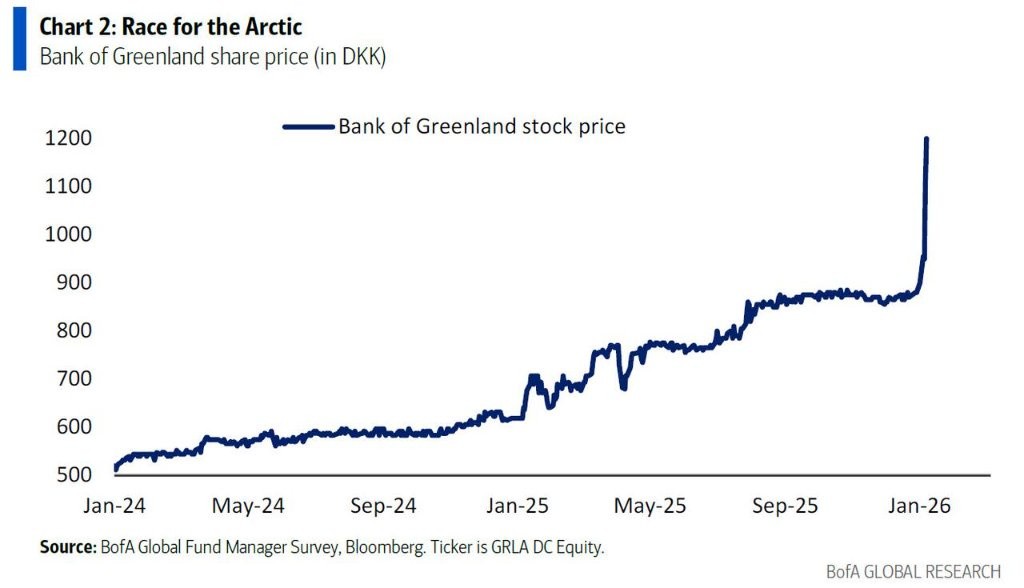
In terms of geopolitics, the market is chasing hedging assets. Greenland Bank's stock price rose 33% in four days, reflecting market speculation about the U.S. potentially "acquiring" Greenland. Hartnett pointed out that investors are preemptively positioning themselves in energy and material reserves (Venezuela holds 17% of the world's proven oil reserves, while the Arctic has 13% of undiscovered oil and 30% of natural gas)

Historical data shows that since 1939, the best-performing assets six months after the outbreak of war are gold (+18.9%), followed by copper (+6.7%) and stocks (+4.9%).
As the US dollar may shift from "exceptionalism" to "expansionism," and with the Federal Reserve and Trump attempting to dilute debt through currency devaluation, this provides the best rationale for going long on gold and shorting the dollar. For international stock markets, Hartnett believes that the consumer sectors in the UK and China have the best upside potential