


Adjustment of export tax rebate policy for photovoltaic and battery products, what is the impact?

The Ministry of Finance and the State Administration of Taxation have adjusted the export tax rebate policy for photovoltaic and battery products, aiming to reduce trade friction and promote industrial upgrading. This is expected to support the export growth rate of related goods in the first quarter of 2026. In the short term, companies can respond to the impact of the tax rebate policy by adjusting battery prices. In the long term, leading battery companies in China are expected to enhance their global competitiveness. The tariff increase in Mexico mainly affects China and South Korea, accounting for about 45% of China's exports to Mexico
Core Insights Overview
Macroeconomics
On January 9, the Ministry of Finance and the State Administration of Taxation announced adjustments to the export tax rebate policy for photovoltaic and battery products. We believe this is aimed at reducing trade friction and upgrading the industry, which may provide some support for the export growth of related goods in the first quarter of 2026. We expect that there may be follow-up adjustments to export tax rebates for chemicals, plastic products, clothing, machinery, and electrical products in the future. In terms of macroeconomic performance, the PPI in December 2025 slightly exceeded market expectations, while the CPI has risen year-on-year for four consecutive months to +0.8%, and the core CPI remains at a high level of +1.2%, basically in line with market expectations. This week, the market is focused on China's price data for December, and next week we recommend paying attention to China's financial data and import and export data for December.
Batteries
On January 9, the Ministry of Finance and the State Administration of Taxation announced adjustments to the export tax rebate policy for battery products. We believe this policy is a concrete measure by the state to firmly promote "anti-involution" and prevent "involution externalization," with strong continuity. In terms of impact, the short-term policy sets a gradient decline in the tax rebate rate and arrangements for a transition period, allowing companies to hedge the impact through battery price adjustments, while overseas demand is expected to see a rush for exports; in the medium to long term, Chinese leading battery companies with battery production capacity overseas are expected to further enhance their global competitiveness, gain more overseas market share, and achieve higher profit levels. We continue to recommend leading Chinese battery companies.
How to View Mexico's Tariffs and China's Export Tax Rebate Adjustments?
▍ We judge that the countries mainly affected by Mexico's tariff increase are Asian economies represented by China and South Korea. We estimate that the goods covered by Mexico's tariff increase account for about 45% of China's exports to Mexico, affecting approximately 1% of China's overall exports. Mexico announced that starting January 1, 2026, it will impose tariffs on countries that have not signed free trade agreements with Mexico. In 2024, Mexico's top three sources of imports were the United States, China, and South Korea, with import shares of 40.3%, 20.7%, and 3.7%, respectively. Since many Asian economies, including China and South Korea, have not signed free trade agreements with Mexico, although Mexico's tariff increase is not explicitly targeting a single country, the main affected economies are indeed represented by China and South Korea. According to HS four-digit coding estimates, the goods subject to Mexico's tariff increase account for about 45% of China's exports to Mexico in the first 11 months of 2025. Considering Mexico's share in China's exports, we estimate that the goods affected by Mexico's tariff increase account for about 1% of China's overall exports in the first 11 months of 2025.
▍ Mexico's tariff adjustment can be seen as a "loyalty oath" to the United States, indicating the need to pay attention to the possibility of other developed economies, especially Canada, following the U.S. in adjusting tariffs on China. The White House released the U.S. National Security Strategy report in December 2025, clearly encouraging major countries such as the EU, Japan, South Korea, Australia, Canada, and Mexico to adjust their trade policies, which can be seen as a clear call from Trump to his allies to adjust their trade policies towards China We judge that Mexico's recent tariff adjustment is mainly a gesture of goodwill towards the United States, aiming to align with the U.S. stance on tariffs against China in exchange for a more friendly and tolerant attitude from the U.S. towards Mexico in future negotiations on issues such as the United States-Mexico-Canada Agreement (USMCA). Considering that Canada, like Mexico, is facing issues related to USMCA negotiations, we believe that the likelihood of Canada adjusting its trade policies under U.S. influence is higher than that of other economies. According to our estimates, from January to November 2025, Canada's export share to China is approximately 1.3%. In the first 11 months of 2025, China's exports to Canada are primarily in the electrical equipment, machinery, non-ferrous metal products, textiles and clothing, plastics and rubber, furniture, and automotive industry chains. If Canada also adopts similar trade policy adjustments as Mexico, we believe that the relevant industries may be relatively significantly affected.
▍ Considering the exposure of exports to Mexico and the increased tariff rates, we expect that China's automotive industry chain, non-ferrous metal products, and machinery equipment exports may be relatively more affected. The products involved in Mexico's increased tariffs cover a wide range of categories, including chemical products, plastics and rubber, leather bags, textiles and clothing, ceramics and glass, steel, non-ferrous metal products, machinery equipment, electrical equipment, automotive industry chains, furniture, toys, and more. According to our estimates, from January to November 2025, the automotive industry chain, textiles and clothing, and machinery equipment are the top three categories in terms of export value to Mexico affected by the increased tariffs, accounting for 33.5%, 12.3%, and 10.3% of the total export value of all tariffed goods, respectively. In terms of tariff rates, the automotive industry chain and steel products may face relatively high rates for exports to Mexico, ranging from 25%-50% and 20%-50%, respectively, followed by footwear, ceramics and glass, textiles and clothing, machinery equipment and parts, electrical equipment and parts, furniture, plastics and rubber, and non-ferrous metal products. Since the export exposure of the automotive industry chain, non-ferrous metal products, and machinery equipment to Mexico is 5.8%, 3.6%, and 2.7% respectively from January to November 2025, which is at a relatively high level among the tariffed categories, combined with the fact that the tariff rates imposed by Mexico are also not low, we judge that the relevant categories may be relatively significantly impacted by this tariff adjustment in Mexico.
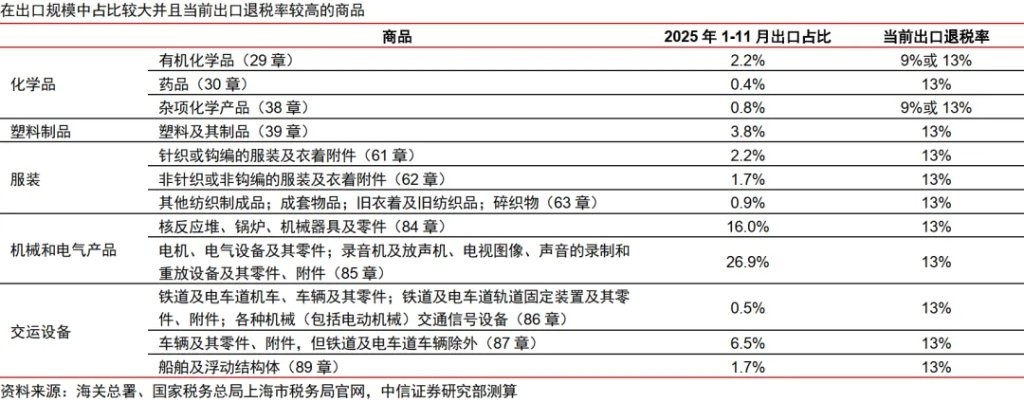
▍ The adjustment of export tax rebates for products such as photovoltaics is aimed at reducing trade friction and meeting the needs of industrial upgrading, which may provide certain support for the export growth of related goods in the first quarter of 2026. It is expected that there may be follow-up adjustments to export tax rebates for chemicals, plastic products, clothing, machinery, and electrical products in the future. On January 9, the Ministry of Finance and the State Administration of Taxation announced adjustments to the export tax rebate policies for photovoltaics and battery products. According to our estimates, the photovoltaic products involved in this export tax rebate adjustment account for approximately 0.8% of exports from January to November 2025, while the battery products account for approximately 2.2%. This adjustment of export tax rebates can reduce the risk of trade friction from overseas to a certain extent. In the long run, this adjustment is also beneficial for compressing the profit margins of some backward production capacities, accelerating the clearance of excess capacities in the domestic photovoltaic and battery-related industries, and stimulating domestic enterprises to develop towards exporting high value-added products We believe that the "export rush" window period brought about by this adjustment in export tax rebates may benefit the export of related goods in the first quarter of 2026, but it may also exert a downward pressure on the export growth rate of related goods after the "export rush" window period. We judge that the trend of declining export tax rebate policies will continue. Our analysis reveals that goods with a significant share in exports and relatively high export tax rebate rates currently include chemicals, plastic products, clothing, machinery and electrical products, as well as transportation equipment. Related categories may see follow-up adjustments to export tax rebates in the future.
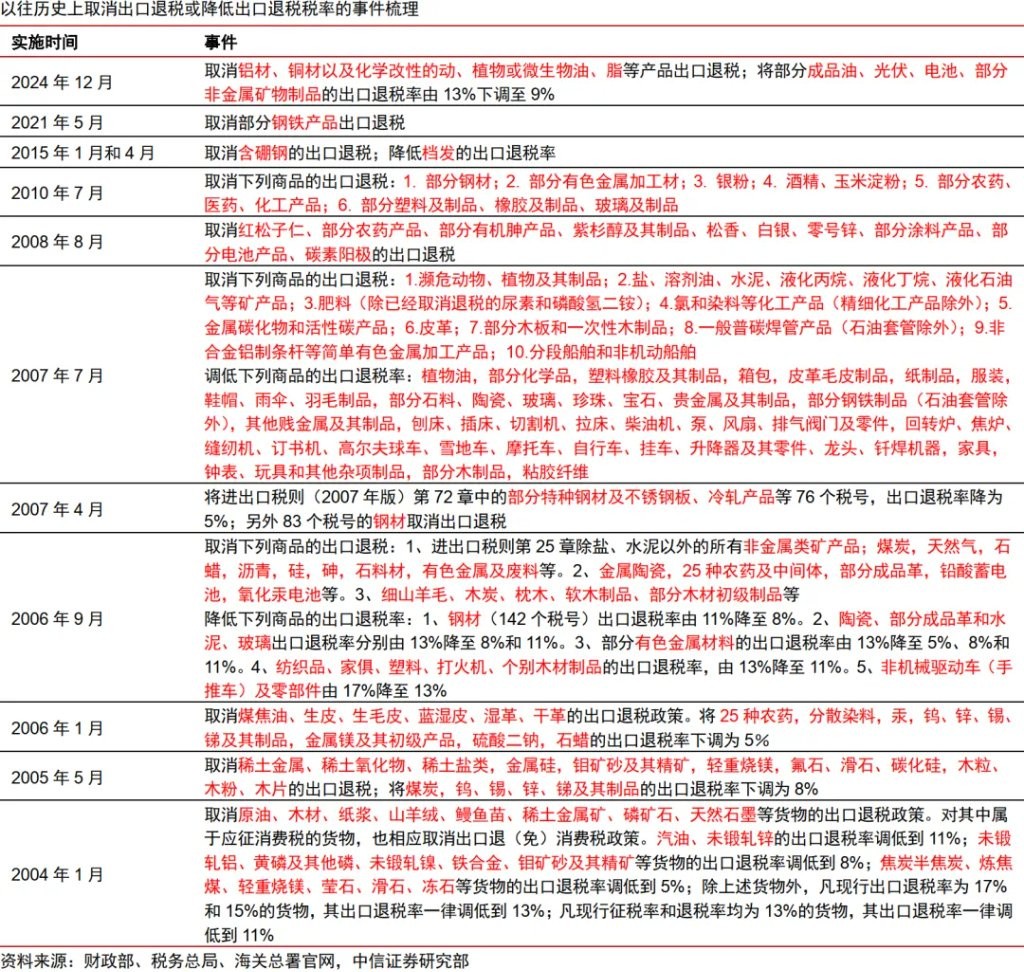
▍ Macroeconomic Operation Tracking: China is expected to welcome "moderate re-inflation" in 2026. The PPI performance in December 2025 slightly exceeded market expectations, with a month-on-month increase of +0.2%, the highest value since 2024, driven primarily by the surge in prices of non-ferrous metals such as copper, aluminum, and silver. The mid and downstream industries generally exhibit characteristics of "continued month-on-month decline, with a narrowing year-on-year decline." However, it should be noted that in a weak demand environment, the phenomenon of poor price transmission from upstream to mid and downstream industries still exists, and the current surge in prices of some upstream raw material industries may exert certain pressure on the profit margins of some mid and downstream industries. The year-on-year CPI has risen for four consecutive months to +0.8%, with the core CPI maintaining a high level of +1.2%, basically in line with market expectations, where the expansion of food price increases constitutes the core driving force behind the recent rise in year-on-year CPI readings. This week, the market is focused on China's price data for December, and next week it is recommended to pay attention to China's financial data and import and export data for December.
Adjustment of Battery Export Tax Rebate Policy, Overall Impact Expected to be Controllable
▍Matter: On January 9, the Ministry of Finance and the State Administration of Taxation issued a notice to adjust the export tax rebate policy for battery products. Our comments are as follows:
▍ Gradual reduction of export tax rebate rates, with a transition period set. According to the announcement, starting from April 1, 2026, until December 31, 2026, the export tax rebate rate for value-added tax on battery products will be reduced from 9% to 6%; starting from January 1, 2027, the export tax rebate for value-added tax on battery products will be canceled. From the list of battery products involved, this tax rate adjustment includes lithium primary batteries, lithium-ion batteries, nickel-hydrogen batteries, etc. This tax rate adjustment will start in April this year, with a certain transition period reserved by the policy.
▍ Preventing "involution and externalization" of China's advantageous industries. This adjustment of the export tax rebate rate follows the reduction of the battery export tax rebate rate from 13% to 9% at the end of 2024. We believe that for China's advantageous industries, lowering the export tax rebate rate helps prevent "involution and externalization," enhancing the profitability of export products The adjustment of the export tax rebate policy aligns with the guiding spirit of the symposium on the power and energy storage battery industry jointly held by the Ministry of Industry and Information Technology, the National Development and Reform Commission, and other departments on January 7. According to information released by the China Automotive Power Battery Industry Alliance, the core of this symposium is to study and deploy further regulations to standardize the competitive order of the power and energy storage battery industry.
▍ It is expected that the export tax rebate amount will be approximately $2.2 billion / $6.6 billion for 2026/2027. We have estimated the impact of this export tax rebate policy adjustment on the industry. According to data from the China Chemical and Physical Power Industry Association, from January to November 2025, China's lithium-ion battery export amount was approximately $69.2 billion, a year-on-year increase of 25.6%. We expect the total export amount for 2025 to be around $76 billion. Assuming the export growth rate for the industry remains at 20% per year for 2026/2027, the corresponding export amounts for 2026/2027 will be approximately $91.2 billion / $109.4 billion. Considering the export tax rebate rate will decrease by 3% after April 2026, the expected impact on the annual rebate amount will be about $2.2 billion; considering the cancellation of the export tax rebate in 2027, the expected impact on the annual rebate amount will be about $6.6 billion.
▍ The short-term impact is expected to be controllable, while the medium to long-term is favorable for companies with overseas production capacity. From the enterprise level, we believe the short-term impact of this export tax rebate is controllable: first, the policy provides a transition period, allowing companies ample time to negotiate with overseas customers before April this year. As batteries are a competitive industry in China, price mechanisms can be used for transmission; second, considering the tiered reduction of export tax rebates, the battery sector is expected to see a rush for exports throughout the year, further boosting overseas demand. In the medium to long term, we believe the policy is favorable for companies with overseas production capacity. In recent years, leading battery companies in China have been establishing overseas production capacity in Southeast Asia and Europe, and 2026-2027 will be a period of intensive production release, which will help further enhance market share and profitability overseas.
Risk Warning and Disclaimer
The market has risks, and investment should be cautious. This article does not constitute personal investment advice and does not take into account the specific investment goals, financial situation, or needs of individual users. Users should consider whether any opinions, views, or conclusions in this article are suitable for their specific circumstances. Investment based on this is at one's own risk
