Brain-Machine Sea River Laboratory: Completed the first "Space Brain-Machine Interface Experiment" for humanity

Wallstreetcn
2026.01.12 07:50
portai
I'm PortAI, I can summarize articles.

The Brain-Machine Sea River Laboratory has successfully completed the world's first "space brain-machine interface experiment," marking the important application of brain-machine interface technology in new industrialization. This technology enables direct communication between the human brain and external devices by collecting neural electrical signals from the brain, promoting the development of intelligence, digitization, and networking. Brain-machine interfaces show great market potential in fields such as healthcare, consumer electronics, and military applications, and will become a core element of new productive forces in the future

Connecting the Technology Chain, Completing the Talent Chain, and Promoting the Transformation and Application of Brain-Computer Interface Technology Achievements

New quality productivity is driven by innovation, breaking away from traditional economic growth methods and productivity development paths, characterized by high technology, high efficiency, and high quality. It aligns with the advanced productive forces of the new development concept and emphasizes that technological innovation can give rise to new industries, new models, and new driving forces, which are core elements in developing new quality productivity. We must continue to focus on innovation to accelerate the development of new quality productivity. As a disruptive technology shaping future industries, brain-computer interfaces are key to integrating biological intelligence with machine intelligence and represent new quality productivity that fully covers the "four orientations."

Promoting New Industrialization, Brain-Computer Interfaces Will Play an Important Role

As a new type of human-computer interaction technology, brain-computer interfaces collect neural electrical signals generated by the brain during cognitive activities, extract and analyze signal features, recognize brain intentions, and output commands, enabling communication and control between the brain and external devices.

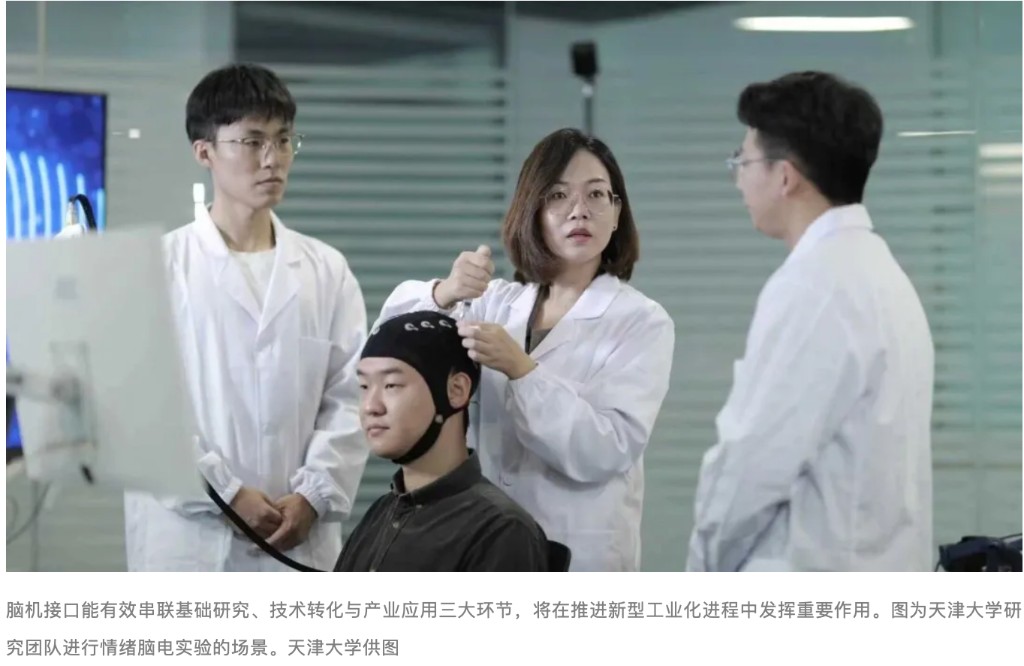
In advancing the new industrialization process, intelligence, digitization, and networking are core characteristics. Brain-computer interfaces break through the physiological limitations of traditional human-computer interaction by establishing direct information pathways between the human brain and machines, upgrading industrial production from "mechanical execution" to "intelligent collaboration." Application scenarios can extend from laboratories to strategic industries such as high-end manufacturing, energy exploration, and aerospace, and are expected to become a foundational technological support for promoting new industrialization. At the same time, brain-computer interface technology integrates cutting-edge disciplines such as medicine, computer science, and materials science, providing breakthroughs for the deep coupling of technology chains and industry chains. Innovations in the underlying technology of brain-computer interfaces need to overcome "bottleneck" issues such as biocompatible electrode materials and high-density signal acquisition chips, and industrialization requires constructing a complete technology chain from brain signal decoding algorithms to intelligent equipment manufacturing. Brain-computer interfaces can effectively connect the three major links of basic research, technology transfer, and industrial application, playing an important role in advancing the new industrialization process.

Brain-computer interfaces show enormous application prospects and market potential in various fields such as medical health, consumer electronics, and military aerospace. In recent years, Western countries such as the United States and Europe have invested heavily in the development of brain-computer interface technology. Since the 1970s, the U.S. Department of Defense's Advanced Research Projects Agency has strongly supported the development of brain-computer interface technology, launching several projects such as "Silent Dialogue," "Avatar," "Neural Engineering System Design," "N3," and "Electronic Prescription." Numerous American technology companies, including Neuralink, Kernel, and Facebook, have successively invested in the development of various related technologies and products. In 2008 and 2013, the European Union launched research programs named "Brain-Computer Interaction Tools" and "The Future of Brain-Computer Interaction: Horizon 2020," respectively.

Once brain-computer interfaces achieve industrialization and large-scale application, they will undoubtedly bring disruptive changes to human production and lifestyle, and their development will become an important variable affecting future global economic cycles and a significant factor influencing the future global economic landscape. Therefore, breaking the technological blockade of brain-computer interfaces and developing independently controllable key technologies and core components of brain-computer interfaces are crucial for the development of new industrialization in our country and national economic security

The Potential of Brain-Computer Interfaces is Huge, but Faces Many Technical Innovations and Industrialization Challenges

From a technical perspective, brain-computer interfaces can be divided into invasive and non-invasive categories based on the electrode placement and method of signal acquisition. In terms of overall development and application, China's brain-computer interface technology is among the world's leading positions. However, due to the broad research field of brain-computer interfaces, which includes different tracks, it is difficult to assess the quality and leading level of technology without considering specific tracks and subfields. Overall, for non-invasive brain-computer interface technology, China basically maintains a level that is synchronized with the most advanced international standards; while for invasive brain-computer interface technology, we currently have gaps in some key components, but these gaps are rapidly narrowing. China's research teams are continuously making efforts and competing to lay out in new research paradigms and innovative research fields.

Invasive brain-computer interfaces place functional devices within the human body through invasive methods. Whether under the scalp, beneath the skull, or within blood vessels, some form of incision is required to monitor various signals from the human brain. Overall, foreign invasive neural electrodes and chips have formed relatively mature commercial products. Domestically, research institutions such as Beijing Tiantan Hospital affiliated with Capital Medical University and the Institute of Semiconductors of the Chinese Academy of Sciences have successively developed flexible and stretchable electrodes for continuous intracranial electroencephalogram monitoring, silicon-based neural electrodes, and flexible neural electrodes, but the number of electrode channels and recording durations are still less than those of foreign products. Fudan University, the Aerospace Information Research Institute of the Chinese Academy of Sciences, and Beijing Institute of Technology are continuously making efforts in the detection of neuroelectrophysiological signals, digitalization, and the development of integrated wireless communication chips, but domestic research results are still some distance from mature integrated chips.

Currently, the application of invasive brain-computer interfaces is mainly concentrated in the medical and health fields. The Swiss Federal Institute of Technology in Lausanne has achieved real-time decoding of patients' movement intentions from three dimensions: time, frequency, and space; a team from the University of California has realized the decoding from cortical electroencephalogram to speech movements, ultimately converting it into audible speech; Neuralink, a U.S. company, is conducting application research on brain-controlled gaming through invasive brain-computer interfaces; the U.S. Department of Defense's Advanced Research Projects Agency has also launched a neural engineering system design project for invasive brain-computer interfaces, focusing on research related to sensory restoration, mainly including functions related to vision, language, and hearing. Domestically, research on invasive brain-computer interface applications is also gradually being carried out, such as Zhejiang University achieving brain-controlled robotic arm applications for paraplegic patients based on invasive brain-computer interfaces; a team from Tsinghua University developed a wireless, minimally invasive brain-computer interface system that can be placed on the brain's sensory motor cortex, helping paralyzed patients with spinal cord injuries to regain hand movements, enabling them to control cursors, wheelchairs, and drink water independently; Fudan University affiliated Huashan Hospital and its collaborative team have successively conducted clinical trials for high-precision real-time motion decoding and language decoding, achieving "brain-controlled" smart devices and "thought dialogue." In a vivid analogy, invasive brain-computer interfaces (BCIs) can be described as a "troops at the city gates, breaking through the walls" method of monitoring. The advantage lies in the excellent quality of the signals obtained, while the disadvantages include certain challenges regarding biocompatibility and safety. More critically, the brain has approximately 86 billion neurons connected through over 100 trillion synapses, creating a constantly active neural network that urgently requires whole-brain monitoring. However, in reality, achieving whole-brain monitoring with invasive BCI technology is extremely challenging.

In contrast, non-invasive brain-computer interfaces use a "listening through the wall" detection method, employing sensors attached to the scalp to detect the weak signals emitted by the brain. Their advantages include being non-invasive and having higher compatibility, allowing for safer monitoring of whole-brain information, making them suitable for a broader population. The drawbacks are also evident; non-invasive BCIs monitor the extremely weak signals emitted by the brain through various means such as sound, light, and electricity, which requires a very high level of engineering perception and processing capability. It necessitates better technological means, more advanced perception technologies, and superior decoding techniques to meticulously extract the weak signals. Countries like the United States and Europe were the first to apply non-invasive BCI technology in the military field, and relevant application results are currently spilling over into civilian sectors, with national funding directed towards applications in healthcare, consumer markets, and more. For example, with support from the National Science Foundation, the University of Minnesota developed a hybrid motor imagery BCI system that effectively helps patients with spinal cord injuries regain motor functions; Neurable, funded by the National Institutes of Health, developed a wearable BCI device called Enten.

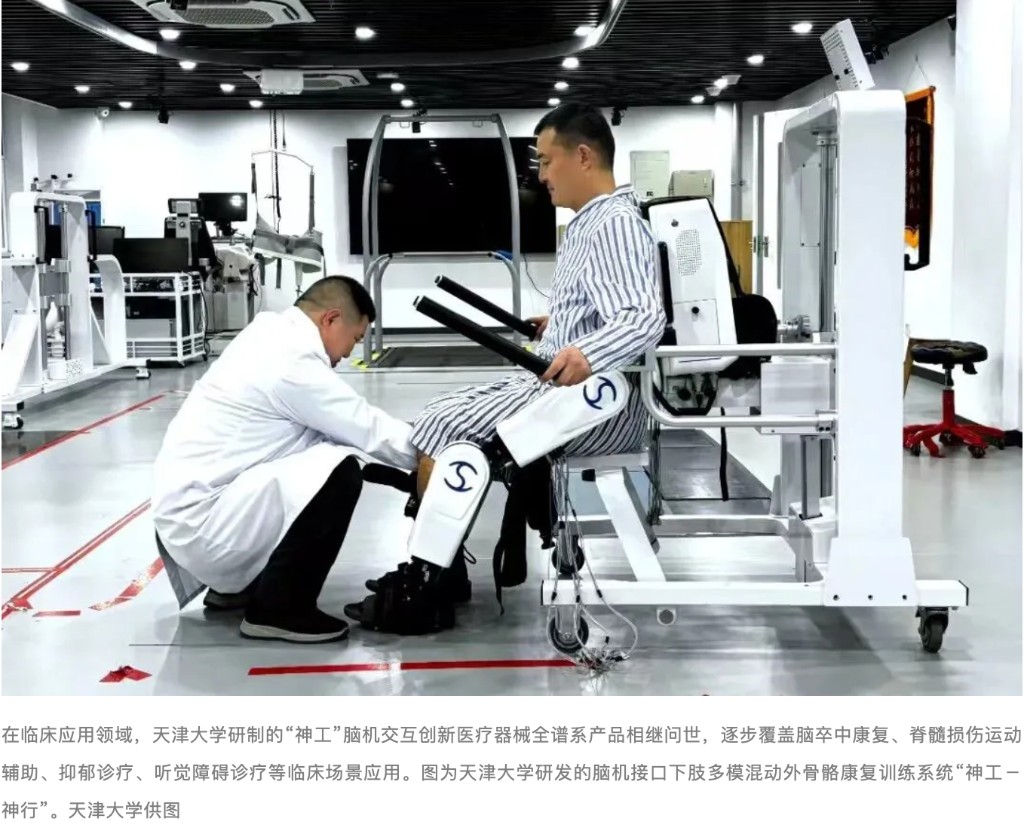
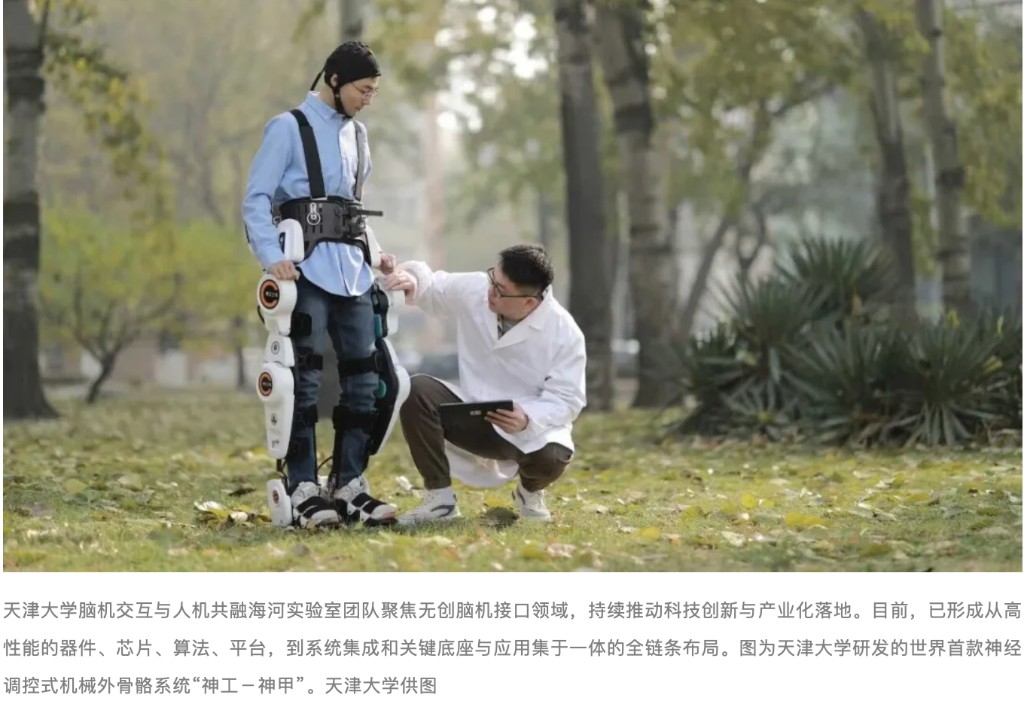
In recent years, domestic development in key technologies and system applications for non-invasive brain-computer interfaces has shown a positive trend, achieving excellent results that are on par with or even leading in some areas. For instance, in the clinical field, Tianjin University independently developed the world's first artificial neural rehabilitation robot system, the "Shengong" series, while a team from Tsinghua University created a non-invasive BCI typing system for ALS patient Wang Jia; in specialized fields, Tianjin University not only developed a 4-degree-of-freedom, 12-command brain-controlled drone system but also created the world's first on-orbit BCI system for space stations, applied in the 2016 "Tiangong II" and "Shenzhou XI" manned spaceflight missions. However, domestic special funding for major technological breakthroughs and results transformation remains relatively insufficient, with short funding durations and limited amounts, making it difficult to meet the demands for results transformation. This has led to most domestic system applications being experimental explorations by research institutions and universities or still in clinical testing phases. Overall, China's non-invasive brain-computer interfaces are in a period of technological explosion, possessing enormous potential for application transformation, urgently needing the push of market demand development and the traction of industrial capability enhancement.

Despite certain progress in BCI technology and applications, China still faces numerous challenges in industrialization and technological innovation in the field of brain-computer interfaces First, China's brain-computer interface companies lack a sound technology chain and a complete talent chain, resulting in weak industrialization capabilities. Brain-computer interfaces integrate the most advanced theories and cutting-edge technologies from multiple disciplines, including medicine, computer science, electronics, mechanics, and materials. It is a heavily invested technology with a relatively long technology chain, where any technical shortcoming in any link can hinder its industrialization process. However, at the same time, brain-computer interfaces are an emerging technological field, and there is a significant shortage of relevant professional talent in the domestic market. This makes it difficult for small-scale enterprises to establish a complete talent chain and technology chain to develop high-quality, system-level brain-computer interface products.

Second, there is insufficient focus on original innovation and significant applications in brain-computer interface research. Due to limitations such as insufficient resources and talent, the domestic innovation capability in brain-computer interface technology is relatively poor. Most work involves low-end repetition and minor improvements of existing technologies, referred to as "follow-up innovation," or multiple reuses of the same technology in different scenarios, known as "scene-switching innovation," while there is a lack of in-depth thinking and exploration of disruptive leading technologies. Additionally, since most enterprises are still in their startup phase and are relatively small, there are issues such as overly narrow application scenarios and unremarkable application benefits. Meanwhile, the domestic brain-computer interface market mainly consists of low-end processing software and collection hardware, with the most basic components relying on imports, a lack of open-source platforms, and a market size accounting for less than 10% of the global share.

Third, current media reporting lacks standards, and excessive exaggeration may trigger a technology bubble in brain-computer interfaces. Due to a lack of correct understanding of the professionalism of brain-computer interfaces, domestic reports often feature exaggerated promotions or apply unrelated results under the brain-computer interface concept to attract public attention. The excessive hype by the media may lead to misguidance in the development of brain-computer interface technology and create a technology bubble, over-consuming social cognition and public confidence, which could affect the long-term sustainable development of the brain-computer interface industry.

Multiple Measures to Effectively Promote the Application and Industrial Innovation of Brain-Computer Interface Technology

The development process in the field of brain-computer interfaces should transition from invasive to non-invasive, and then to non-perceptive. The current progress in the brain-computer interface field may only represent a transitional state, and the ultimate form of brain-computer interfaces has yet to emerge. Currently, the key to the development of brain-computer interfaces lies in whether there is good technology and whether suitable scenarios for technology implementation can be found. It is foreseeable that in the future, people will engage in natural human-computer interaction with almost no sensation, referred to as "future natural brain interaction." At that time, brain-computer interfaces will be accepted by a broader population, truly benefiting the public.

To promote the development of the brain-computer interface field and better realize its benefits for the public, the following measures are recommended.

First, quickly streamline the technology chain and complete the talent chain to create a reliable foundation for the high-quality development of the brain-computer interface industry chain. In response to the current issues of incomplete technology chains, talent shortages, and weak industrial capabilities in China's brain-computer interface sector, it is necessary to guide high-level universities to actively build talent training bases for brain-computer interfaces through interdisciplinary settings, cultivating high-quality composite talents By encouraging state-owned enterprises to take responsibility and collaborating with universities to build high-level scientific research and innovation platforms, we promote the formation of an integrated model of industry-university-research, undertake key tasks in the field of brain-computer interfaces, solve the difficulties of industrialization, and gradually establish a sound and healthy brain-computer interface industry chain.

In terms of completing the talent chain, Tianjin University and its partners continue to make efforts in talent cultivation and scientific research, launching the country's first brain-computer interface specialization in 2024 and officially enrolling students. It is hoped that this will serve as an opportunity to drive the rapid completion of the talent chain in the brain-computer interface and related industries, build a reliable foundation for the high-quality development of the brain-computer interface industry chain, and enhance the industrialization capability of brain-computer interfaces. In terms of connecting the technology chain, Tianjin University actively integrates into the national development strategy, cultivates a full industry chain cluster of industry-university-research-use, leads the promotion of national key laboratories for advanced medical materials and medical devices, and the Haihe Laboratory for brain-computer interaction and human-machine integration in Tianjin, and collaborates with Tianjin Huangu Hospital to establish the country's first comprehensive clinical trial area for brain-computer interfaces, actively serving the economic and social development of Tianjin.

Secondly, strengthen innovation and leadership in non-invasive brain-computer interface technology, focusing on major engineering applications and transformation issues. Compared to the ethical and safety risks of invasive technologies, non-invasive brain-computer interfaces are safe, convenient, and cost-effective, with broad application prospects. China has a good technical accumulation in non-invasive brain-computer interfaces and is at an important opportunity period to lead a new generation of technology and accelerate the industrialization process. At this stage, we should avoid simple follow-up and low-end repetitive research that merely changes scenarios, tackle the pain points and difficulties in technological development, and carry out original and disruptive explorations of cutting-edge technologies. Around the demand for major engineering application transformations, strengthen engineering technology research on non-invasive brain-computer interfaces, promote the improvement of industrialization and systematic development pathways, and accelerate China's leapfrog development in the field of brain-computer interfaces.

The team at Tianjin University's Haihe Laboratory for brain-computer interaction and human-machine integration focuses on the field of non-invasive brain-computer interfaces, continuously promoting technological innovation and industrialization. Currently, a full-chain layout has been formed, ranging from high-performance devices, chips, algorithms, and platforms to system integration and key foundations and applications. In the field of clinical applications, the "Shengong" brain-computer interaction innovative medical device product line developed by Tianjin University has been successively launched, gradually covering clinical application scenarios such as stroke rehabilitation, spinal cord injury motion assistance, depression treatment, and auditory disorder treatment. In the aerospace field, the design and development of the fifth-generation space station's on-orbit brain-computer interaction system have completed the first human "space brain-computer interface experiment," achieving important applications in subsequent manned flight missions, serving precise detection of astronauts' functional and emotional states, enhancing astronaut efficiency, and providing key technical support for the new generation of medical and human factors assurance systems in China's manned space program. In terms of market-oriented consumer-grade integrated product research and application, the first comprehensive open-source software platform in the field of brain-computer interfaces, Meta Brain-Computer Interface, has been released, which has been used by over 100 institutions domestically and internationally, including the University of California and Peking University, with downloads exceeding ten thousand; in collaboration with Huawei, a new type of entertainment game based on brain-computer interaction has been developed, building an intelligent ecological industrial platform spanning medical, education, entertainment, national defense, and transportation fields Third, standardize media reporting to strictly prevent the "four transformations" of brain-computer interfaces and avoid the risks of a technology bubble. Relevant policies are needed to guide and regulate publicity and reporting related to brain-computer interfaces, emphasizing the transmission of objective, in-depth, and comprehensive information, and avoiding one-sided hype, exaggeration, conceptualization, and trivialization of the role of brain-computer interfaces by the media. At the same time, establish an authoritative window for the public to popularize science and technology, promptly correct any misleading statements that may exist, and guide the public to scientifically treat the research results of brain-computer interfaces, thereby effectively avoiding the risks of a technology bubble in brain-computer interfaces.

Tianjin University will deeply grasp the basic laws of promoting new industrialization in the new era and new journey, actively adapt to and lead a new round of technological revolution and industrial transformation, and integrate the requirements of high-quality development throughout the entire process of new industrialization. It will continue to increase innovation efforts, break through the application of brain-computer interface technology, cultivate and expand emerging industries, and contribute the strength of higher education institutions to promote new industrialization.

Risk Warning and Disclaimer

The market has risks, and investment requires caution. This article does not constitute personal investment advice and does not take into account the specific investment goals, financial situation, or needs of individual users. Users should consider whether any opinions, views, or conclusions in this article are suitable for their specific circumstances. Investment based on this is at one's own risk.