


The U.S. Supreme Court temporarily suspends tariff ruling, with the market focusing on seven key issues

The U.S. Supreme Court has postponed its ruling on Trump's global parity tariff case, and the market is waiting for the next "opinion day." A report from Bank of America indicates that even if the tariffs are rejected, U.S. stocks may be boosted, but the government may still resort to "alternative tools" such as Section 122 to fill the revenue gap. The current effective tariff rate is only 11.2%, lower than expected. Regardless of the outcome, investors should be wary of the risks of significant fluctuations in industry tariff structures
According to CCTV News, on January 9 local time, the U.S. Supreme Court stated that it would not make a ruling that day regarding the global reciprocal tariffs imposed by the Trump administration under the International Emergency Economic Powers Act (IEEPA). This means the market may have to continue waiting for the next "opinion day."
According to news from the Wind Trading Desk, a research report released by the Bank of America Aditya Bhave team on the 9th indicated that although the gambling market believes there is a high probability that the tariffs will be overturned, regardless of the outcome, the government may fill the revenue gap through other statutory authorizations, and the supportive tone of trade policy for economic growth this year has not changed.
If the IEEPA tariffs are rejected by the court, Bank of America expects bond yields to rise due to concerns over the fiscal deficit, while the stock market may rise due to alleviated pressure on retailer profit margins and a loosening fiscal stance. In this scenario, the administration is very likely to quickly activate alternative legal provisions such as Section 122, Section 232, and Section 301 in an attempt to recoup some tariff revenue, which could lead to significant fluctuations in the tariff structure for specific industries.
Conversely, if the tariffs unexpectedly receive support, the market reaction will be the opposite, with bond yields and the stock market declining. It is worth noting that current tariff revenues are already below expectations due to import substitution and exemption measures, with the actual collection rate at only 11.2%, significantly lower than the theoretically calculated 14.5%, which somewhat buffers the direct impact of the ruling on the real economy.
During this critical window period for the ruling, investors urgently need to clarify the core logic from the probability of the ruling, subsequent policy evolution, to asset price fluctuations. Here are the seven key questions the market is most concerned about:
Key Question 1: What will happen, and when will the ruling be made?
The Supreme Court will issue its opinion at 10 a.m. Eastern Time on January 9. [According to CCTV News](https://content-static.cctvnews.cctv.com/snow-book/index.html?item_id=16065691992560464564&channelId=1119&toc_style_id=feeds_default&module=ccnews%3A%2F%2Fappclient%2Fpage%2Ffeeds%2Fdetail%3Furl%3Dhttps%253A%252F%252Fcontent-static.c On January 9th, local time, the U.S. Supreme Court stated that it would not make a ruling on the global equivalent tariffs imposed by the Trump administration under the International Emergency Economic Powers Act (IEEPA) that day. This means the market may have to continue waiting for the next "opinion day."
According to Bank of America, this opinion may only be announced on a future "opinion day."
Key Question 2: What is the market betting on?
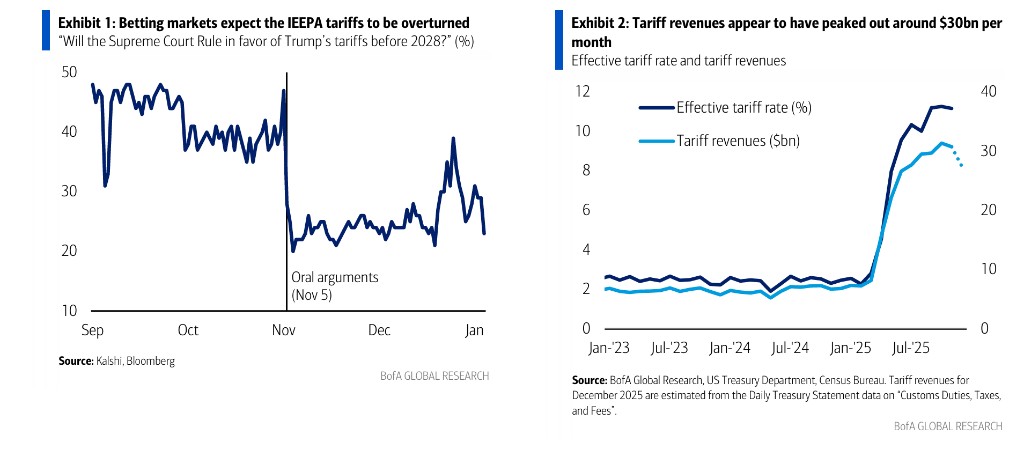
At the time of writing the Bank of America report, Kalshi indicated that the probability of "tariffs being maintained" was less than 25%. This probability had been in the range of 35% to 40% before the oral arguments on November 5, but dropped to as low as 20% a few days after the arguments.
Key Question 3: How much revenue do tariffs currently bring to the treasury?
Bank of America estimates that tariff revenue is currently running at about $30 billion per month, which annualizes to about 1.2% of GDP. Approximately 55% to 65% (about 0.7% to 0.8% of GDP) of this is attributed to tariffs related to the IEEPA.
This baseline determines that the ruling is not only a trade policy event but will also be included in the market's discussion framework regarding fiscal and deficit paths.
Key Question 4: If IEEPA tariffs are overturned, what alternative tools might the government use?
Bank of America assesses that if IEEPA tariffs are overturned, the government may turn to other statutory authorizations to recover some revenue, with the first step possibly using Section 122, which allows for tariffs of up to 15% to be imposed within 150 days, after which Congress must extend it.
Bank of America expects the government may utilize this 150-day window to initiate more Section 232 (national security) and Section 301 (unfair trade practices) investigations. Even so, overall tariff revenue may still experience a net loss of about 0.3% of GDP, equivalent to approximately $90 billion annually.
More importantly, the final tariff structure may be more "uneven": some industries identified as involving national security may face higher tariffs under the 232 and 301 frameworks, while some sectors (such as consumer-related) may see a significant decrease in tariff burdens.
Key Question 5: What is the main impact of the ruling on the stock and bond markets?
Bank of America's baseline projection is: if IEEPA tariffs are overturned, the market will factor in reduced tariff revenue and expanded deficits, pushing long-term U.S. Treasury yields higher; at the same time, stocks may rise due to alleviated profit margin pressures on retailers and "implied fiscal easing," likely concentrating in sectors less likely to be covered by 232 or 301, such as consumer stocks. **
However, the extent of the market reaction depends on the details of the ruling, including whether the Fentanyl tariffs are also overturned or only the reciprocal tariffs; whether the tariffs already imposed need to be refunded, etc.
If the tariffs are maintained, Bank of America expects the opposite direction, with the stock market and bond yields falling. Given that the market currently leans more towards "overturning," the unexpectedness of this direction may be stronger, and the price impact may also be greater.
Key Question Six: What does it mean for growth, inflation, and the Federal Reserve?
Bank of America believes that regardless of how the Supreme Court rules, this year's trade policy overall may be more supportive of growth.
If the tariffs are maintained, Bank of America expects the government may reduce trade uncertainty more quickly and push for more "market and growth-friendly" outcomes before the midterm elections, with potential measures including renegotiating the United States-Mexico-Canada Agreement.
If the tariffs are overturned, the macro level may benefit from a looser fiscal stance (larger deficits), but this tailwind may be partially offset by a new round of trade uncertainty. The short-term inflation impact may be slightly downward: retailers that have already passed on tariff costs to consumers may hold off for a longer time or even lower some prices; companies that previously absorbed costs will also reduce the incentive to continue raising prices.
This may marginally provide room for the Federal Reserve to further cut interest rates, but Bank of America emphasizes that the impact may be limited, due to reasons including: the majority of FOMC members tend to "look through" the one-time impact of tariffs on inflation, and a looser fiscal stance may also stimulate demand, bringing upward risks for subsequent inflation.
Key Question Seven: Why are tariff revenues already below expectations, and how should the market interpret this?
Bank of America points out that the collection of IEEPA-related tariffs is lower than expected, which itself will weaken the net impact of the Supreme Court ruling on the market and macro.
The effective tariff rate corresponding to the latest trade data was 11.2% in November 2025 (Bank of America conventionally assumes that the tariffs collected in that month correspond to imports from the previous month), and this level has stabilized for three consecutive months. According to the daily financial report data for December, the effective tax rate for November imports may even decline further. This contradicts the previous expectation that "the tax rate would significantly rise after fully reflecting the measures announced in the summer."
Bank of America provides two reasons: First, importers have clearly shifted to low-tariff products and sources, and Bank of America estimates that this substitution effect has caused the effective tax rate to decline by about 3 percentage points; second, the gap of more than 3 percentage points between the theoretical tax rate and the effective tax rate may come from unaccounted exemptions and workaround arrangements, with the EU gap being the most significant, where the theoretical tax rate is about 16% and the effective tax rate is about 9%. Similar "below theoretical value" situations also appear in Switzerland, Brazil, Mexico, and India, among other major trading partners.

For investors, this means that regardless of the ruling outcome, the "real leverage" of fiscal revenue and price transmission may be less than model assumptions, and the market is more likely to shift towards trading "alternative tariff paths" and industry redistribution, rather than just trading total volume shocks
