AI glasses enter the era of independent smart terminals, beginning to take over core functions of smartphones

CITIC Securities stated that AI glasses are making a key transition from smartphone accessories to independent smart terminals. Jensen Huang's concept of "physical AI" has set the tone, with Chinese manufacturers like Thunderbird Innovation leading at CES. The eSIM technology allows glasses to break free from the constraints of smartphones. Global shipments surged by 110%, coupled with the "trade-in" national subsidy bonus, giants like ByteDance and Alibaba are accelerating their entry, and this sector may see a large-scale explosion by 2026
Smart glasses are undergoing a critical transition from smartphone accessories to independent smart terminals. With the integration of eSIM communication modules and the implementation of multimodal AI technology, this category is beginning to take over core smartphone functions such as calls, connectivity, and complex computations.
According to a research report released by the Liu Yuenan team at Cathay Securities on the 12th, the "Physical AI" concept proposed by NVIDIA CEO Jensen Huang at CES 2026 (International Consumer Electronics Show) sets the tone for the industry, marking a shift in AI development focus from the digital world to a stage of deep integration with hardware that can understand and interact with the physical world.
Cathay Securities stated that AI glasses have become the focus of the exhibition. Among approximately 23 related exhibitors, 16 are from China, including brands like Rayneo, Rokid, and INMO. Notably, smart glasses with independent communication capabilities made their debut, breaking the long-standing reliance of this category on smartphone computing power and networks, accelerating the industry's move towards large-scale applications.
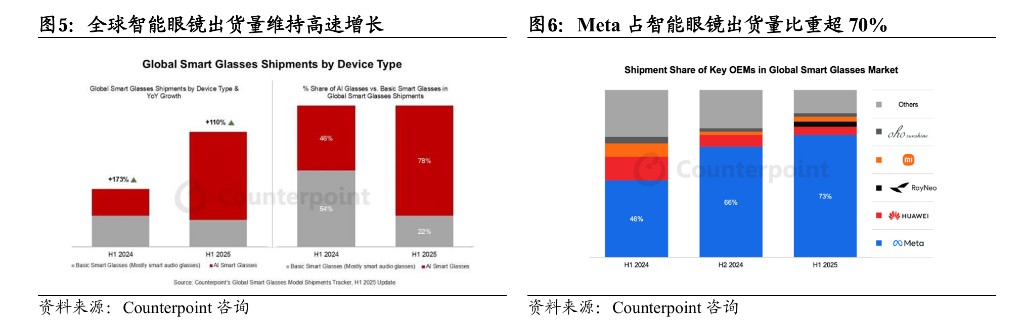
This technological leap is compounded by strong market growth and favorable policies. According to Counterpoint Consulting data, global smart glasses shipments are expected to surge by 110% year-on-year in the first half of 2025, with AI glasses accounting for 78% of the total. Meanwhile, smart glasses will be included in the "trade-in" national subsidy program for the first time by the end of 2025, which is expected to bring significant incremental sales in 2026.
Breaking Free from Smartphone Constraints: Establishing Independent Terminal Forms
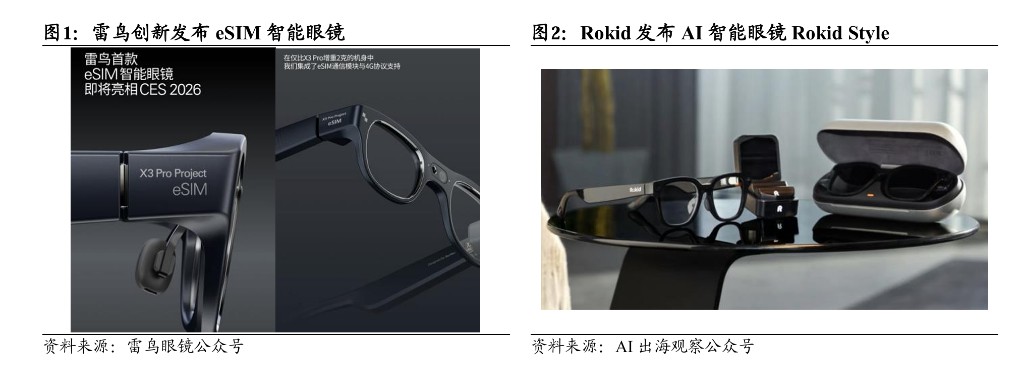
Cathay Securities indicated that a landmark event for AI glasses moving towards independent terminals is the launch of the first eSIM-supported smart glasses, X3 Pro Project eSIM, by Rayneo at CES. This product achieves independent operation capabilities by integrating an eSIM communication module and 4G protocol, allowing users to make calls, engage in real-time AI conversations, perform real-time translations, and stream online content directly through the glasses without needing to connect to a smartphone or WiFi.
At the same time, Rokid's newly released AI smart glasses, Rokid Style, demonstrate the trend towards an open ecosystem. Weighing 38.5g, this product utilizes Qualcomm's AR1 platform and NXP RT600 dual-chip design, ensuring a typical battery life of 12 hours while supporting various large models such as ChatGPT, DeepSeek, and Qwen, thereby building an open AI service ecosystem.

Tech Giants Accelerate Entry: Hardware and Software Collaboration Speeds Up
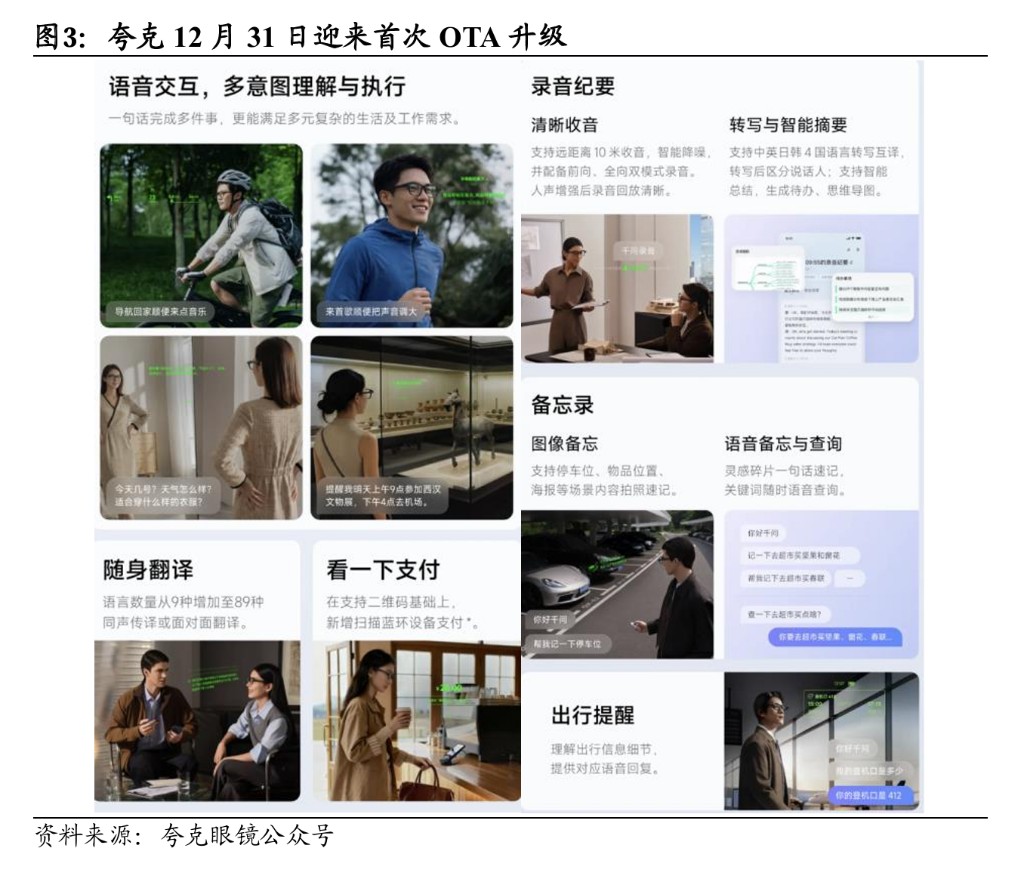
In addition to startups at the CES exhibition, tech giants are also accelerating product launches. According to the report, ByteDance's "Doubao" AI glasses are about to enter the shipping phase. This product is developed by ByteDance for the upper-level app, while Longqi Technology is responsible for the underlying UI and mass production, featuring a self-developed spatial algorithm chip and weighing under 50 grams. The screenless version of the AI glasses is planned for release in the first quarter of 2026, with a starting price expected to be under 2,000 RMB, while the version with display functionality is anticipated to launch in the fourth quarter Quark Glasses, a subsidiary of Alibaba, has recently completed a key update. As of December 23, 2025, the inventory of the dual new products of Quark Glasses has sold out, and on December 31, it will welcome its first OTA upgrade, adding features such as Qianwen AI multi-intent understanding, scanning blue ring device payment, and voiceprint recognition, further enhancing AI's proactive service capabilities in payment and interaction scenarios.

Design Returns to Daily Use and the Evolution of "Physical AI"
Industry trends indicate that smart glasses are accelerating their return to "everyday accessories." Currently, mainstream products have reduced their weight to the range of 30-50g, with some solutions like the XGIMI Memo Air Display even dropping below 30g, greatly enhancing wearing comfort.
In terms of functionality, the integration of multimodal technology drives AI from passive response to proactive service. Based on the concept of "Physical AI," the new generation of glasses can not only achieve simultaneous interpretation and visual recognition but also actively intervene in business and office scenarios, such as automatically extracting meeting highlights or providing instant schedule reminders. Additionally, environmental perception and real-time assistance for people with hearing and visual impairments also demonstrate the commercial potential of this category in vertical fields.
Surge in Shipments and Release of Policy Dividends
Market data validates the industry's prosperity. Reports indicate that in the first half of 2025, global shipments of smart glasses maintained rapid growth, with Meta holding a leading position with a 73% market share. In terms of product structure, the shipment proportion of glasses with AI functions has significantly increased from 46% in the first half of 2024 to 78% in the same period of 2025, while the proportion of basic smart glasses with only audio functions has drastically shrunk.

Policy support is also providing assistance for industry expansion. On December 30, 2025, China's National Development and Reform Commission and the Ministry of Finance issued a notice, including smart glasses for the first time in the new subsidy range for digital products in the large-scale equipment update policy to be implemented in 2026. Consumers purchasing products priced at no more than 6,000 yuan can enjoy a subsidy of 15% of the sales price, with a maximum subsidy of 500 yuan per item. This policy is expected to directly stimulate end consumer demand and accelerate the penetration of AI glasses in the consumer market