Do you remember the trigger for last year's "AI crash"? Coreweave has made "significant progress," and its stock price has surged accordingly

Wallstreetcn
2026.01.13 01:43
portai
I'm PortAI, I can summarize articles.

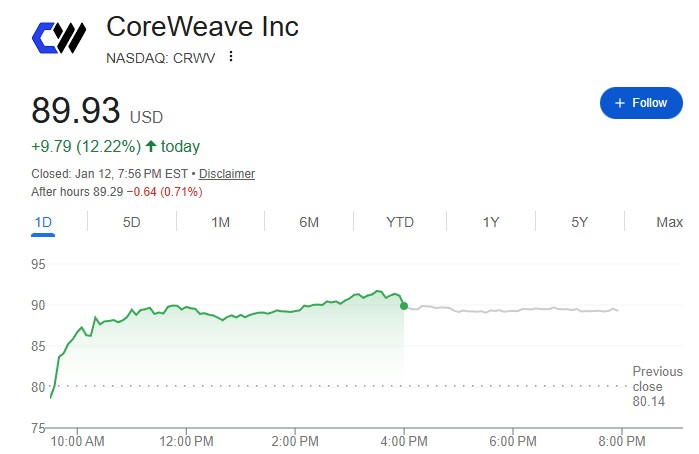
The first batch of chip deliveries for OpenAI's data center in Denton, Texas has been completed, rapidly increasing from several racks in mid-November to over 16,000 GPUs by the end of December, with a peak of over 2,000 GPUs coming online in a single day. Following the announcement, the stock price surged over 12%, with a cumulative increase of over 20% this year. Previously, delays at the Denton data center had caused its stock price to plummet over 60%, affecting companies such as Broadcom and Oracle

CoreWeave, which previously faced a trust crisis in the AI infrastructure industry due to delays in data centers, announced key progress.

On Monday, The Information reported that internal company news indicates that the data center being built by CoreWeave for its client OpenAI in Denton, Texas, has successfully reached an important milestone with the first batch of chip deliveries.

According to CoreWeave executives, the company rapidly increased from "several racks delivered" in mid-November last year to over 16,000 GPUs by the end of December. Company leadership pointed out that the maximum number of GPUs brought online in a single day exceeded 2,000.

This progress marks that CoreWeave is recovering from the revenue hit caused by delays from data center suppliers in the fourth quarter of last year. Following the news, CoreWeave's stock surged over 12%, with a cumulative increase of over 20% this year.

CoreWeave's Chief Operating Officer Sachin Jain, Chief Technology Officer Peter Salanki, and Senior Vice President of Engineering Chen Goldberg stated in a joint message to employees:

We have achieved this milestone under a highly scrutinized spotlight. The challenges we faced over the past few months are ones that few companies have experienced. We encountered setbacks from partners and uncontrollable factors.

The delay of the Denton project has become a typical case of the increasingly prominent "blame game" phenomenon in the data center construction field. As construction and deployment delays become more common in the AI infrastructure industry, parties have begun to shift responsibility onto each other.

Wall Street Journal mentioned that the market panic triggered by this incident not only caused CoreWeave's stock price to plummet over 60%, but also affected Broadcom and Oracle, both of which saw their stock prices drop over 17% within three trading days.

Heavy Rain Delays Data Center Delivery

This large AI data center cluster in Denton, Texas, plans to install approximately 260 megawatts of computing power for lease to OpenAI, but was delayed by about 60 days last year due to heavy summer rains and strong winds, preventing contractors from pouring concrete as scheduled.

The delays directly impacted CoreWeave's business model— the company relies on high-interest debt to purchase thousands of advanced AI chips from NVIDIA, installs them in server racks rented from third-party landlords, and then subleases the chip usage rights to AI companies.

The contradictory statements from CoreWeave's management during the earnings call on November 10 exacerbated investor panic.

CEO Michael Intrator initially stated that "only one data center" had issues, but was immediately corrected by CFO Nitin Agrawal, who clarified that it was actually "one data center supplier" that faced delays, indicating a broader scope of the problem The next day, CoreWeave's stock price fell from $105.61 to $88.39, a decline of 16.3%, and the stock price continued to slide until December.

Despite progress in deliveries, CoreWeave still faces severe financial challenges.

D.A. Davidson analyst Gil Luria previously stated that CoreWeave has "the ugliest balance sheet in the tech industry to date." The company's revenue doubled year-on-year to nearly $1.4 billion in the most recent quarter, but it is still not profitable, with a loss of $110 million in the most recent quarter