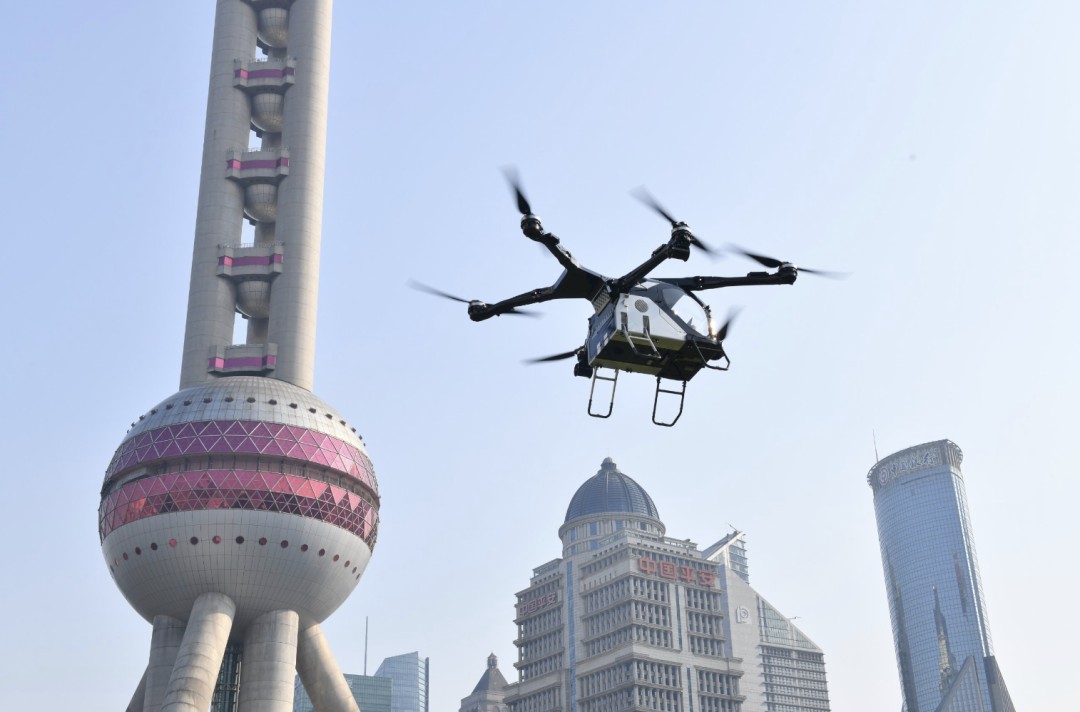
XPeng Huitian secretly submitted its application for IPO

Wallstreetcn
2026.01.13 03:18
portai
I'm PortAI, I can summarize articles.

A key step

Author | Chai Xuchen

Editor | Zhou Zhiyu

As the low-altitude economy sweeps through the global capital markets, a "unicorn" is quietly adjusting its takeoff posture.

Recently, news about Huitian's IPO in Hong Kong has spread in the market. It is reported that it has hired JP Morgan and Morgan Stanley as joint sponsors and has secretly submitted its listing application, with the earliest expected completion of the listing within this year. In response, Huitian did not comment to Wall Street Insight but also did not deny it.

The so-called secret submission is a system of the Hong Kong Stock Exchange. Some investors pointed out that last year, the Hong Kong Securities and Futures Commission and the Hong Kong Stock Exchange launched a "special line for technology companies" to promote the listing applications of specialized technology and biotechnology companies, allowing these companies to choose to submit their listing applications confidentially, with the disclosure timing postponed to later stages to protect research and development layouts and trade secrets.

Huitian's choice to submit secretly at this time reflects the game between the approaching monetization cycle of technology and the huge R&D investment. Developing flying cars is a typical capital-intensive game, where every link, from flight control system development, power redundancy design to the crucial airworthiness certification, requires continuous capital injection.

Although XPeng provides strong backing in terms of supply chain and manufacturing capabilities, it is difficult to support Huitian's large-scale expansion through blood transfusion against the backdrop of a fierce price war in the current new energy vehicle industry and compressed profit margins. Therefore, seeking independent financing through an IPO not only alleviates its own financial pressure but, more importantly, prepares for truly growing into an industry unicorn.

Industry insiders pointed out to Wall Street Insight that globally, companies like Joby Aviation, Archer, and EHang have already entered the capital market. As the largest flying car company in Asia, if XPeng Huitian can complete its IPO this year, it will establish a rare position as the "leader of the low-altitude economy" in the Hong Kong stock market. This "first stock" mental dividend often means a higher valuation premium.

In terms of product strategy, XPeng Huitian has demonstrated a unique approach that differs from traditional airlines.

Currently, Huitian's first card is the split-type flying car "land aircraft carrier," with its flying body (X3-F) currently in the critical stage of applying for a type certificate. Huitian's thinking is quite pragmatic; they realize that pure eVTOL faces the real pain points of short endurance and inability to connect with ground transportation.

Therefore, the "land aircraft carrier" is designed as a "car with an airplane," using the mothership body to provide mobile charging for the flying body, solving the energy replenishment anxiety for outdoor flights; at the same time, users can drive the "aircraft carrier" to the suburbs like a regular car and then release the flying body for experience, lowering the usage threshold for users.

Currently, the TC application for X3-F is Huitian's current strategic focus. Once approved, it means that this technical route has received legal recognition from the regulatory authorities, which will be the last key ticket to commercialization If the "land aircraft carrier" is a compromise aimed at the present, then the A868, the first fully tilt-rotor flying car unveiled last November, represents Huitian's ultimate definition of the future. Tilt-rotor technology is recognized as the "crown jewel" in the eVTOL field, combining the vertical takeoff and landing capabilities of helicopters with the high-speed cruising capabilities of fixed-wing aircraft. This product targets future urban air traffic scenarios that require longer distances and more complexity.

Beyond the product, when discussing the industry leader position, outsiders often overlook Huitian's key advantage—its manufacturing capabilities derived from the automotive industry.

Traditional aviation often relies on "artisan-style" boutique manufacturing, which is costly and inefficient, while Xiaopeng Huitian's core logic is to treat flying cars as automobiles. According to Huitian, its products have a high degree of supply chain reuse with Xiaopeng Motors in areas such as the three-electric system, intelligent cockpit, and components.

This means that Huitian can leverage the automotive industry's procurement scale of millions to spread the cost of aircraft components. While competitors are still struggling to customize a high-priced motor, Huitian may have already obtained a high-performance motor that has been modified for aviation standards.

Huitian founder Zhao Deli revealed to Wall Street News that the first batch of equipment has already been installed and debugged, with the current production rate being one aircraft per hour. Once the second batch of equipment is in place, this speed can be reduced to 30 minutes; the annual production capacity can reach 10,000 units, a figure that is astronomical in the aviation industry.

Once the land aircraft carrier achieves mass production, its cost reduction curve will be extremely steep. Huitian's goal is to bring the price of flying cars down to the "million-level" or even lower through scaled manufacturing, thereby disrupting the industry's pricing system.

The key to becoming a leader ultimately lies in who can first successfully run a business model. Currently, mainstream eVTOL companies tend to focus on To B operational service providers or To G government emergency markets, emphasizing the "air taxi" concept. In contrast, Xiaopeng Huitian boldly chose the "first To C" path.

Huitian believes that in the current environment where low-altitude airspace is not fully open and urban air traffic regulations are not mature, selling to individual users as "high-end toys" or "adventure tools" is a more pragmatic monetization path. The "land aircraft carrier" precisely targets high-net-worth individuals such as off-road enthusiasts and tech aficionados, who are less sensitive to price but have high demands for experience.

To support this strategy, Huitian is actively promoting the construction of flying camps. Just as Tesla built its supercharging stations, Huitian is collaborating with local governments and partners to weave a "flying network." When users buy a car and know where they can legally and safely fly, a commercial closed loop will naturally form.

Therefore, the news of Xiaopeng Huitian's IPO in Hong Kong may just be the tip of the iceberg. In this competition for the low-altitude economy, Huitian has demonstrated its leading qualities, seeking to be the first to go public to establish a valuation anchor, building barriers with TC certification and tilt-rotor technology, and introducing the automotive industrial system for a dimensional attack in manufacturing.

However, for the general public, flying cars remain a relatively distant and novel concept. How to convince the public of the absolute safety of "cars" flying overhead, and whether the price can be lowered to a level that can tap into the mass market, are questions that the entire industry will need to address over a long period with substantial investment Despite the challenges that still exist, if it can leverage the support of the capital market and achieve the smooth delivery of the "land aircraft carrier" this year, Huitian may change the dilemma of scaling aircraft and become the industry leader that defines the new category of "flying cars."