


Soaring 130% in ten days! Venezuela's stock index hits a new high, the first related ETF in the U.S. filed

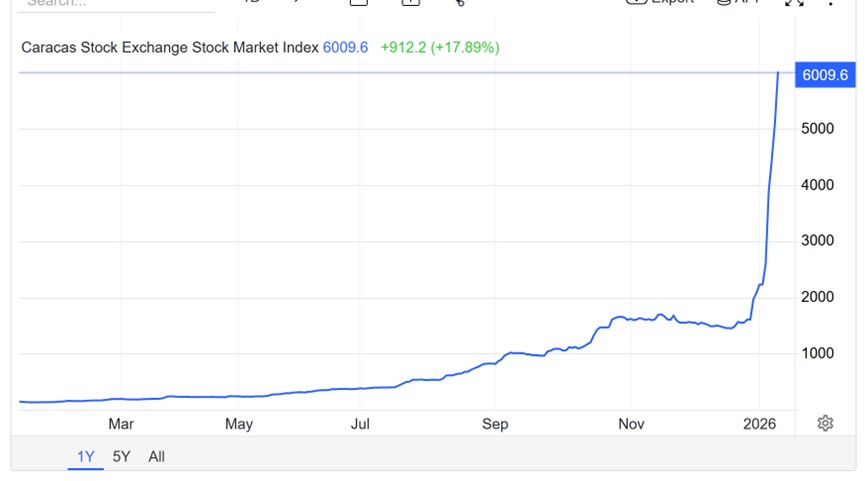
The dramatic political changes in Venezuela have triggered a market frenzy, with the benchmark stock index IBC soaring over 130% in ten days, reaching a historic high. Wall Street quickly bets on an economic turnaround and a revival of oil, with U.S. ETF issuer Teucrium having applied for the first ETF focused on exposure to the country. Despite the $170 billion external debt remaining extremely fragile, global capital is making a big bet on this "complete re-rating."
With significant changes in Venezuela's political situation, the market bets that the country's severely damaged economy will see a turnaround, driving its benchmark stock index to soar and reach a historic high in the past ten days.
According to relevant data, since January 3rd when Maduro was forcibly controlled by the U.S., the country's benchmark stock index Indice Bursatil de Capitalizacion (IBC) has surged over 130%. Investor sentiment has been boosted by the recent oil revival plan proposed by the Trump administration. According to Xinhua News Agency, the White House has requested major U.S. oil companies to invest heavily in Venezuela to repair its crude oil extraction infrastructure.
In the face of this rare market volatility, Wall Street is responding quickly. U.S. ETF issuer Teucrium submitted an application to the U.S. Securities and Exchange Commission (SEC) on Friday, planning to establish what is believed to be the first exchange-traded fund (ETF) focused on investing in companies with exposure to Venezuela. This move signifies that the channel for global funds to enter this closed market may soon open.
Analysts point out that this round of rebound reflects the market's expectations for Venezuela to end years of mismanagement and achieve economic stability. Investors generally believe that government restructuring is likely to attract capital back, revitalize oil production, and pave the way for debt restructuring.
Institutions Bet on Sanction Lifting and Debt Restructuring
Despite the astonishing rise, strategists warn that Venezuela's stock market is small, illiquid, and difficult for global investors to enter, which means price fluctuations could be very severe.
Alice Blue, a comprehensive brokerage under TradingView, wrote in a report that due to the thin trading in the Venezuelan market, even minor expected changes can trigger huge price fluctuations. The agency pointed out that the current rise reflects more hope and speculation rather than confirmed results. Data shows that the Venezuelan IBC index has soared 1644% in a year.
Jeff Grills also warned that the current stock market rebound is mainly driven by headlines. He believes that the rebound at this stage seems to be tactical rather than the beginning of a structural re-rating, as merely changing the leadership is insufficient to constitute a complete regime transition.
Anthony Simond, investment director at the British wealth and investment company Aberdeen, stated that investors have begun to view Maduro's ousting as a prerequisite for ultimately reaching a restructuring agreement. The current market demand comes from a broad range of investors, including mainstream emerging market asset management companies, as well as hedge funds and distressed debt specialists seeking asymmetric upside potential Apart from the stock market, since Maduro was forcibly taken control, investors have also flocked to the country's sovereign bonds and bonds from the state oil company. Jeff Grills, head of cross-market and emerging market debt at Aegon Asset Management, pointed out that the renewed interest in Venezuelan bonds mainly stems from optimism about a potential debt restructuring, which investors see as a way to unlock value that has been frozen since the default in 2017.
However, the timeline for recovery still faces significant challenges. Eric Fine, a portfolio manager at VanEck, noted that according to Reuters estimates, Venezuela's external debt is estimated to be as high as $150 billion to $170 billion, complicating any recovery plan. Fine emphasized that everything depends on this process not going off track; if it can be achieved, it would be a "complete re-rating situation."
