Tonight's US CPI: Government shutdown disturbances fade, core inflation may return to 2.7%, is the rebound just beginning?

The U.S. December CPI will be announced tonight. As the statistical distortions caused by the government shutdown fade, economists expect the year-on-year growth rate of core CPI to rebound to 2.7%. Due to the rebound in housing inflation and potential tariff cost transmission, the inflation rate remains stubbornly above the 2% target, leading to nearly zero expectations for a rate cut in January. Against the complex backdrop of judicial controversies affecting the Federal Reserve's independence, tonight's data will set the tone for monetary policy direction at the beginning of 2026
As the distorting effects of the U.S. government shutdown on data collection gradually fade, the inflation trend in the U.S. by the end of 2025 is expected to show resilience, a change that may mark a temporary end to the previous trend of slowing price growth. The market widely anticipates that the core CPI data to be released tonight will show a rebound, indicating that underlying price pressures still exist.
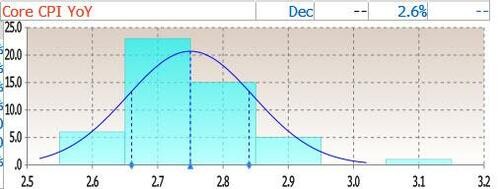
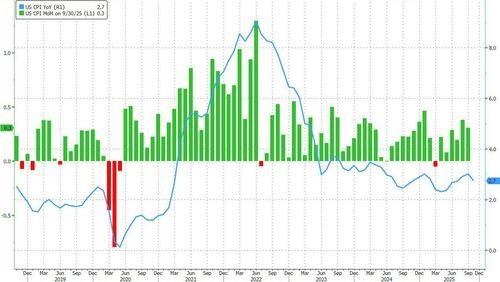
The U.S. Bureau of Labor Statistics will release the December Consumer Price Index (CPI) at 8:30 AM Eastern Time on Tuesday (9:30 PM Beijing Time tonight). According to economists surveyed by Bloomberg, the overall CPI for December and the core CPI, excluding food and energy costs, are both expected to rise by 2.7% year-on-year. If this prediction holds true, the overall CPI will remain unchanged from November, while the core CPI will slightly accelerate from the previous value of 2.6%.

The stickiness of inflation data supports the Federal Reserve's decision to maintain interest rates unchanged in the short term. Currently, the pricing in the interest rate futures market shows that investors do not expect the Federal Reserve to cut rates at the January 27-28 meeting, and the implied probability of a rate cut in March is only about 25%. Previous data indicated that although the Federal Reserve cut rates three times in 2025 to support the labor market, policymakers are facing a more complex situation before achieving their inflation target.
Analysts point out that the unexpected decline in November's inflation data was largely affected by technical factors, and December's data will reflect the true price levels after the elimination of these disturbances. The delays in data collection and statistical window shifts caused by the previous government shutdown may have masked some of the real inflation pressures.
Disturbances from the Shutdown Fade, Monthly Data May Strengthen
The key focus of the December CPI data is the recovery of month-on-month growth rates. According to consensus estimates from Bloomberg and FactSet, the month-on-month increases for both the overall and core inflation indices are expected to be 0.3%, higher than November's 0.2%. However, some institutional economists, including those from Goldman Sachs and Bank of America, believe that the monthly performance of core inflation may be stronger, potentially reaching 0.4%.

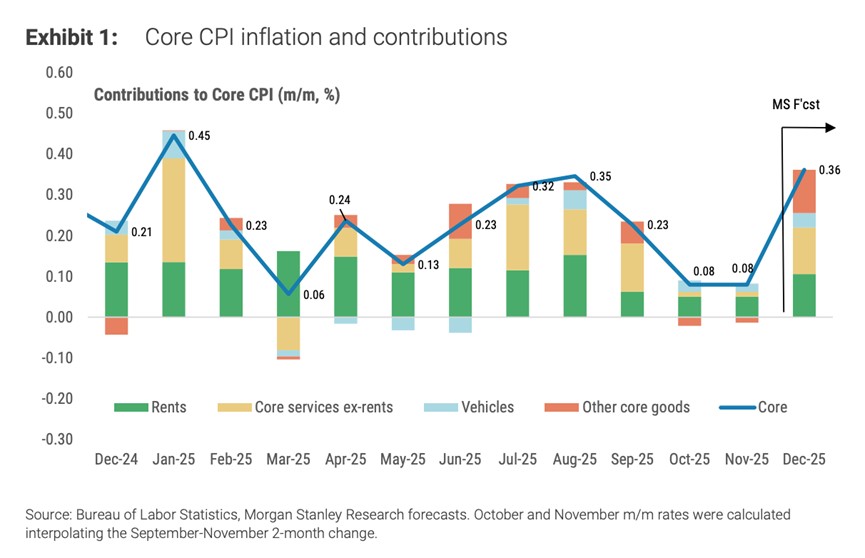
Morgan Stanley expects a significant rebound in the core CPI for December, with a month-on-month increase of 0.36%, far exceeding the average of 0.08% for October and November.
This potential strengthening mainly stems from the reversal of the "shutdown effect." The government shutdown hindered the Bureau of Labor Statistics from collecting complete data in October, making the monthly comparisons for November difficult. Additionally, the delay in the data collection window meant that November's data captured more discount prices during the holiday promotion period, which is widely believed to underestimate housing inflation.
Morgan Stanley stated that the December CPI data will reflect two major statistical biases caused by the government shutdown:
- Bi-monthly sampling bias: With the exception of the three major cities of Chicago, Los Angeles, and New York, some prices for goods and services are collected bi-monthly. Due to the missing October data, the Bureau of Labor Statistics carried over August prices to October, effectively assuming zero inflation for these cities in October. December will re-survey these cities, leading to a lower price comparison base. Morgan Stanley estimates that CPI categories significantly affected by the bi-monthly sampling averaged only 0.10% month-on-month from October to November, while the underlying trend is 0.23%. By comparing the differences between the three major cities and the overall data, the firm expects the bi-monthly sampling to contribute about 8 basis points of upward bias to the core CPI in December.
- Holiday discount bias: The delay in price collection for November until the end of the month implicitly over-weighted holiday promotion discounts, artificially lowering the prices of core goods (excluding automobiles). This bias has historically existed but has been amplified this year due to the delay in the survey timing. Morgan Stanley has added an additional 3 basis points to its core CPI forecast for this reason.
Andrew Schneider, a senior U.S. economist at BNP Paribas, pointed out that the data from October to November appears overly weak, partly because housing data has been artificially suppressed, and the movement of the data collection window has given some non-essential consumer goods categories an extra "promotional" boost. As these methodological issues fade in December, the year-on-year increase in core inflation and overall inflation could even reach 2.8%.
Rebound in Service Prices and Tariff Clouds
In specific segments, economists expect significant rebounds in hotel prices, airfare, and clothing prices. Economists at Bank of America predict that the pace of inflation for food, core goods, and core services will accelerate compared to November. However, Mike Reid, head of U.S. economics at the Royal Bank of Canada, holds a different view, expecting that Owners' Equivalent Rent (OER) will only rise moderately, which will help control the inflation data for December, given that housing costs account for more than one-third of the CPI weight.
Looking ahead, the sources of inflationary pressure are shifting from purely the service sector to tariff transmission. JPMorgan's market intelligence team analyzed that while companies have recently been restrained in raising prices to maintain market share, the latest GDP data suggests that an increasing number of companies are trying to pass rising input costs onto consumers. Seema Shah, Chief Global Strategist at Principal Asset Management, believes that although the inflation effects of high tariffs have not yet fully manifested, the risk of continued price growth remains, and inflation is expected to remain slightly elevated through 2026 Stephen Stanley of Santander also warned that the "wave" of price increases related to tariffs will hit in the first few months of 2026. Many companies have explicitly stated in earnings call conferences and business surveys that they plan to start passing on the higher costs brought by tariffs to consumers. Stanley added that inflation data in the coming months may provide justification for the Federal Reserve to maintain interest rates unchanged.
Concerns About the Federal Reserve's Policy Path and Independence
Although Federal Reserve officials have recently pointed out that monetary policy is in an unstable state, inflation has remained above the 2% target for most of the past year. The overall CPI readings have long hovered in the range of 2.3% to 3.0%, while core CPI has stubbornly maintained a mid-to-high level around 2%.
The risk of inflation peaking has been viewed by JP Morgan as one of the high-probability risks facing the U.S. stock market in the first half of 2026. While a single CPI data point cannot confirm this hypothesis, combined with previously released non-farm employment data, this data may further delay market expectations for a rate cut by the Federal Reserve. JP Morgan economists predict that the Federal Reserve may remain on hold in fiscal year 2026.
Additionally, Matt Weller, head of market research at FOREX.com, pointed out that the U.S. Department of Justice's subpoena of Federal Reserve Chairman Powell increases the risk to the Federal Reserve's independence. Although the likelihood currently seems low, this has sparked speculation in the market about President Trump potentially appointing a new chairman early. If this occurs, regardless of the current inflation data, more aggressive rate cuts may happen. However, under the baseline scenario, the central bank may remain on hold unless inflation significantly declines in the first quarter.
Market Reaction Scenario Forecast
In anticipation of the upcoming CPI data, JP Morgan's market intelligence team has constructed a predictive matrix for the core CPI month-on-month (Core MoM) and the S&P 500 Index (SPX) response:
- Core MoM between 0.35% and 0.40% (highest probability at 40.0%): The S&P 500 Index is expected to rise by 0.25% to 0.75%.
- Core MoM between 0.40% and 0.45% (probability of 32.5%): The S&P 500 Index is expected to fluctuate between an increase of 0.25% and a decrease of 0.75%.
- Core MoM between 0.30% and 0.35% (probability of 20.0%): The S&P 500 Index is expected to rise by 1% to 1.5%.
- Core MoM above 0.45% (probability of 5.0%): The S&P 500 Index is expected to decline significantly by 1.25% to 2.5%.
- Core MoM below 0.30% (probability of 2.5%): The S&P 500 Index is expected to rise by 1.25% to 1.75%.
The foreign exchange market is closely watching tonight's data, especially the USD/JPY (U.S. dollar to Japanese yen) movement. This currency pair typically reacts most directly to U.S. data. Technically, USD/JPY is currently in a long-term upward trend and is testing previous resistance around 158.00

Weller analysis states that if inflation data exceeds expectations, it will increase the likelihood of an upward breakout, thereby opening up bullish space. However, traders should be cautious of the risk that if the exchange rate approaches 159, the Japanese Ministry of Finance may directly intervene in the market. Conversely, if inflation data unexpectedly cools, traders may bet on an early interest rate cut by the Federal Reserve, leading to a pullback in the exchange rate, which could fall to 157.00 or lower