What signals does the U.S. December CPI send? Wall Street has low expectations for a rate cut this month, and the "New Federal Reserve News Agency" states that the Fed's wait-and-see attitude is unlikely to change

In December, the core CPI in the United States grew at a rate lower than Wall Street's expectations, with a year-on-year growth rate being the lowest in nearly five years. Analysts believe this indicates a cooling of price pressures, but it is not enough to prompt the Federal Reserve to cut interest rates this month. Wall Street Journal reporter Nick Timiraos pointed out that Fed officials will need more evidence showing that inflation is stabilizing before they may consider lowering rates. Morgan Stanley's Ellen Zentner stated that the current inflation report does not meet the conditions for a rate cut. Following the data release, stock index futures and U.S. Treasury yields initially rose before volatility decreased, with the market expecting a probability of over 97% that the Federal Reserve will maintain interest rates at the end of January
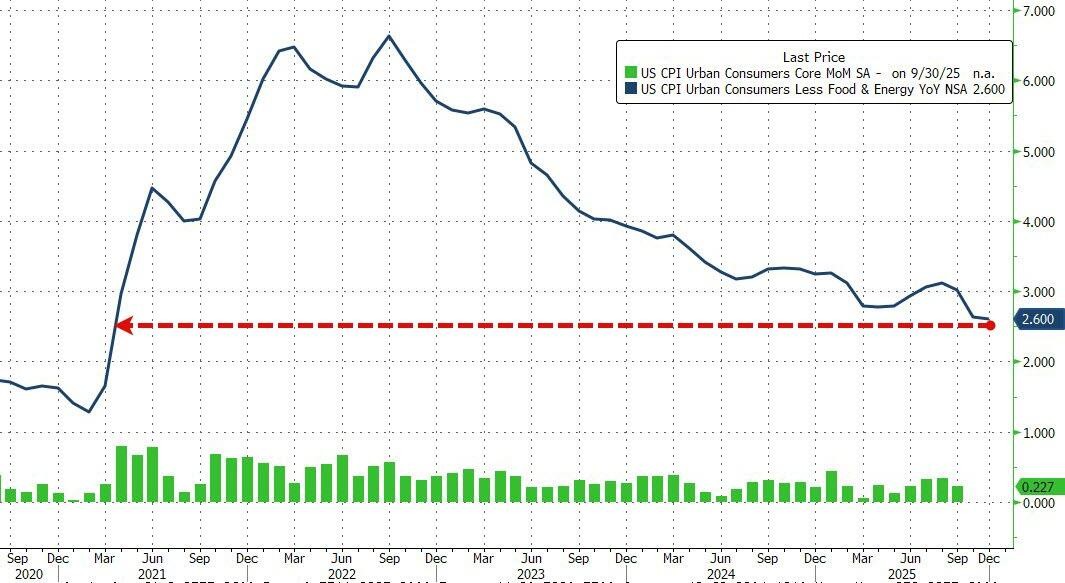
The core CPI growth in the U.S. for December was lower than Wall Street's expectations, with the year-on-year growth rate being the lowest level in nearly five years. Market analysts believe this provides a more definitive signal that price pressures are cooling, but it is still not enough to prompt the Federal Reserve to cut interest rates this month.
Nick Timiraos, the chief economic reporter for The Wall Street Journal, known as the "new Federal Reserve news agency," commented that the December CPI report is unlikely to change the Federal Reserve's wait-and-see stance, as Fed officials may want to see more evidence of inflation stabilizing and then declining before cutting rates. He noted,
To restore rate cuts, Federal Reserve officials may need to see new evidence indicating that the labor market is weakening or that price pressures are dissipating. The latter may require at least a few more months of inflation reports to be confirmed.
Ellen Zentner, chief economic strategist at Morgan Stanley Wealth Management, stated, "We have seen similar situations before—inflation has not reignited but is still above target levels. The transmission of tariffs remains limited, but (residential) housing affordability has not improved. Today's inflation report does not provide the conditions needed for the Federal Reserve to cut rates later this month."
After the data was released, stock index futures and U.S. Treasury yields initially rose, but the volatility diminished as the trading session progressed. The Bloomberg Dollar Spot Index was basically flat. Expectations for the Federal Reserve to maintain interest rates at the end of January's policy meeting were further strengthened. On Tuesday, during U.S. stock trading, data from the CME indicated that the futures market expected a slightly over 97% probability that the Federal Reserve would keep interest rates unchanged during the January 27-28 monetary policy meeting, up from 95.6% the day before. 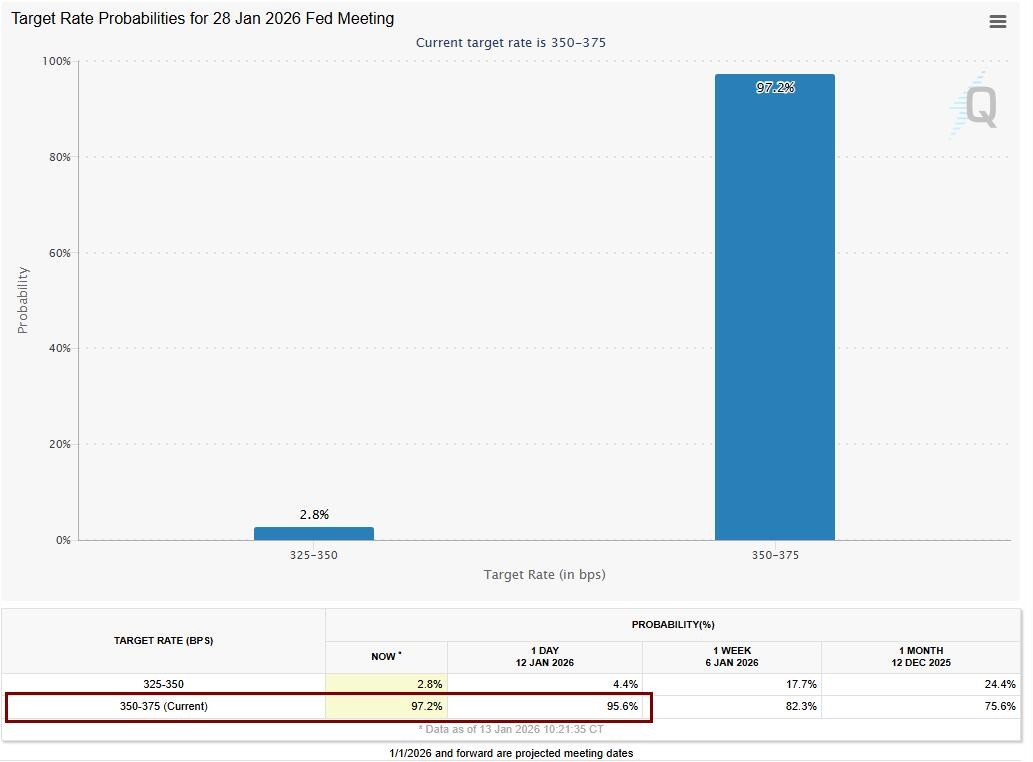
Core Inflation Below All Mainstream Predictions
According to data released by the U.S. Bureau of Labor Statistics (BLS) on Tuesday, excluding the volatile food and energy categories, the core CPI for December increased by 0.2% month-on-month, while economists' consensus expectation was for a 0.3% increase. The year-on-year core CPI for December grew by 2.6%, matching the lowest level since March 2021 set in November, while economists expected a growth of 2.7%.
Media reports indicated that this data provides a more convincing signal that inflation is on a downward path. The previous November report complicated the data due to statistical issues. Due to the record-length U.S. government shutdown, the BLS was unable to collect price data in October and assumed that key housing indicators did not rise. The collection period for November data was also later than usual and may have been affected by holiday discounts In December, the overall CPI increased by 0.3% month-on-month and 2.7% year-on-year, both in line with economists' expectations. The BLS stated that housing costs were the "largest factor" contributing to the month-on-month increase in overall CPI, with this category rising by 0.4% in December, the largest increase in four months. Excluding housing, the core CPI only increased by 0.1%.
Olu Sonola, the U.S. Economic Research Director at Fitch Ratings, stated in the report: "Although the impact of the government shutdown on the data has not been fully eliminated, a key positive factor in this report is that core commodity prices remained flat, reinforcing the view that the pass-through of tariffs to consumers is much milder than expected."
Declines in Auto and Furniture Prices Offset Rising Housing Costs
Categorical data shows that auto prices helped to lower the core CPI inflation in December, with used car prices falling by 1.1% month-on-month, while new car prices remained flat. Prices for household goods fell by 0.5%, also suppressing core prices. Vehicle repair costs saw the largest recorded decline. Core commodity prices, excluding food and energy, stagnated in December, also falling short of rebound expectations.
However, for voters concerned about the cost of living, several categories still raised red flags. Prices for household food (groceries) increased by 0.7% month-on-month, marking the largest increase since 2022. Prices for recreation and entertainment jumped by 1.2% month-on-month, reaching the highest recorded increase. The cost of homeowners insurance rose by 1% month-on-month and surged by 8.2% year-on-year, also setting a record.
Economists Anna Wong, Chris G. Collins, and Troy Durie from Bloomberg Economics stated: "The December CPI report indicates that the underestimation of the November CPI was milder than imagined. The real signal is that the pass-through of tariffs may have peaked."
Reports indicate that prices in some tariff-sensitive categories, such as clothing, have risen. However, household goods prices saw a 0.5% decline, as President Trump's plans to impose tariffs on imported goods in that industry have eased. Energy prices increased by 0.3% month-on-month and 2.3% year-on-year, but gasoline prices fell by 0.5% and 3.4%, respectively.
The Federal Reserve Needs More Evidence to Support Rate Cuts
Timiraos pointed out that despite the stagnation of inflation in the U.S. last year, the Federal Reserve has cut rates in its last three meetings, the most recent being in December 2025, when the federal funds target rate was lowered to 3.5% to 3.75%. The rate cuts were due to Fed officials being more concerned about the risk of an unexpectedly sharp slowdown in the labor market. The Fed's next policy meeting will be held at the end of January.
Currently, the market widely expects that Fed officials will keep rates unchanged at the FOMC meeting at the end of this month. Officials have differing views on the extent of further rate cuts this year, needing to balance between inflation above target and a weak labor market. Trump's tariff policy complicates this balancing act, although most Fed decision-makers believe that the impact of tariffs on inflation is temporary Another service industry indicator closely monitored by the Federal Reserve—the "super core" CPI inflation excluding housing and energy costs—rose by 0.3% month-on-month in December. Year-on-year, the so-called super core inflation was 2.7% in December, down from about 4% a year ago. Chris Low, Chief Economist at FHN Financial, stated that this improvement in inflation slowdown should create conditions for the Federal Reserve to further cut interest rates this year.
Stephen Brown, an economist at Capital Economics, wrote in a report: "Certain items rebounded to some extent after unusually weak price changes in October and November, but the downside surprise in core prices in December indicates that underlying inflation pressures have indeed eased in recent months."
Reports indicate that after accounting for the price increase in December, real wages were flat for the month, with a year-on-year increase of 1.1%. This indicator has been positive for the past two and a half years, meaning that on average, American wages have grown faster than price increases. However, persistently high living costs have depressed consumer confidence indicators.
Looking ahead to 2026, economists expect that high inflation will gradually ease. Kathy Bostjancic, Chief Economist at Nationwide, stated on Tuesday that the CPI report is "very encouraging," and that the report "supports our view that the impact of tariffs on commodity prices will fade by 2026."
Risk Warning and Disclaimer
The market has risks, and investment should be cautious. This article does not constitute personal investment advice and does not take into account the specific investment goals, financial situation, or needs of individual users. Users should consider whether any opinions, views, or conclusions in this article are suitable for their specific circumstances. Investment based on this is at one's own risk.