ROI-Talent, not territory will define AI future: Taosha Wang

Reuters
2026.01.13 23:00
portai
I'm PortAI, I can summarize articles.

In a significant move, Meta acquired Manus, a Chinese-founded AI startup, for over $2 billion, challenging the narrative of U.S.-China tech decoupling. Manus, known for its agentic AI, has seen rapid growth, surpassing $100 million in annual recurring revenue shortly after its launch. The deal signals a thaw in global growth-stage capital for China-linked founders and highlights a shift towards talent-focused strategies in the AI race. The acquisition underscores the importance of talent over territory in the evolving landscape of AI development, as companies navigate geopolitical tensions.

(The views expressed here are those of the author, a portfolio manager at Fidelity International)

By Taosha Wang

HONG KONG, Jan 14 (Reuters) - In the final days of 2025, one deal cut through the holiday noise: Meta’s (META.O) acquisition of Manus, a Chinese-founded artificial intelligence startup, reportedly for more than $2 billion. This acquisition challenges the widespread narrative of U.S.-China tech decoupling and could signal a new modus operandi in the future of AI. Manus specializes in agentic AI, systems that can autonomously plan and execute complex digital tasks, much like a capable human assistant. Founded in 2022 in Wuhan and now based in Singapore, Manus burst into public view in early 2025 when a preview of its main offering went viral, just weeks after China’s DeepSeek rattled Silicon Valley with its highly efficient and cost-effective AI model that rivalled top U.S. offerings.

Within months, Manus passed $100 million in annual recurring revenue. In April 2025, Benchmark Capital, a venture capital firm famous for early investments in tech companies like eBay (EBAY.O) and Uber (UBER.N) , led a funding round that valued Manus at nearly $500 million. By December, Meta was writing a cheque several times larger.

These numbers hardly look extraordinary in today’s AI context, where leading model companies are valued at hundreds of billions of dollars. Yet this partnership between a U.S. tech giant and an originally Chinese startup could be a preview of the border-crossing, talent-focused future of the global AI race.

CHINA CAPITAL CHILL THAWS

For capital markets, there are three notable takeaways from the Manus deal.

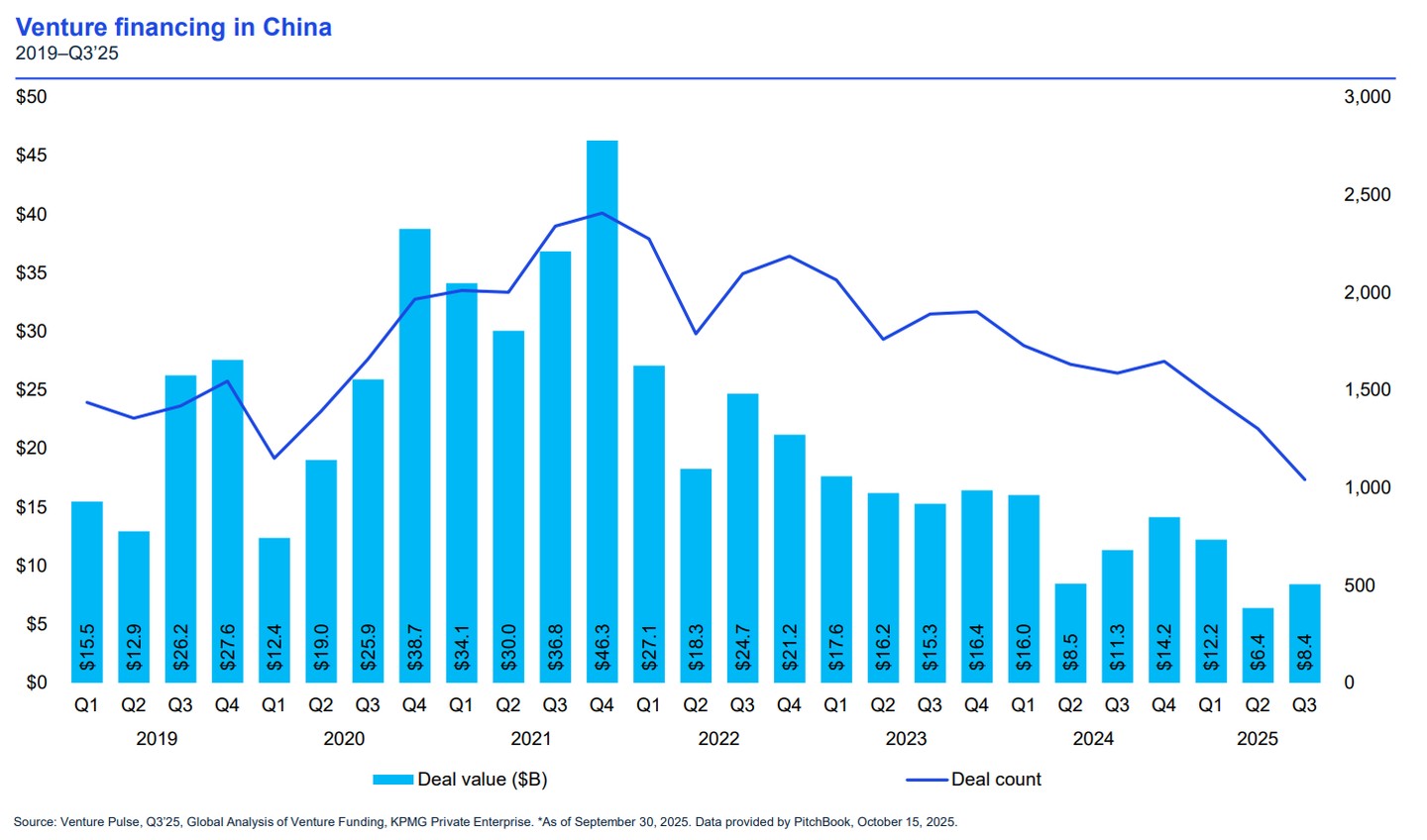
First, global growth-stage capital for China-linked founders is reemerging. Benchmark Capital is one of Silicon Valley’s most selective venture firms. Its willingness to lead Manus’s round is a powerful signal following a multi-year VC winter for China. Domestic economic slowdown, regulatory concerns and geopolitical tensions had held back foreign investors.

That private-market chill coincided with a period in which China’s “investability” was widely questioned in public markets. The mood shifted decisively last year, however, as the MSCI China index (.dMICN00000PUS) delivered a 31% return, compared with 18% for the S&P 500 (.SPX) index.

Now, public and private market narratives may begin reinforcing one another. Benchmark exited Manus at a multiple of more than four times its entry price within a year of investment. Such a profitable, quick-turn outcome may embolden global growth investors to re-underwrite China technology risk, particularly in AI and related areas.

The second notable feature is that Meta is buying Manus for its globally competitive technology and talent, not as a route into China.

This differs sharply from earlier generations of Chinese internet champions, which often followed proven U.S. product templates but offered the promise of access to China’s huge domestic market.

That certainly doesn’t describe Manus. Its unique AI offering focuses on workflow orchestration, and, perhaps surprisingly, its services are unavailable in China. Its main revenue reportedly comes from Japan, the Middle East and the U.S.

The third implication is that the global AI contest is more fluid and multi-dimensional than a simple “U.S. versus China” frame suggests. DeepSeek’s R1 model forced many investors to confront the reality that a Chinese model could match top U.S. systems at a fraction of the cost. But there is also a race among Silicon Valley heavyweights - and Manus now sits firmly within that story.

TALENT NOT TERRITORY Manus is also a reminder that the global AI race is fundamentally a talent war. Nvidia’s (NVDA.O) Jensen Huang, speaking in Washington in April, reminded his audience that 50% of the world’s AI researchers are Chinese, a fact that American business leaders and policymakers must consider when they imagine an AI-enabled future.

Manus’s trajectory is a case in point. It was founded by Chinese engineers with entirely domestic academic and professional backgrounds. It then scaled and relocated to Singapore to serve international markets. The company shows how Chinese-founded businesses and talent can plug into global capital and corporate structures despite elevated geopolitical noise.

The next phase of AI development is likely to be defined by messy interdependence: cross-border acquisitions, strategic alliances and shifting corporate domiciles, even as governments emphasize national security and digital sovereignty.

Conflicting priorities between governments and businesses could create tensions and potentially slow down innovation, but, ultimately, the best ideas will win out. Technology and talent, like science and information, do not always respect neat borders. (The views expressed here are those of the author. Taosha Wang is a portfolio manager and creator of the “Thematically Thinking” newsletter at Fidelity International.) Enjoying this column? Check out Reuters Open Interest (ROI), your essential new source for global financial commentary. ROI delivers thought-provoking, data-driven analysis of everything from swap rates to soybeans. Markets are moving faster than ever. ROI can help you keep up. Follow ROI on LinkedIn, and X.

Venture financing in China Venture financing in China

(Writing by Taosha Wang Editing by Marguerita Choy)