8-inch wafer foundry collectively raises prices! The highest increase is 20%!

Wallstreetcn
2026.01.14 02:40
portai
I'm PortAI, I can summarize articles.

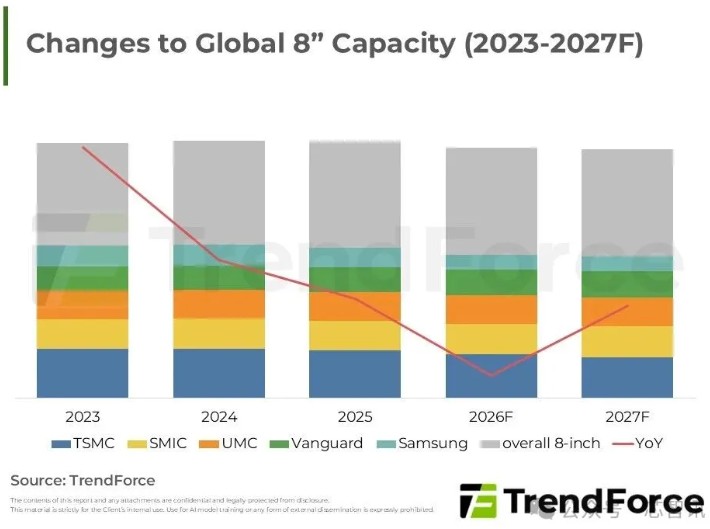
On January 14th, market research firm TrendForce released a report stating that due to TSMC and Samsung Electronics reducing 8-inch wafer foundry capacity, the global total capacity for 8-inch wafer foundry is expected to decrease by 2.4% in 2026. At the same time, the demand for AI-driven power management chips is strong, and the capacity utilization rate of 8-inch wafer foundries is expected to rise to 90% this year, with prices increasing by 5% to 20%. TSMC plans to gradually exit 6-inch wafer manufacturing, while Samsung will also reduce production of 8-inch wafers. United Microelectronics Corporation (UMC) and Semiconductor Manufacturing International Corporation (SMIC) will consolidate market share through special process technologies

On January 14th, market research firm TrendForce recently released a report indicating that as TSMC and Samsung Electronics reduce their 8-inch wafer foundry capacity, the global total capacity for 8-inch wafer foundry is expected to decrease by 2.4% by 2026. Meanwhile, the demand for AI-driven power management-related mature process chips remains strong, which is expected to boost the capacity utilization rate of 8-inch wafer foundries to 90% this year. In this context, 8-inch wafer foundries may raise their prices by 5% to 20% this year.

From the perspective of specific manufacturers, leading foundry TSMC announced in August 2025 that it would gradually exit the 6-inch wafer manufacturing business over two years and continue to reduce 8-inch wafer capacity. Currently, TSMC has four 8-inch wafer fabs and one 6-inch wafer fab in Taiwan. If it aims to fully exit by 2027, it will need to continue reducing capacity in 2026. Currently, TSMC's monthly production capacity for 8-inch wafers is approximately 528,000 pieces.

Samsung Electronics will also start reducing production at its 8-inch wafer fabs in the second half of 2025, with a more proactive approach, hoping to allocate more resources to compete in the 12-inch wafer market. As early as the end of 2024, Samsung began planning to scale down its 8-inch wafer fabs to address ongoing losses in its foundry business and low capacity utilization rates at its 8-inch fabs, with rumors of layoffs of over 30% in its 8-inch foundry manufacturing and technology teams. Currently, Samsung Electronics' monthly production capacity for 8-inch wafers is also approximately 528,000 pieces.

United Microelectronics Corporation (UMC) once had a monthly production capacity exceeding 360,000 pieces for its 8-inch wafers, with the current capacity utilization rate around 70%. Looking ahead, UMC is optimistic about its operations in 2026, expecting to continue its growth trajectory. In the face of industry changes, the company chooses not to compete directly with advanced process manufacturers but instead focuses on deepening its special process technologies to consolidate its market share.

SMIC currently has three 8-inch wafer fabs and four 12-inch wafer fabs in Shanghai, Beijing, Tianjin, and Shenzhen. According to SMIC's Q3 2025 financial report, its third-quarter capacity utilization rate has risen to 95.8%, an increase of 3.3 percentage points quarter-on-quarter. As of the third quarter of 2025, SMIC has surpassed the milestone of 1 million pieces in monthly production capacity equivalent to 8-inch wafers. Among them, the monthly production capacity for 8-inch wafers is approximately 355,000 pieces, with the capacity utilization rate for 8-inch wafers reaching as high as 96% in Q4 2025.

SMIC's co-CEO Zhao Haijun pointed out in the financial report meeting in mid-November 2025 that although the growth of major application markets, except for AI, is stable, the company has become an important partner for customers during the adjustment of the industry chain structure, with high visibility of orders and production lines still in a state of supply not meeting demand In December 2025, industry rumors indicated that due to the sustained high capacity utilization rate, Semiconductor Manufacturing International Corporation (SMIC) has raised prices for some capacities by about 10%.

In the third quarter of 2025, Hua Hong Semiconductor's overall capacity utilization rate reached an astonishing 109.5%, indicating an overloaded operational state. Hua Hong Semiconductor stated that the utilization rates of its three 8-inch wafer fabs remain high, while the actual output of its first 12-inch wafer fab has exceeded the designed capacity of 100,000 wafers per month. Therefore, to cope with the continuous influx of orders, Hua Hong is actively expanding its capacity. Another 12-inch wafer fab, which is currently in the growth phase, is expected to complete its overall capacity configuration by the third quarter of 2026. Currently, Hua Hong Group's 8-inch wafer foundry capacity is approximately 190,000 wafers, and the utilization rate of the 8-inch wafer foundry capacity has also exceeded 100%.

Waal's current monthly capacity for its 8-inch wafer fab is about 120,000 wafers (including Fab 8A and 8B in Hsinchu and Zhunan), and the current capacity utilization rate continues to rise. With the tight supply and price increases of memory chips and the recovery of logic process products driving performance growth, coupled with layouts in high value-added products such as AI advanced packaging and power management ICs, Powerchip Semiconductor Manufacturing Corporation (PSMC) is expected to see significant growth in performance this year.

World Advanced's annual capacity in 2025 is approximately 3.45 million wafers, with its 8-inch wafer fabs primarily producing power management ICs, display driver ICs, and discrete components (MOSFET/IGBT/GaN). World Advanced has long been deeply involved in the power management field and possesses a robust technical foundation and precise capabilities in AI server and data center applications, which is expected to further enhance performance amid the AI demand boom.

It is worth mentioning that some leading IDM manufacturers are also reducing their 8-inch wafer fabs. In June 2025, Dutch media reported that NXP Semiconductors plans to close four 8-inch wafer manufacturing plants, one located in the Netherlands and three in the United States, as part of NXP's strategic shift towards 12-inch (300 mm) wafer production.

As TSMC and Samsung Electronics, the two major wafer foundries, reduce their 8-inch wafer capacity, other manufacturers like GlobalFoundries are focusing their efforts on expanding 12-inch wafer fabs. TrendForce predicts that global 8-inch wafer foundry capacity will decline by approximately 0.3% year-on-year in 2025, entering a negative growth trend; although companies like SMIC and World Advanced plan slight capacity expansions in 2026, it will still be less than the reduction by the two major foundries, with the estimated annual year-on-year decline expected to widen to 2.4%.

However, as AI servers, edge AI, and other terminal applications enhance computing power and power consumption in 2026, the demand for power-related chips required for power management is expected to continue growing, becoming a key support for the annual utilization rate of 8-inch wafer foundries. Additionally, recent concerns in the PC/laptop supply chain about the potential growth in IC demand for AI server peripherals may lead to pressure on 8-inch wafer foundry capacity, prompting early stocking of PC/laptop power ICs and even non-power-related components TrendForce estimates that by 2026, the average capacity utilization rate of global 8-inch wafer foundries will rise to 85% to 90%, significantly better than the 75% to 80% in 2025. Some foundries are optimistic that the capacity of 8-inch plants will become tight this year and have notified customers of a price increase for foundry services ranging from 5% to 20%. Unlike the price adjustments in 2025, which were only targeted at certain old processes or technology platform customers, this time the price adjustment is comprehensive and applies to all customers and process platforms.

Risk Warning and Disclaimer

The market carries risks, and investments should be made cautiously. This article does not constitute personal investment advice and does not take into account the specific investment objectives, financial situation, or needs of individual users. Users should consider whether any opinions, views, or conclusions in this article are suitable for their specific circumstances. Investment based on this is at one's own risk.