U.S. CPI cools down, why is the market indifferent? Data distortion, the key is to look at next week's PCE

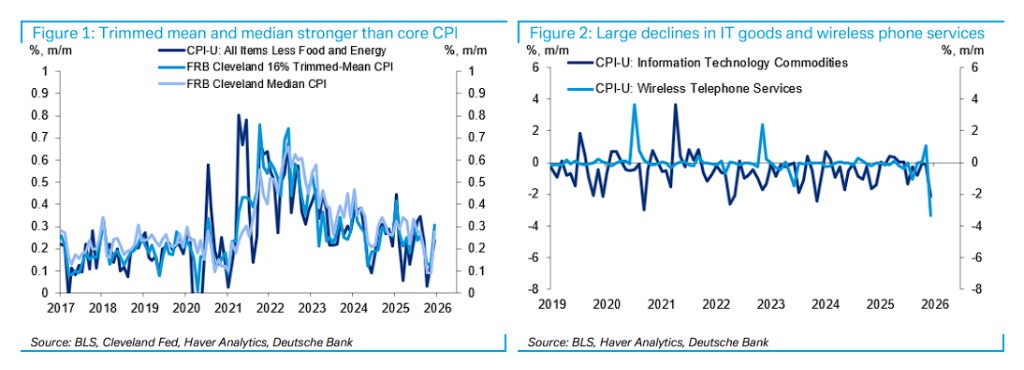
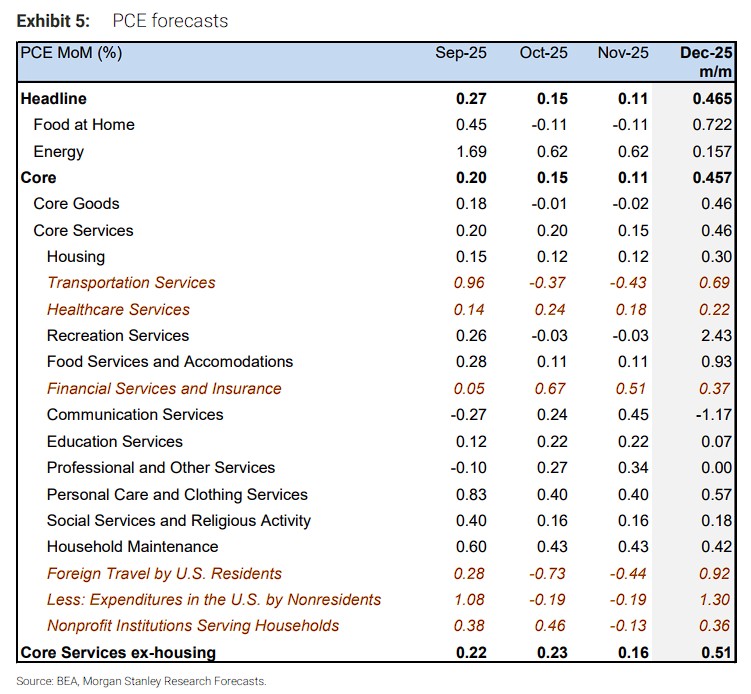
Deutsche Bank stated that part of the cooling is due to an unusually large decline in information technology goods and wireless telephone services, which together lowered the core CPI by about 6 basis points. The trimmed mean CPI, excluding outliers, reached 2.95%, higher than the core CPI of 2.64%, indicating that underlying inflation pressures are more stubborn. Morgan Stanley warned of a "scissors gap" between CPI and PCE, predicting that the core PCE price index will reach a month-on-month rate of 0.46% in December, far exceeding the performance of CPI
The U.S. December CPI data appears mild, but in reality, it is a "fake move" filled with traps. According to the latest research reports from Deutsche Bank and Morgan Stanley, this "positive" report is full of unsustainable noise and statistical distortions. The real test will be the PCE data released next week!
According to an article from Wallstreetcn, data released by the U.S. Bureau of Labor Statistics on January 13 shows that the December CPI year-on-year and month-on-month met expectations, with the core CPI year-on-year increase at 2.6%, the lowest level since March 2021, and below the expected 2.7%; month-on-month at 0.2%, below the expected 0.3%.
Although the December CPI seems to provide evidence of cooling inflation, the market's reaction has been tepid, and investors have not viewed this as a signal for the Federal Reserve to accelerate interest rate cuts. On January 14, according to news from the Wind Trading Desk, Deutsche Bank and Morgan Stanley believe the key reason is: this data may be distorted, and the core PCE inflation indicator, which truly determines the Federal Reserve's policy path, is expected to rebound significantly.
Deutsche Bank analysts bluntly stated in their report that the December CPI data is "filled with distortions and outliers," and part of the cooling is due to an unusually large drop in information technology goods and wireless telephone services, which together lowered the core CPI by about 6 basis points. The trimmed mean CPI and median CPI from the Cleveland Fed, excluding outliers, were 0.31% and 0.28%, respectively, both stronger than the core CPI, indicating that underlying inflation pressures are actually more stubborn.
Morgan Stanley warned in their report that despite the core CPI being lower than expected, its estimation of the core Personal Consumption Expenditures (PCE) price index indicates that the December PCE price index month-on-month may reach 0.46%, far exceeding the CPI performance. This unusual divergence stems from the differences in weight of goods and services in the two indicators—items with higher weights in the PCE have seen larger increases. According to the Wallstreetcn calendar, the November core PCE price index report will be released next Thursday.
The market now needs to wait for the PCE data to confirm the true inflation trend. Analysts believe that if the PCE rebounds as expected, the Federal Reserve's room for continued interest rate cuts will be significantly constrained.
Deutsche Bank Analysis: CPI "inflated" severely, outliers mask the true inflation hardness
The cooling of the December CPI data is largely due to technical factors.
Deutsche Bank pointed out that the price of information technology goods fell by 2.16%, and wireless telephone services fell by 3.33%, which together had a downward drag of about 6 basis points on the core CPI. These abnormal fluctuations do not represent a sustained trend.
Indicators that better reflect underlying inflation tell a different story.
According to the research report, the trimmed mean CPI from the Cleveland Federal Reserve, after excluding outliers, rose 2.95% year-on-year, while the median CPI rose 3.08% year-on-year, both significantly higher than the core CPI's year-on-year growth rate of 2.64%. This indicates that when extreme fluctuations are excluded, inflationary pressures are actually more entrenched.
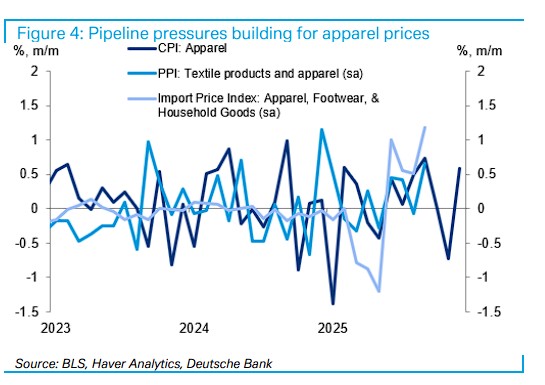
At the commodity level, clothing prices increased by 0.59%, marking the second-largest monthly increase since February 2025; household goods prices rose by 0.54%, the third-largest increase since November 2024.
Deutsche Bank believes this may reflect a correction of distortions caused by data collection delays due to the government shutdown. The price collection point in November was closer to the holiday promotion period, artificially suppressing the data for that month, while December saw a reverse correction.
The report from Deutsche Bank noted that housing rents are showing signs of recovery. The monthly rate of primary residence rent increased by 0.26%, and the owners' equivalent rent rose by 0.31%, both returning to the average growth rate seen in the first nine months of 2025.
The bank specifically pointed out that this rebound is not due to data missing from the government shutdown (the related impact will appear in April), but rather a genuine increase in prices. While the market generally holds an optimistic view on the prospects of rent deflation, this data undoubtedly douses that perspective with cold water.
Morgan Stanley Warns: Huge "Wedge," PCE May See Astonishing Rebound Next Week
This may be the most overlooked risk point in the current market.
Morgan Stanley warned that a huge "wedge" is forming between CPI and PCE. Based on this seemingly mild CPI report, Morgan Stanley has instead significantly raised its forecast for core PCE.
The bank raised its December core PCE month-on-month forecast from the previous 0.37% to 0.46%, a calculation based on the detailed CPI data, but the conclusion is completely opposite to the overall performance of CPI. This divergence stems from the fundamental differences in weight distribution between the two inflation indicators.

The categories of goods and services with higher weights in PCE performed strongly in December. Video media rental prices surged 19.5% month-on-month, contributing about 8 basis points to core PCE; software prices rose, contributing another approximately 8 basis points.
Morgan Stanley stated that if these two items are excluded, the core PCE month-on-month valuation would drop to 0.30%, but the importance of these two items in the PCE basket cannot be ignored.
Additionally, Morgan Stanley predicts that core goods PCE month-on-month will reach 0.46%, far exceeding the flat performance of core goods in CPI. This difference arises from the weakness of new and used cars in CPI, while prices of goods with higher weights in PCE, such as appliances, software, and electronics, are accelerating.
Analysis indicates that this divergence poses a dilemma for the Federal Reserve. The CPI, as the inflation indicator most familiar to the public, shows cooling, which may enhance market expectations for interest rate cuts; however, the PCE indicator that the Federal Reserve is truly focused on may indicate a re-acceleration of inflation. If Morgan Stanley's prediction is accurate, the year-on-year core PCE in December will rise to 2.90%, far exceeding November's 2.67%. **
The Effects of Tariffs Begin to Emerge
Signs of tariff impacts have begun to surface in inflation data. Both Deutsche Bank and Morgan Stanley have noted the ongoing upward pressure of tariffs on commodity prices.
Morgan Stanley's breakdown shows that prices of goods more sensitive to tariffs rose again in December, continuing the upward trend after a brief decline in October and November.
Deutsche Bank specifically pointed out that although clothing prices have not yet significantly reflected the impact of tariffs, there is already pressure building upstream in the supply chain. The clothing category in import prices and the Producer Price Index (PPI) indicates that pipeline pressures are forming. This suggests that a rise in consumer prices may just be a matter of time.

How Will the Federal Reserve Respond?
Analysts believe that in the face of noisy data, the Federal Reserve is unlikely to rush to signal further interest rate cuts.
Deutsche Bank clearly stated that the December CPI data is a mix of distorted November data and genuine signs of weakness, and the Federal Reserve "is likely to want to see more data before feeling comfortable enough to signal any further rate cuts."
Morgan Stanley believes that the Federal Reserve can identify the "noise" in the data and "is likely to downplay the apparent strength shown in the core PCE estimates." However, even so, the uncertainty of the data itself is enough to keep the Federal Reserve cautious