Ice and Fire: U.S. Electricity Prices Are About to Explode, While China's Electricity Prices Have Started to Decline

Wallstreetcn
2026.01.14 03:40
portai
I'm PortAI, I can summarize articles.

The U.S. electricity market has seen prices reach regulatory limits due to a surge in demand from AI and data centers, with Trump pressuring tech companies to bear the costs. Meanwhile, electricity prices in China have significantly dropped due to the expansion of renewable energy, with contract prices in core economic provinces falling. A report from Bank of America Merrill Lynch indicates that the proxy purchase electricity price in January 2026 has decreased by 10% year-on-year. The auction prices from U.S. grid operator PJM have hit a record high, and without price controls, electricity prices could rise another 60%

The global power market is experiencing significant differentiation.

In the United States, the explosive growth of artificial intelligence (AI) and data centers is pushing the power grid to its limits, with capacity prices reaching regulatory ceilings, forcing regulators to intervene in cost-sharing; meanwhile, in China, the rapid expansion of renewable energy installations is leading electricity prices into a significant downward channel, with industrial and commercial electricity costs facing reevaluation.

Recent market data shows that the latest auction prices from PJM, the largest grid operator in the U.S., have reached historical highs. Without price controls, demand from data centers would have driven electricity prices up by another 60%. In response, U.S. President-elect Trump has clearly pressured technology giants to "foot the bill" for the surging electricity demand. This political game has directly intensified market concerns about the operating costs of utility sectors and technology companies.

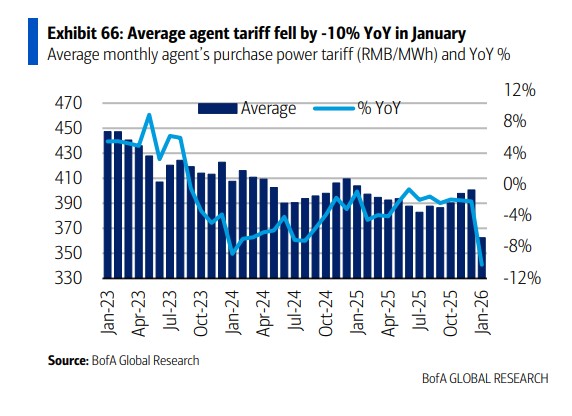
Meanwhile, across the ocean, the Chinese market presents a starkly different picture. According to the latest research report released by BofA Global Research, the downward trend in China's electricity prices is intensifying. The proxy purchase price for January 2026 has dropped significantly by 10% year-on-year, with annual electricity contract prices in key economic provinces such as Guangdong and Jiangsu showing notable declines.

United States: AI Overwhelms the Power Grid, Trump Pressures Tech Giants

The supply-demand contradiction in the U.S. electricity market has reached a critical point.

Wall Street Journal reported that PJM Interconnection, the largest grid operator in the U.S., saw the price of generation capacity rise to $333.40 per megawatt-day (MW-day) in the basic residual auction for 2027/2028, breaking records and directly hitting the price ceiling approved by the Federal Energy Regulatory Commission (FERC).

Even more astonishing is the regulated "shadow price." Auction report details indicate that if the price ceiling were removed, the simulated market clearing price would soar to $529.80 per megawatt-day. This means that in a completely unregulated market environment, the enormous demand from data centers would push electricity prices up nearly 60% from the current "cap price."

Goldman Sachs warned that if future auctions eliminate the price cap, U.S. electricity bills could double, and the market may face an extreme test of choosing between "AI development" and "reliability of basic electricity supply."

In the face of uncontrollable electricity price expectations, political pressure has followed.

Trump stated on social media platform Truth Social that while data centers are crucial for the prosperity of AI, large technology companies that build these facilities must "foot the bill" themselves, rather than passing costs onto ordinary consumers.

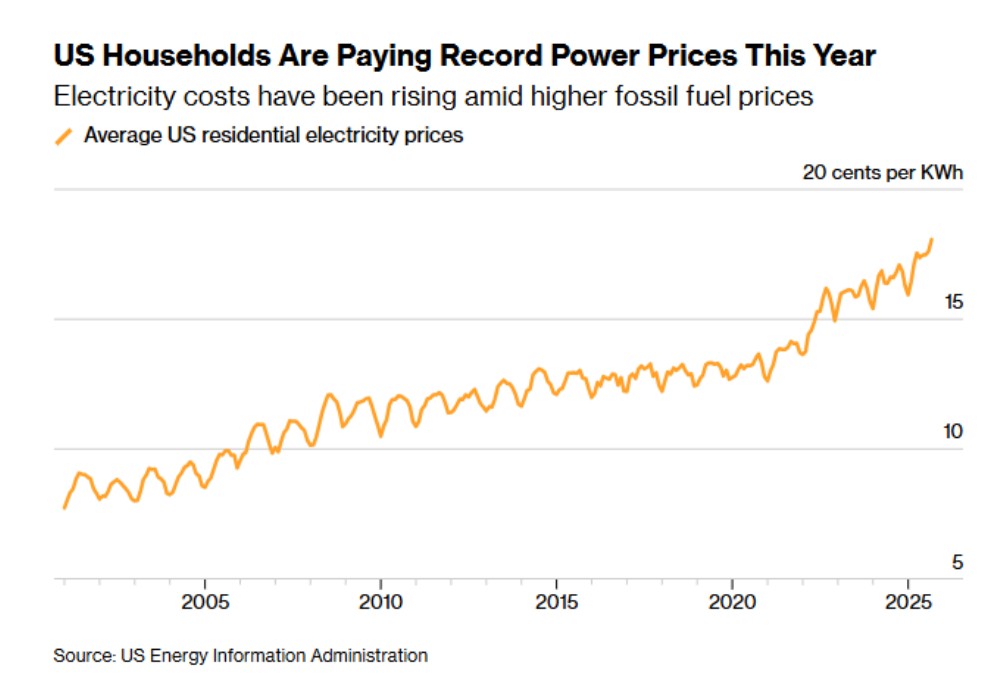
He revealed that the government has engaged in discussions with Microsoft, which will make "significant changes." Microsoft Vice Chairman Brad Smith is expected to make a statement regarding the cost-sharing issue of AI infrastructure. This policy shift means that while tech giants enjoy the benefits of AI, they will have to bear substantial electricity infrastructure costs The U.S. Energy Information Administration (EIA) reported last November that American households' electricity expenses have reached a historical high, approaching a record of 20 cents per kilowatt-hour. With rising fuel costs and increasing demand, electricity costs are expected to climb further by 2026, with transportation and commercial users facing similar trends.

China: Significant Decline in Electricity Prices, Annual Contracts Down Across the Board

In stark contrast to the "high fever" of electricity prices in the U.S., the report "China Power: Issue 7 Power Pulse" released by Bank of America Merrill Lynch indicates that electricity prices in China are facing downward pressure.

Data shows that the agent purchase power tariff for January 2026 has decreased by 10% year-on-year, which is a drop of 4 cents per kilowatt-hour.

Bank of America Merrill Lynch pointed out that in Guangdong, annual contract prices have fallen to the floor price level; contract prices in Jiangsu have decreased by 7 cents year-on-year; Fujian and Jiangxi have seen declines of 3-4 cents, while provinces like Hubei and Liaoning have experienced drops exceeding 4-5 cents.

Early market checks indicate that, excluding capacity prices and potential rebates, the annual electricity price for 2026 may decline by 3-4 cents year-on-year nationwide. This trend confirms that the Chinese electricity market is shifting from structural tightness to looseness, with increasingly evident characteristics of a buyer's market.

Supply Loosening: Rapid Growth in Wind and Solar Installations, Decline in Thermal Power Output

The core reason for the decline in electricity prices in China is the rapid expansion on the supply side and relatively weak demand on the demand side. The Bank of America Merrill Lynch report analyzes that due to a warm winter delaying heating demand, thermal power output in December is expected to be disappointing. Data from November indicated that the weekly thermal power output, as reported by the China Electricity Council (CEC), decreased by 9% year-on-year.

At the same time, the supply of renewable energy continues to grow. Although a 44% year-on-year decrease in rainfall in December may drag down hydropower utilization hours, the water flow of Yangtze Power increased by 55% year-on-year in the fourth quarter of 2025, driving its output up by 20% year-on-year. In terms of wind power, domestic wind power bidding volume reached 167GW in 2025, which, despite a 13% year-on-year decrease, remains at a high level, and the bidding price for onshore wind turbines rebounded by 20% year-on-year in the fourth quarter of 2025, indicating strong future installation momentum.

The photovoltaic industry chain is facing more intense price competition. The report indicates that the gross margin of photovoltaic module manufacturers has fallen to a historical low (-11 cents per watt), and January pre-production data shows that the output of silicon wafers, battery cells, and modules has all declined month-on-month This kind of "involution" across the entire industry and the release of production capacity have further lowered the on-grid price of new energy electricity, thereby driving down the overall electricity price center.

Risk Warning and Disclaimer

The market has risks, and investment should be cautious. This article does not constitute personal investment advice and does not take into account the specific investment goals, financial situation, or needs of individual users. Users should consider whether any opinions, views, or conclusions in this article are suitable for their specific circumstances. Investment based on this is at one's own risk.