


Japanese stocks hit new highs, yen approaches 160! Will the Japanese election determine life and death? Deutsche Bank dissects three scenarios

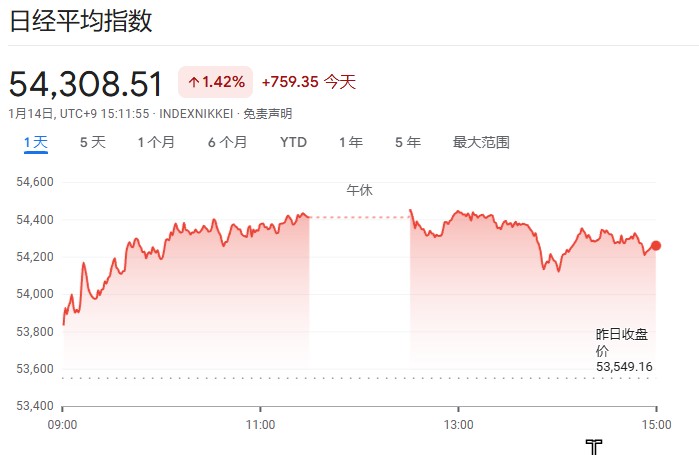
On Wednesday, Takashi Sato reiterated the consideration of holding an emergency election on February 8. The Nikkei 225 index briefly broke through the 54,000-point mark, while weak demand in the five-year government bond auction highlighted fiscal concerns. Deutsche Bank outlined three possible election outcomes: the first scenario is an absolute stable majority, where the Liberal Democratic Party secures more than 261 seats, which is seen as a bullish option for the market. The other two scenarios are a simple majority and failure to achieve a simple majority, with the latter potentially triggering a market sell-off
The expectation that Japanese Prime Minister Sanae Takaichi plans to hold early elections is stirring the financial markets, driving Japanese stocks to new highs, accelerating the depreciation of the yen, and causing bond yields to soar to decades-high levels. Investors are betting that the Liberal Democratic Party (LDP) may win the election, thereby clearing the way for large-scale fiscal stimulus, and this "Takaichi trade" is sweeping across Japanese assets.
According to a report by Xinhua News Agency citing Kyodo News on the 13th, Prime Minister Sanae Takaichi has decided to dissolve the House of Representatives on the opening day of the Diet on the 23rd and hold early elections. Takaichi reiterated on Wednesday that she is considering holding an emergency election on February 8.
The Nikkei 225 index rose more than 1% on Wednesday, briefly breaking through the 54,000-point mark, after rising over 3% the previous day to set a new historical high. The Tokyo Stock Exchange index also continued its upward trend, rising by 0.87%. This is Takaichi's first time facing voters since taking office; she supports loose monetary policy and has announced a large-scale economic stimulus plan, which is seen as a positive signal by the market.
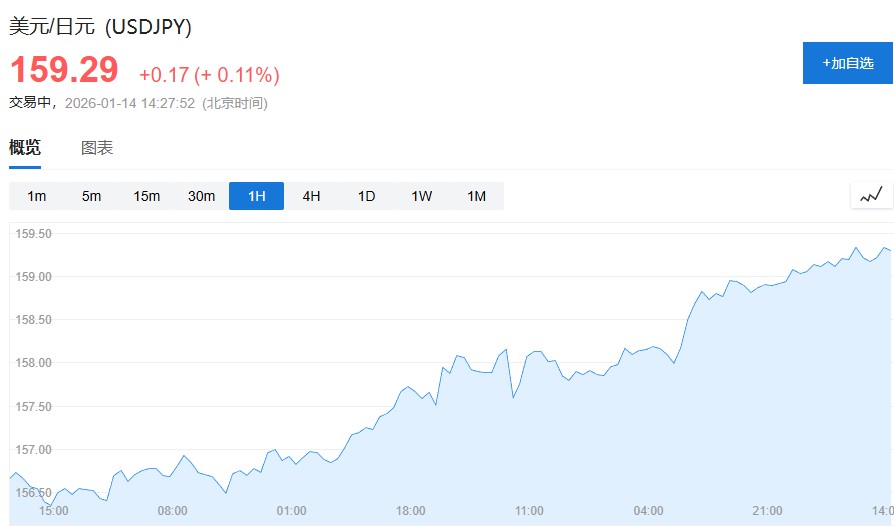
Meanwhile, the yen fell below the 159 mark against the dollar, reaching its weakest level since July 2024. Philip Wee, a senior foreign exchange strategist at DBS Group Research, stated that the market may continue to test Japanese policymakers' tolerance for yen depreciation. Due to the lack of clear guidance on the timing, scale, or triggering conditions for intervention, speculative pressure on the yen remains high, and early elections may further weaken the coordination of the Japanese Ministry of Finance and the central bank in the foreign exchange market.
The bond market has seen significant selling. The yield on Japan's five-year government bonds rose by 1.5 basis points to 1.615% on Wednesday, marking the highest level since the bond was introduced in 2000. Yields on two-year and ten-year government bonds also increased, reflecting growing investor concerns about fiscal expansion and increased debt supply.
Weak Demand in Five-Year Government Bond Auction Highlights Fiscal Concerns
The results of Wednesday's five-year government bond auction in Japan showed a significant weakening in demand, with the bid-to-cover ratio dropping to 3.08, below 3.17 in December last year and the average of 3.54 over the past 12 months, marking the weakest performance since August last year. Following the auction results, bond futures further declined.
Ken Matsumoto, a macro strategist at Crédit Agricole Securities Asia, stated that this is a relatively weak result, which may reflect market expectations that the LDP will win the election or even secure an absolute majority, making it easier for the Takaichi government to implement aggressive fiscal policies. He pointed out that if elections are held, the yield curve may steepen further.
The fragility of market sentiment is also rooted in structural changes in debt supply. Although the Takaichi government plans to launch a record initial budget in the new fiscal year starting in April, the Ministry of Finance previously announced it would reduce the issuance of ultra-long-term government bonds while increasing the sale of two-year and five-year bonds According to Bloomberg analysis, this will increase net sovereign debt supply by about 8% to approximately 65 trillion yen (USD 40.8 billion), marking the largest increase in over a decade.
Combined with the impact of the Bank of Japan reducing its bond purchase scale, this shift is expected to further push up yields. Takashi Fujiwara, Chief Fund Manager at Resona Asset Management, stated that the auction results may also reflect a weakening demand from banks for five-year bonds, as changes in the Bank's lending conditions have improved the loan-to-deposit ratio for banks.
Weak Yen May Force Central Bank to Raise Interest Rates Sooner
The continued decline of the yen may increase pressure on the Bank of Japan to raise interest rates earlier. Although the central bank raised the policy interest rate to its highest level in thirty years last December, the ongoing depreciation of the yen may compel the central bank to take quicker action.
Former Bank of Japan member Masayuki Sakurai stated in an interview that due to market concerns over the government's fiscal policy stance, the central bank may raise the benchmark interest rate as early as April. However, overnight index swaps indicate that the market has not fully priced in expectations for the first rate hike this year, which may only be fully accounted for by July, suggesting that if the yen's weakness persists, there is still room for further repricing in the market.
According to Nikkei News, the government plans to express its intention for an early election to the leadership of the Liberal Democratic Party (LDP) on Wednesday, a move seen as an attempt to leverage its high approval ratings to solidify the LDP's control over the more powerful House of Representatives. If successful, this would pave the way for a large-scale fiscal stimulus later this year while increasing Japan's fiscal premium, putting pressure on the yen and Japanese government bonds.
Three Election Scenarios Determine Market Direction
Deutsche Bank outlined three scenarios for possible election outcomes in its latest report:
The first scenario is an absolute stable majority, where the LDP secures more than 261 seats alone. This is seen as a bullish option for the market, with a strong political foundation likely to boost stock prices and weaken the yen due to expectations of fiscal expansion.
The second scenario is regaining a simple majority (233 seats) alone. Although a victory, it is precarious, with market uncertainty temporarily dissipating, but governance challenges still remain.
The third scenario is failing to secure a simple majority, which is viewed as a nightmare for the market. This would be interpreted as a substantial failure, with fears of political stagnation triggering a stock market sell-off and a safe-haven appreciation of the yen.
Investors are closely monitoring the latest statements from the government and the decisions of the LDP. For capital betting on Japan's political stability, the next month will be a critical moment to validate their beliefs. The outcome of this gamble will directly impact investors' portfolios and reshape the pricing logic of Japanese assets
