反壟斷調查,對攜程意味着什麼?

Wallstreetcn
2026.01.15 03:36
portai
我是 PortAI,我可以總結文章信息。

UBS, JP Morgan and other institutions have analyzed that, referencing the precedents of Alibaba and Meituan, this investigation may last 4-6 months, with the fine expected to be in the range of 3%-4% of the previous year's sales. The stock price of Trip.com may be trapped in a long-term sideways movement and valuation suppression in the next 4-6 months. In terms of business model, the core "pricing tool" is facing rectification, which may lead to enhanced bargaining power for suppliers, a decline in platform monetization rate, and a slowdown in advertising revenue growth

On January 14, 2026, the sword of Damocles hanging over Trip.com finally fell.

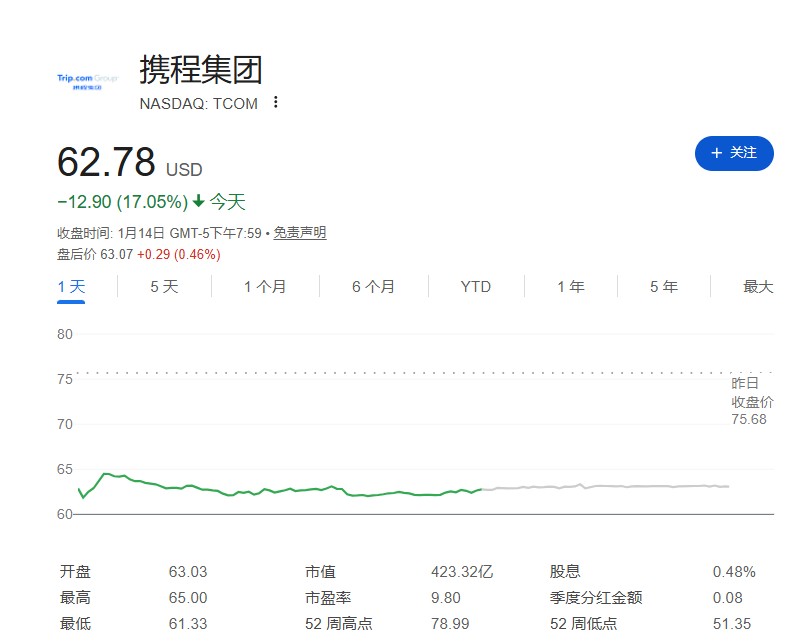
According to an announcement from the State Administration for Market Regulation, based on prior investigations and in accordance with the Anti-Monopoly Law of the People's Republic of China, a case has been filed against Trip.com Group Limited for suspected abuse of market dominance and monopolistic behavior. Upon the news, the capital market immediately shook. On January 14, Trip.com's Hong Kong stock closed down 6.49%, and its U.S. stock pre-market dropped more than 15% at one point.

In response to the investigation, Trip.com quickly stated: "We will actively cooperate with regulatory authorities and fully implement regulatory requirements," emphasizing that all business operations are currently running normally.

What does this storm mean for Trip.com? Wall Street major banks and market analysts are looking for answers from the past experiences of Alibaba and Meituan.

Stock Price Impact: From "Sharp Decline" to "Prolonged Valuation Suppression"

The panic selling in the market following the announcement of the investigation was expected. However, JP Morgan issued a warning in its latest research report: the pain for investors may not end in a few days.

JP Morgan analyst Alex Yao pointed out that, referencing past cases of Alibaba and Meituan, Trip.com's stock price is likely to enter a "range fluctuation phase" lasting 4-6 months after an initial dip.

"Before the regulatory authorities make a final penalty decision or close the case, the market can only trade based on the potential scale of fines and regulatory risks due to the slow emergence of incremental information," JP Morgan analyzed in the report. "This means that for the next six months, Trip.com's valuation will be suppressed by 'regulatory uncertainty.'"

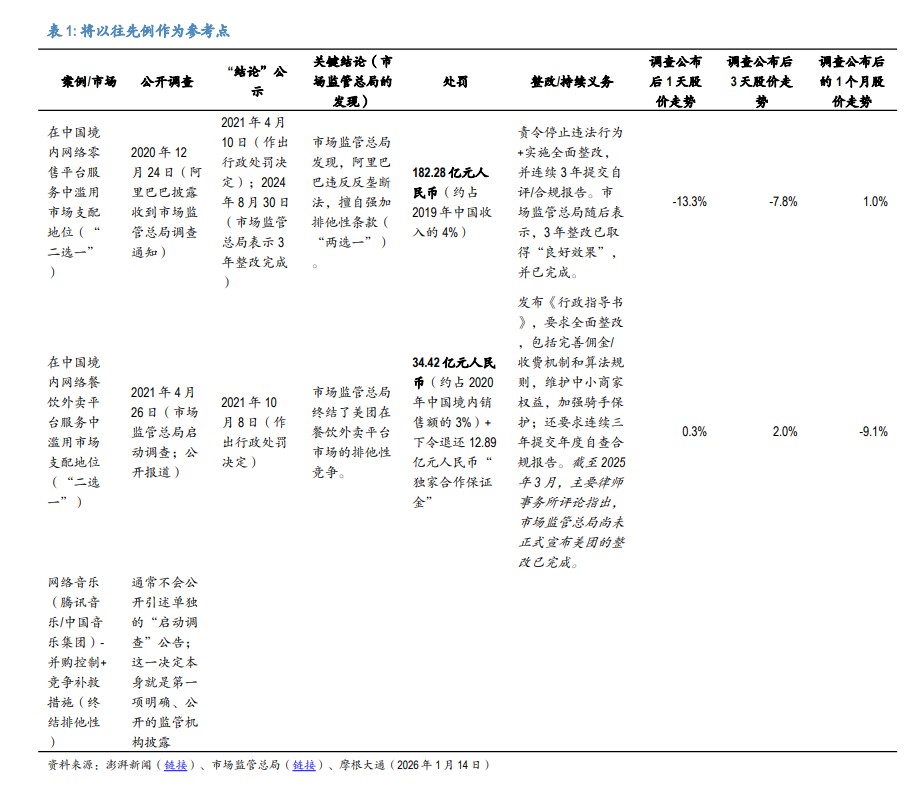
UBS reviewed historical data: Alibaba's H-shares fell 13.3% on the day the investigation was announced, while Meituan only fell 0.3% (as it was already anticipated), but during the subsequent long investigation period, market sentiment remained suppressed. Citigroup expressed a similar view, believing that the investigation will continue to affect market sentiment until it concludes, making short-term valuation adjustments inevitable.

JP Morgan also detailed the timeline of past antitrust investigations and stock price reactions through charts (as shown below).

Investigation Period May Last Six Months, Business Model Facing Reconstruction

In addition to monetary fines, the impact of the investigation process and rectification measures on the business is even more profound.

UBS predicts that it typically takes 4-6 months from the filing of the case to the announcement of the final penalty decision. During this period, market sentiment may continue to be under pressure.

JP Morgan believes that if the rectification measures restrict Trip.com's "pricing tools" or traffic allocation mechanisms, it may lead to two main impacts:

  1. Decline in Monetization Rate: The bargaining power of suppliers (such as hotels and airlines) will significantly increase, which may lead to a decrease in the platform's effective monetization rate (Take Rate)
  2. Slowing Growth of Value-Added Services: If regulatory requirements for higher transparency are imposed, the growth of high-margin businesses such as advertising and product placement may be suppressed.

This means that Trip.com may not be able to generate excess returns as strongly as in the past. However, major institutions generally believe that Trip.com's industry position is unlikely to be shaken by this.

Citigroup stated in its report: "The investigation may affect market sentiment towards the company before it concludes, but it is unlikely to change Trip.com's industry position."

JP Morgan also holds a similar view, pointing out that the remedies for China's platform antitrust cases "are more about compressing 'rule-based' advantages rather than creating new winners."

From "Local Interviews" to "National Bureau Case Filing"

This case filing did not come without warning. JP Morgan pointed out in its latest research report that this investigation is an escalation of enforcement rather than a surprise attack.

Analyst Alex Yao stated in the report: "We believe this is an enforcement action targeting individual companies driven by complaints/evidence, rather than a directional tightening of China's overall platform regulatory stance."

In fact, as early as the second half of 2025, regulatory signals targeting Trip.com had been frequently raised.

  • August 2025: The Guizhou Provincial Market Supervision Administration held concentrated interviews with Trip.com and other platforms, directly addressing issues of "choose one from two" and technical intervention in pricing.

  • September 2025: The Zhengzhou Municipal Supervision Bureau issued a "Notice of Correction," requiring Trip.com to optimize its pricing tools.

  • December 2025: The Yunnan Provincial Tourism Homestay Industry Association initiated antitrust rights protection, accusing the platform of having "unfair clauses."

JP Morgan's analysis suggests that the trigger for this investigation mainly revolves around "suppliers' pricing autonomy." In particular, the controversial "pricing assistant" and other tools have been questioned by merchants for limiting their independent pricing capabilities. When local administrative interviews failed to resolve the issue thoroughly, the regulatory level naturally escalated from local to national.

Billions in Fines? Referencing Alibaba and Meituan Precedents

Regarding the penalties that investors are most concerned about, several investment banks have conducted calculations based on the Antitrust Law and past cases.

According to the Anti-Monopoly Law of the People's Republic of China, operators who abuse their dominant market position may be fined between 1% and 10% of the previous year's sales.

UBS analyzed the precedents of Alibaba and Meituan in its report on January 15:

  • Alibaba: In 2021, it was fined 18.228 billion yuan, approximately 4% of its 2019 revenue in China.

  • Meituan: In 2021, it was fined 3.442 billion yuan, approximately 3% of its 2020 sales in China.

Analyst Wei Xiong pointed out: "If a similar statutory range is applied, we estimate that Trip.com's potential fine could be around 3.92 billion yuan, which could account for 2%-18% of its estimated Non-GAAP net profit for 2026."

Citigroup analysts Brian Gong and others provided a broader estimate range. Citigroup stated in its report that if Trip.com is found to be in violation, the fine could range from 1% to 10% of the previous year's revenue, thus it may face fines of approximately 490 million to 4.9 billion yuan

Internal and External Challenges Amid Intensifying Competition

In addition to regulatory pressure, Trip.com is facing increasingly fierce market competition.

Since 2025, giants like JD.com and Alibaba's Fliggy have been making frequent moves in the hotel and travel sector. The JD.com app has launched a primary entry point for "lifestyle travel," and Fliggy saw a significant increase in GMV during the National Day holiday. Data from QuestMobile shows that as of June 2025, the user overlap among Trip.com, Meituan, and JD.com reached 65.21 million, a year-on-year increase of 20.4%.

Analysts at Huatai Securities have previously issued a warning: "The monopoly investigation and compliance rectification issues faced by Trip.com may put pressure on its profit growth in the next 1-2 years; at the same time, the intensification of industry competition may trigger a price war, further eroding profit margins."

Investor feedback collected by UBS indicates that current market concerns are mainly focused on two points: "In addition to economic penalties, will there be fundamental impacts on the business model?" and "Will the recent profit margin outlook and long-term market share be affected?"

As the sword of Damocles falls, is it the end of bad news or the beginning of an adjustment? As one analyst put it: "For the market, the key is where the boundaries of rectification lie."