


Is this time different? This round of "lithium price bull market" is different from history

Deutsche Bank pointed out that the lithium market is entering a new rational cycle. The core driving force behind this round of price increases has shifted from past policy-driven factors to the rigid demand for energy storage driven by AI and data centers. Coupled with the improvement of market tools and China's production capacity discipline, this indicates that lithium prices are breaking away from previous irrational fluctuations and entering a new stage characterized by stronger fundamentals and resilience
Old players in the lithium market are well aware of the brutal cyclicality of this industry—it's an "immature" commodity where demand often grows at double-digit rates, but prices are extremely unstable. However, Deutsche Bank believes that while history often rhymes, this time the melody may have truly changed.
According to the Wind Trading Desk, on January 14, Deutsche Bank's Corinne Blanchard team pointed out in their latest research report that lithium reached the bottom of its cycle in the summer of 2025 (around August). Since then, lithium spot prices have climbed approximately 160% from their lows, while futures have soared by 180%. Unlike the past electric vehicle (EV) frenzy driven by government subsidies and supply chain shocks, the foundation of this bull market is more solid: it is built on a mature market that has expanded 11 times and is driven by the "rigid demand" for battery energy storage systems (BESS) from AI and data centers.
For investors, this means that the past "basket" of speculative strategies may no longer be effective. The market is returning to fundamentals, and the abundance of financial instruments (such as futures) has increased transparency, while the restart of idle capacity will suppress uncontrolled price surges. This marks a shift from "irrational exuberance" to "rational growth."
Review: The Cycle of Boom and Bust
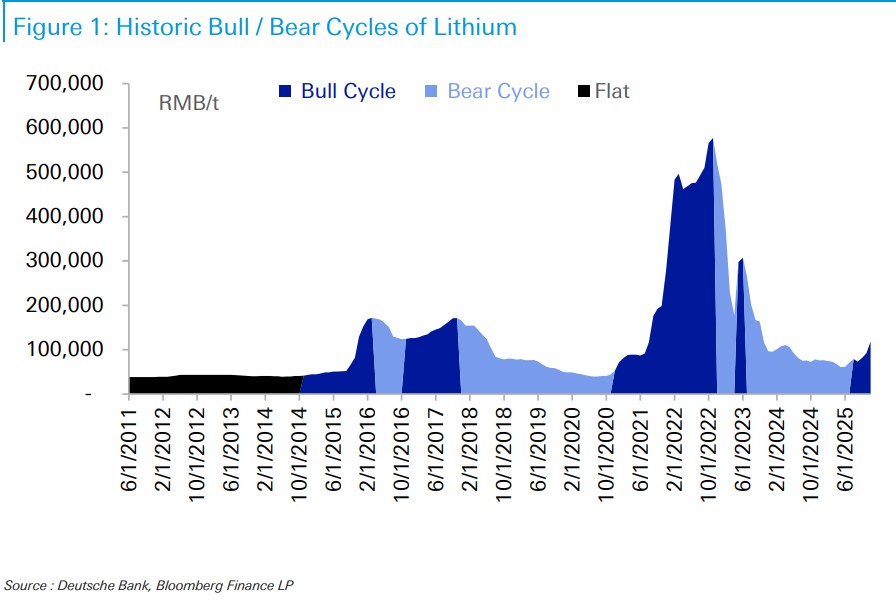
Over the past 15 years, the lithium market has experienced 5 "booms" and 4 "busts" (defined as fluctuations exceeding 20% between peaks and troughs).
-
Average Cycle: Boom periods last an average of 13 months, while bust periods last an average of 18 months.
-
Super Bust (2021-2022): Lasted approximately 25 months.
-
Most Recent Bottom: August 2025.
Historical price fluctuations often stem from the small scale of the market and severe mismatches in supply and demand. For example, the boom of 2016-2017 was based on overly optimistic expectations for energy storage systems (ESS); while the "irrational exuberance" of 2020-2022 pushed spot prices to a peak of about $82/kg, followed by a collapse of "over-rationalization" from 2023 to 2025, with prices plummeting to a low of $8/kg, a nearly 90% drop.
Deutsche Bank specifically mentioned the "dead cat bounce" in the summer of 2023, when prices briefly rebounded to $69/kg driven by sentiment, but then resumed their downward trend in July.
Drivers: Dornbusch Overshooting and Policy Whipsaw
Why do lithium prices always experience wild fluctuations? The report identified three key factors:
-
Dornbusch Overshooting Mechanism: Similar to the foreign exchange market, lithium prices often "overshoot" in response to shocks. Spot prices react quickly, while corporate pricing lags behind, and new supply reacts extremely slowly to price signals, leading to amplified supply-demand shocks.
-
Market Scale Effect: Although the market has significantly grown now, it was previously a very small market. Minor changes in supply-demand balance can trigger massive price fluctuations
-
Dynamic Policy Impact: From government support on the supply side (such as China's anti-involution policy) to EV subsidies on the demand side, policies often exacerbate overheating in the market and intensify overcapacity when the market is too cold.
Why This Time is Different: The New Narrative of AI and Energy Storage
Investors have been cautious about commodity cycles, but Deutsche Bank believes this cycle is fundamentally different, mainly reflected in the following aspects:
-
Market Maturity and Scale: The estimated supply in 2025 is about 11 times the market size of 2015. Additionally, the introduction of financial instruments like GFEX futures provides more risk exposure management tools, reducing speculative behavior that solely relies on stock exposure, which helps form more rational valuations in a bull market.
-
China's Role and Discipline: China's share in global production has risen to 15-20%. More importantly, the recent "anti-involution" policy seems to be curbing speculative or irrational supply from entering the market, providing support for prices.
-
Shift in Demand Drivers—from EV to BESS: This is the most critical difference. Part of the past boom was driven by government-subsidized electric vehicle mandates, while the current rise is mainly driven by pure fundamental demand for Battery Energy Storage Systems (BESS).
-
AI and Data Center Theme: The demand for stable power (renewable energy + BESS) has surged in the AI and data center industries, becoming a key catalyst for the proliferation of BESS.
-
Policy Agnosticism: This demand is endogenous and organic, unlike the past EV demand that relied on government subsidies, making it more resilient.
-
-
Buffering Effect of Idle Capacity: Currently, the maintained capacity (excluding CATL) is about 115,000 tons. The restart of this capacity may bring short-term daytime fluctuations but also acts as a "circuit breaker," preventing prices from skyrocketing uncontrollably as in the past, thus avoiding subsequent catastrophic crashes.
Return of Valuation Logic
As market sentiment shifts, investors are beginning to return from "thematic investing" to "fundamental investing."
Data shows that the valuation multiples in the lithium industry (EV/EBITDA) typically peak before spot prices rise and actually decline when spot prices are at their highest. This is due to the cyclical nature of commodities and the lag in analysts' earnings forecast adjustments.
Currently, the market is refocusing on specific valuations and cash flows, rather than just broad thematic investments based on policy expectations. This shift towards value-driven investment further confirms that this cycle is being built on a more rational foundation
