


"Capacity is very tight"! Taiwan Semiconductor's performance guidance exceeds expectations across the board, and capital expenditures will significantly increase over the next three years

Taiwan Semiconductor announced that its capital expenditure plan for 2026 will reach up to $56 billion, a significant increase of 37% compared to the actual expenditure of $40.9 billion in 2025, setting a new historical high for the company. It is expected that Q1 revenue will reach between $34.6 billion and $35.8 billion, exceeding the market consensus expectation of $33.22 billion. The guidance for gross margin and operating margin is also significantly better than analysts' expectations, at 63%-65% and 54%-56%, respectively
Taiwan Semiconductor Manufacturing Company (TSMC) expects its capital expenditure to surge to $56 billion in 2026, exceeding market expectations and highlighting its strong confidence in the sustainability of the global AI boom. The company also predicts that revenue growth will approach 30% in 2026, higher than the average analyst expectations.
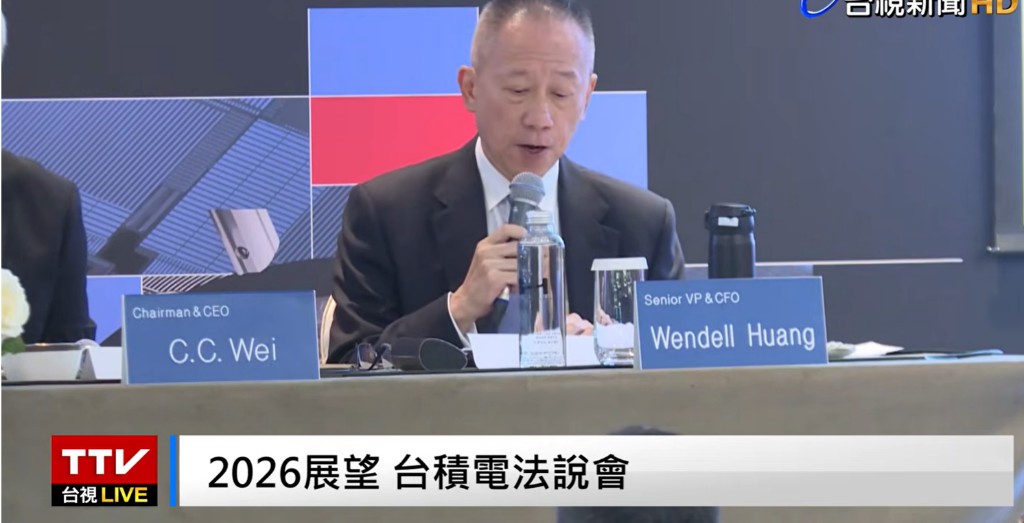
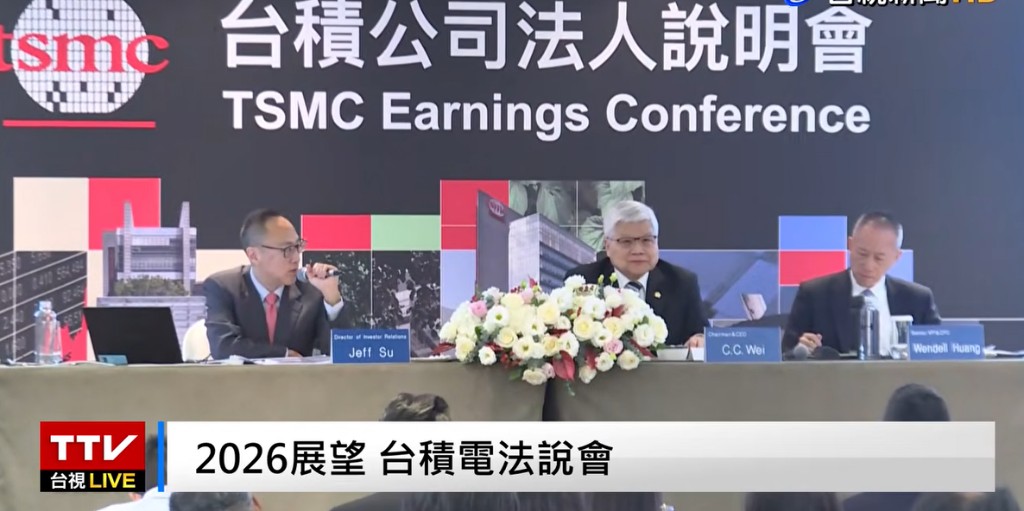
On the 15th, TSMC Chairman and CEO C.C. Wei and CFO Wendell Huang held a post-2025 Q4 earnings conference call. TSMC announced that its capital expenditure plan for 2026 will reach up to $56 billion, a significant increase of 37% compared to the actual expenditure of $40.9 billion in 2025, setting a new historical high for the company. This record-breaking investment scale underscores that the world's largest chip foundry is accelerating capacity expansion to meet the strong demand for AI chips.
The company also released first-quarter earnings guidance that exceeded market expectations. TSMC expects revenue for the current quarter to reach between $34.6 billion and $35.8 billion, higher than Bloomberg's consensus expectation of $33.22 billion. The guidance for gross margin and operating margin is also significantly better than analyst expectations, at 63%-65% and 54%-56%, far exceeding market estimates of 59.6% and 49.7%. Management stated:
“Capital expenditure will significantly increase over the next three years. Achieving a long-term gross margin of 56% or higher is attainable. … Capacity is very tight.”
Significant Increase in Capital Expenditure
As a barometer of the AI boom, TSMC's strong outlook sends a positive signal for the development of AI, a trend that has consistently supported demand for NVIDIA accelerators. This expectation may help alleviate market concerns about the sustainability of data center spending by tech giants like Meta and Amazon.
NVIDIA CEO Jensen Huang reiterated this month that demand for AI accelerators remains robust. AMD CEO Lisa Su also expressed a similar view, anticipating a renewed surge in demand for more AI computing power and user numbers. Planned expenditures for building and filling AI chip data centers have exceeded $1 trillion, helping TSMC achieve over 30% annual sales growth in the past two years.
The Q4 2025 earnings showed that TSMC's net profit reached NT$505.7 billion, a year-on-year increase of 35%, exceeding the market expectation of NT$467 billion. The gross margin improved from 59.5% in the previous quarter to 62.3%, while the operating margin jumped from 50.6% to 54%, both surpassing analyst expectations.
C.C. Wei stated that TSMC will focus on business fundamentals to further consolidate its competitive advantage. The company expects the overall wafer foundry industry to grow by 14% annually in 2026, and TSMC is confident in continuing to outpace industry growth rates due to its leading position in AI-related demand and advanced packaging technology
AI Business Proportion Exceeds 10% Strong Customer Demand
CC Wei revealed that by 2025, revenue from accelerated AI growth will account for more than 10% of total revenue. Looking ahead, the application of AI models in consumer, enterprise, and sovereign AI fields is becoming increasingly widespread, which will drive higher demand for computing power, thereby supporting strong demand for advanced processes.
Several customers and cloud service providers have sent strong signals, directly contacting Taiwan Semiconductor Manufacturing Company (TSMC) to request capacity to support their business development. CC Wei emphasized that TSMC's mission in this long-term development trend of AI remains clear, and as a foundry, its primary responsibility is to fully support customers by providing the most advanced technology and necessary capacity. With the increasing complexity of process technology, CC Wei stated that TSMC is currently collaborating with customers at least 2 to 3 years ahead of schedule. The company employs a rigorous capacity planning system that assesses market demand from both top-down and bottom-up perspectives.
The severe shortage of memory chips expected in 2025 may pose challenges to TSMC's broader business. Manufacturers are prioritizing the production of high-end, high-bandwidth memory compatible with NVIDIA and AMD chips, forcing consumer electronics manufacturers to raise prices. Industry observers such as IDC have lowered their shipment forecasts for 2026.
TSMC still relies heavily on Apple iPhone and smartphones using Qualcomm's advanced processors for a significant portion of its business. According to Bloomberg, the market generally expects the memory shortage to impact mobile device sales in 2026, with Macquarie Capital forecasting an 11.6% year-on-year decline in smartphone sales.
The following is a transcript of the earnings call, organized by AI:
- CC Wei: Chairman and Chief Executive Officer
- Jeff Su: Director of Investor Relations
- Wendell Huang: Senior Vice President and Chief Financial Officer (Spokesperson)
Jeff Su: Good afternoon, everyone. Welcome to TSMC's Q4 2025 earnings release and conference call. I am Jeff Su, the Director of Investor Relations at TSMC, and I will be your host today. This event is being streamed live on TSMC's official website, and you can also download the earnings release materials from the site. If you are joining via the conference call, your line is currently muted.
Today's agenda is as follows: First, Mr. Wendell Huang, Senior Vice President and Chief Financial Officer, will briefly summarize the operational performance for Q4 2025 and provide an outlook for Q1 2026. Following that, Mr. Huang will convey key company messages together with Dr. CC Wei, Chairman and Chief Executive Officer. Afterward, we will open the floor for questions both in-person and online.
As usual, I would like to remind everyone that today's discussion may contain forward-looking statements, which involve significant risks and uncertainties that could cause actual results to differ materially from those expressed. Please refer to the safe harbor statement in our press release. Now, I will hand the microphone over to Chief Financial Officer Wendell Huang
Jensen Huang: Thank you, Jeff. Good afternoon, everyone, and thank you for joining us today. I will first introduce the financial highlights for the fourth quarter of 2025 and provide an overview of the entire year, followed by the performance outlook for the first quarter of 2026.
Performance in the fourth quarter of 2025: Supported by strong demand for leading process technologies, revenue in the fourth quarter increased by 5.7% quarter-over-quarter (in New Taiwan Dollars). In US dollars, revenue increased by 1.9% to $33.7 billion, slightly above the expected upper limit. The gross margin rose by 2.8 percentage points quarter-over-quarter to 62.3%, mainly due to cost improvements, favorable exchange rates, and increased capacity utilization. Due to operating leverage, operating expenses accounted for 8.4% of net revenue, down from 8.9% in the third quarter. As a result, the operating profit margin increased by 3.4 percentage points quarter-over-quarter to 54%. Overall, the earnings per share (EPS) for the fourth quarter was NT$19.5, and the return on equity (ROE) was 38.8%.
Revenue by technology: The 3-nanometer process contributed 28% of the wafer revenue in the fourth quarter, while the 5-nanometer and 7-nanometer processes accounted for 35% and 14%, respectively. Advanced processes (7 nanometers and below) accounted for 77% of total wafer revenue. For the entire year, the revenue shares for 3-nanometer, 5-nanometer, and 7-nanometer were 24%, 36%, and 14%, respectively. The share of advanced processes increased from 69% in 2024 to 74%.
Revenue by platform: High-performance computing (HPC) grew by 4% quarter-over-quarter, accounting for 55% of fourth-quarter revenue; smartphones grew by 11%, accounting for 32%; the Internet of Things (IoT) grew by 3%, accounting for 5%; automotive electronics declined by 1%, accounting for 5%; and consumer electronics (DCE) declined by 22%, accounting for 1%. For the entire year of 2025, HPC revenue grew by 48% year-over-year, while smartphones, IoT, and automotive electronics grew by 11%, 15%, and 34%, respectively, with DCE remaining flat.
Balance sheet and cash flow: As of the end of the fourth quarter, the total cash and cash equivalents amounted to NT$3.1 trillion (approximately $98 billion). In terms of cash flow, operating activities generated NT$726 billion this quarter, capital expenditures were NT$357 billion, and NT$130 billion was paid in dividends. The cash balance at the end of this quarter increased to NT$2.8 trillion.
Summary of the full year 2025: With strong demand for leading processes, our performance in 2025 continued to outperform the wafer foundry industry. Total revenue reached $122 billion, a year-over-year increase of 35.9%. The gross margin rose to 59.9%, and the operating profit margin increased to 50.8%. The full-year EPS grew by 46.4% to NT$66.25. Capital expenditures for 2025 were NT$1.3 trillion (approximately $40.9 billion). Free cash flow reached NT$1 trillion, a year-over-year increase of 15.2%. A cash dividend of NT$18 per share was distributed in 2025, up from NT$14 in 2024 We expect the per-share dividend to be at least NT$23 in 2026.
Q1 2026 Outlook: Based on the current business outlook, we expect revenue in Q1 2026 to be between USD 34.6 billion and USD 35.8 billion, with a median quarter-over-quarter growth of 4% and a year-over-year growth of 38%. Assuming an exchange rate of 1 USD to 31.6 NT dollars, the gross margin is expected to be between 63% and 65%, and the operating margin is expected to be between 54% and 56%. The effective tax rate is expected to rise to 17%-18% (16% in 2025).
Key Information Conveyance: Regarding gross margin, we face several influencing factors in 2026. Favorable factors include: improved capacity utilization, N3 (3-nanometer) gross margin crossing the company average at some point in 2026, improved manufacturing efficiency, and cross-node capacity optimization (such as flexible support between N7/N5/N3). Challenging factors include: the expansion of overseas wafer fabs, which is expected to dilute gross margin by 2% to 3% in the early years, potentially expanding to 3% to 4% later. Additionally, the initial mass production of 2-nanometer technology is expected to start diluting gross margin in the second half of 2026, with an estimated annual impact of about 1%.
Capital Budget: Capital expenditures for 2026 are expected to be between USD 52 billion and USD 56 billion. About 70% to 80% will be used for advanced processes, 10% for specialty processes, and 10% to 20% for advanced packaging, testing, and mask manufacturing. Due to the mass production of 2-nanometer, depreciation expenses in 2026 are expected to increase by about 15%-19% year-over-year.
Our goal is to maintain a long-term gross margin of over 56% and a ROE of over 25%.
CC Wei: Thank you, Wendell. Good afternoon, everyone.
2026 Outlook: Strong AI demand in 2025, with a rebound in the non-AI market. Foundry 2.0 (including logic foundry, packaging, testing, etc.) is expected to grow by 16% in 2025, while TSMC's revenue is expected to grow by 35.9%, far exceeding industry levels. Looking ahead to 2026, although there are uncertainties regarding tariff policies and rising component prices (especially in the consumer market), driven by strong AI demand, we expect the Foundry 2.0 industry to grow by 14%. We are confident that TSMC will continue to outperform the industry, with expected dollar revenue growth close to 30% in 2026.
AI Demand and Long-Term Growth: AI accelerators are expected to account for a significant percentage of total revenue in 2025. We see consumers, enterprises, and sovereign AI strengthening model adoption. Our customers (especially cloud service providers) are directly contacting us for more capacity. Therefore, we have raised our revenue forecast for AI accelerators: the compound annual growth rate (CAGR) from 2024 to 2029 is expected to be close to 55%. TSMC's overall long-term dollar revenue CAGR is expected to be close to 25%
Global Manufacturing Layout:
- Arizona: The first factory is expected to start mass production in the fourth quarter of 2024. The second factory has been completed and is planned to begin mass production in the second half of 2027. The third factory has started construction, and a permit for the fourth factory (advanced packaging factory) is being applied for. We have just purchased a second large piece of land nearby to support the forward-looking AI demand, creating an independent GIGAFAB wafer fab cluster.
- Japan: The first factory in Kumamoto is expected to start mass production by the end of 2024, with excellent yield rates. The second factory has begun construction.
- Europe: The factory in Dresden, Germany is progressing as planned.
- Taiwan: New Hsinchu and Kaohsiung in Taiwan are preparing for multiple phases of 2-nanometer wafer fabs.
N2 (2-nanometer) and A16 Status: The 2-nanometer technology is expected to start mass production simultaneously in Hsinchu and Kaohsiung in the fourth quarter of 2025, with good yield rates, and is expected to ramp up quickly in 2026. N2P (enhanced version) is planned to start mass production in the second half of this year. A16 (using super electric rail technology) is planned to start mass production in the second half of 2026. We believe the N2 series will become another long-lasting and large-scale node for Taiwan Semiconductor.
Q&A Session
Host: Jeff Su Thank you, Wendell, and thank you, CC. That concludes our briefing. Now we will start the Q&A session. First, I would like to invite questions from the guests present, starting with Gokul Hariharan from JP Morgan.
Question: Gokul Hariharan (JP Morgan) Thank you, and Happy New Year to everyone. CC, over the past three to four months, you have clearly been listening carefully to customer needs. Could you elaborate on the feedback you have received regarding "demand" from customers (and their customers)? The increase in capacity commitments is quite significant. There are many concerns in the financial markets right now, particularly about whether there is an AI bubble. Since Taiwan Semiconductor is one of the major players investing heavily in this industry, I assume you have given this considerable thought.
Can you provide more details on the customer feedback you have heard and your views on the cycle? If we reference a typical semiconductor cycle, the current cycle may be slightly longer than usual, but it doesn't feel like a typical cycle.
Answer: Jeff Su (Host) Gokul, let me summarize for the online and offline audience: Gokul wants CC to discuss his views on the overall demand related to AI and the semiconductor cycle. He mentioned that Taiwan Semiconductor has significantly increased capital expenditures to support customers, but the market is concerned about an AI bubble. So he wants to understand what specific feedback CC has received from customers and their downstream clients, as well as how long he thinks this cycle will last.
Answer: CC Wei Okay, Gokul, you are essentially asking whether AI demand is real. To be honest, I am also quite nervous. We are planning to invest $52 billion to $56 billion in capital expenditures, and if we do not approach this cautiously, it could be a disaster for Taiwan Semiconductor So over the past few months, I have spent a lot of time communicating with clients and their clients.
I had to confirm that the demand was real, so I asked those Cloud Service Providers (CSPs). The answers were quite satisfactory: they demonstrated that AI is indeed helping their business growth, reflected in financial returns. I also verified their financial status—they are very wealthy, sounding even richer than Taiwan Semiconductor (laughs), so this is beyond doubt.
I specifically inquired about application scenarios. One hyperscale computing vendor told us that AI has improved the performance of their social media software, with a continuous increase in user numbers. I firmly believe this. Additionally, based on our own experience applying AI, it has indeed helped us improve the productivity of our fabs. I mentioned that a 1% to 2% productivity increase is pure profit for Taiwan Semiconductor, which is why we can maintain a satisfactory gross margin even during high-cost periods.
In summary, I believe that AI is not only real but has already begun to penetrate our daily lives. We believe this is a Mega Trend. Our American clients are requesting more support locally, so we must accelerate the expansion of our Arizona plant.
Of course, most of our capacity is still increasing in Taiwan, as it has the most complete supporting facilities and the best progress. In the U.S., we are also accelerating with the help of the government, and the progress is good, although we still need to meet various licensing requirements. In short, whether in Taiwan or Arizona, we are accelerating capacity expansion to meet AI demand. I can only say one thing: current capacity is very tight, and we are doing our utmost to narrow the supply-demand gap. This year and next, we must double our efforts. We just purchased a second piece of land in Arizona, which indicates our plans: we need to build more fabs there, and this "GIGAFAB" cluster will help improve productivity, reduce costs, and better serve our American clients.
Q: Laura Chen (Citibank) Thank you, CC and Wendell, for the detailed outlook, and congratulations on the company's achievements. The growth of AI semiconductors is very strong, and I believe clients are eager for Taiwan Semiconductor's capacity support. But I am curious, how does Taiwan Semiconductor assess the power supply issues for data centers? Besides the chips themselves, many factors in infrastructure construction are also critical. How does Taiwan Semiconductor consider these external constraints in planning?
A: CC Wei Laura, first I must tell you that my biggest concern is the power supply in Taiwan. I need sufficient power to expand capacity without limits. As for the construction of global AI data centers, I will answer you with a response from one of my client's clients, as I asked the same question.
They told me that they started planning five or six years ago. These cloud service providers are very smart. They said that the power supply has been laid out for five or six years. Today, their feedback to me is that Taiwan Semiconductor's wafer (capacity) is the bottleneck. They told me not to worry about anything else and to first solve the chip supply issue.
Of course, we are indeed observing the global power supply, especially in the United States, and even paying attention to the supply situation of supporting facilities such as turbines and nuclear power plants, as well as racks and cooling systems. Everything seems fine at the moment. Our primary task now is still to narrow the gap between TSMC's own capacity and demand.
Question: Laura Chen (Citibank) I'm glad to hear that these won't become bottlenecks for AI development. The second question is about advanced packaging processes. How much revenue did advanced packaging contribute last year? Previously, capital expenditures for advanced packaging accounted for about 10%, and now it has risen to 20%. Can you elaborate on the focus of the expansion? Is it 3D IC, SOIC, or long-term panel-level packaging? Additionally, how will the cooperation model with OSAT (Outsourced Semiconductor Assembly and Test) change in advanced packaging?
Answer: Wendell Huang (CFO) Last year, advanced packaging (backend business) contributed nearly 10% (about 8%) of revenue, and this year it is expected to slightly exceed 10%, with a growth rate over the next five years expected to be higher than the company's average level. In terms of capital expenditures, it was indeed below 10% in the past, but now advanced packaging, along with photomask manufacturing, has increased to account for 10% to 20%. Investment focus will closely follow customer demand. We are continuously investing in the areas you mentioned, such as 3D IC and SOIC.
Question: Charlie Chan (Morgan Stanley) First of all, congratulations to the management team for achieving excellent performance. The first question is: How are the market conditions outside of AI? Considering factors such as rising memory costs, what are your shipment assumptions for PCs and smartphones? Additionally, what is the growth potential for network processors and general servers in the HPC business?
Answer: CC Wei Although we refer to it as the "non-AI" field, it is actually closely related to AI. For example, network processors are still needed for AI data scale-out, so demand for network switches remains strong. As for PCs and smartphones, due to the expected rise in memory prices, we believe that growth in unit shipments will be very limited. However, for TSMC, we have not seen any changes in customer behavior, as we mainly supply high-end smartphones, which are less sensitive to memory prices, and demand remains robust. In short: we are still working hard to catch up.
Question: Charlie Chan (Morgan Stanley) The second question is about competition in Intel's foundry business. The U.S. president seems satisfied with Intel's progress and even mentioned that your major customers like NVIDIA and Apple might collaborate with Intel. Should we be concerned about market share loss? How will TSMC respond?
Answer: CC Wei To put it simply: we are not worried. Today's competition cannot be solved with money. Of course, I would like those companies you mentioned to invest in TSMC. But the fundamental issue is that the technology is too complex now. Designing a cutting-edge product takes two to three years to fully understand the process, and after product validation, it takes another one to two years to ramp up We do have a strong competitor that cannot be underestimated. But first, this takes time; secondly, we never underestimate our opponents, but we are not afraid either. Taiwan Semiconductor has been in competition for over 30 years, and we are confident in maintaining our expected growth.
Q: Arthur Lai (Macquarie Securities) There are rumors that Taiwan Semiconductor is converting 8-inch and some 12-inch mature process capacity to advanced packaging. Is this true? Is it based on power shortages or considerations of return on investment (ROI)?
A: CC Wei Yes, we are indeed reducing 8-inch capacity to invest in other areas. But rest assured, we will support all customers. We will serve our customers through more flexible and optimized resource allocation, and we will never let them down. Even for the 8-inch business, as long as there is customer demand, we will continue to provide support.
Q: Arthur Lai (Macquarie Securities) Regarding consumer electronics demand, rising memory prices may suppress consumer desire, and investors are concerned about weak demand next year. How does management view this issue?
A: CC Wei This does not affect Taiwan Semiconductor. As I mentioned, our customers focus on the high-end market and are less sensitive to component prices. Their forecasts for the next two years remain very healthy.
Q: Brett Simpson (Arete Research) Taiwan Semiconductor's AI capacity has been limited. Does your capital expenditure of $52 billion to $56 billion this year mean that supply and demand can reach balance by 2027? Additionally, is the shortage of engineering talent a bottleneck?
A: CC Wei Building a new factory takes two to three years. Even if we spend so much money this year, it contributes almost nothing to this year's output and only a little to 2027. These investments are mainly aimed at supply for 2028 and 2029, and we hope to narrow the gap by then. In the short term, for 2026 and 2027, we will mainly rely on improving the efficiency of existing capacity. Our employees are very motivated to meet customer needs. After 2028, with a significant increase in capital expenditure, capacity will be significantly enhanced. As for talent, we have been working hard to address this.
Q: Brett Simpson (Arete Research) Regarding pricing. 2025 will be the second consecutive year that Taiwan Semiconductor's average selling price (ASP) for wafers rises by about 20%. With rising costs for overseas factory production, will a 20% ASP increase become the norm?
A: Wendell Huang (CFO) With each new process generation launched, the ASP does indeed rise. However, profit margins are influenced by six factors, and price is just one of them. In recent years, price increases have only been enough to offset the cost increases brought about by inflation (such as equipment, materials, and labor). What truly supports high profit margins are: 1. Extremely high utilization rates; 2. Manufacturing excellence (productivity improvements); 3. Cross-process support (such as flexibly converting N5 capacity to N3) These efforts allow us to maintain sustainable returns, enabling continued investment to support our clients.
Q: Sunny Lin (UBS) The current trend is that new processes can still generate extremely high revenue in the fourth and fifth years of mass production, whereas previously they peaked in the second and third years. What impact does this have on finances and competition?
A: CC Wei We can say we are lucky. The current trend is to pursue low power consumption and high performance, and TSMC's technological differentiation advantage is becoming increasingly apparent. The first, second, and third waves of demand from leading customers are coming in succession, extending the demand cycle. We are making progress every year, from N2 to N2P and then to subsequent versions. This continuous innovation keeps customers closely aligned with TSMC, thus maintaining the competitiveness of their products. The current "headache" is not a decline in demand, but rather a supply shortage.
Q: Sunny Lin (UBS) Will 2 nanometers have significant revenue in 2026? Additionally, why are PC and mobile customers quickly returning to the fast lane of migrating to 2 nanometers?
A: Wendell Huang (CFO) 2 nanometers will be a larger node than 3 nanometers from the initial stage. Although the percentage may not be significant, because TSMC's overall revenue scale has increased a lot, the absolute amount will be very high.
A: CC Wei The reason is simple: all products are pursuing power consumption and performance, and our technology can provide this value. Although the cost of single transistors is increasing, the performance-to-power ratio (CP value) is improving even more. Our current challenge is how to narrow the supply-demand gap.
Q: Bruce Lu (Goldman Sachs) AI revenue is growing by over 50% annually, but token consumption is increasing by 15% each quarter, leaving a huge gap (the so-called "chip wall"). In TSMC's five-year outlook, how much computing power (GW) can you support?
A: CC Wei You stumped me (laughs). I am indeed trying to understand the growth of tokens. But from the perspective of customer products, from Hopper to Blackwell to Rubin, performance is exponentially increasing, and the computing power that can be supported is massive. From my perspective, the current bottleneck remains wafer supply, not power, at least for now.
Q: Bruce Lu (Goldman Sachs) Regarding capital expenditures, you mentioned that it will be higher in 2028-2029. In 2021, you proposed a three-year plan of $100 billion. Now that demand is stronger, will it reach $200 billion in the next three years?
A: Wendell Huang (CFO) I won't provide specific numbers, but capital expenditures in the next three years will indeed be significantly higher than the $101 billion of the past three years. The current investment is for output two to three years down the line.
Host: Jeff Su Thank you, everyone. The Q&A session ends here today. Wishing you all a Happy New Year, and see you next quarter
