A major new opportunity for CPUs? When Intel and AMD collide with the new trend of Agents

With the transformation of the AI industry structure, the demand for CPUs has surged, and Intel and AMD are facing price increase challenges, with an expected increase of 20-30% in the first quarter. TSMC's shift in production has led to a decline in PC CPU shipments, driving this trend. The importance of CPUs in the AI field is becoming increasingly prominent, especially in high-end AI server configurations, where the CPU is the core of system stability, capable of handling complex logical operations and non-parallel tasks. The market's pursuit of GPUs has overshadowed the critical position of CPUs in energy efficiency, and computing architecture is undergoing a disruptive revolution
The demand for inference has exploded, the era of Agents has arrived, and the AI industry structure is facing transformation.
Will the logic of hardware procurement undergo a major reversal?
What key dividends do Intel and AMD respectively possess?
1. What has happened? CPU Prices Rise
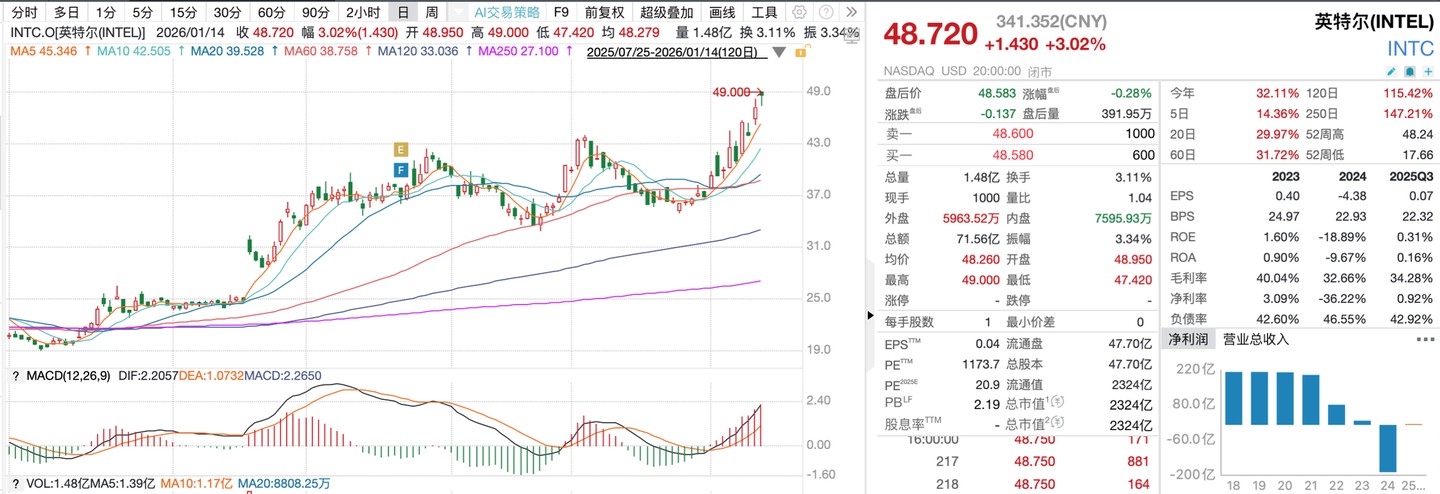
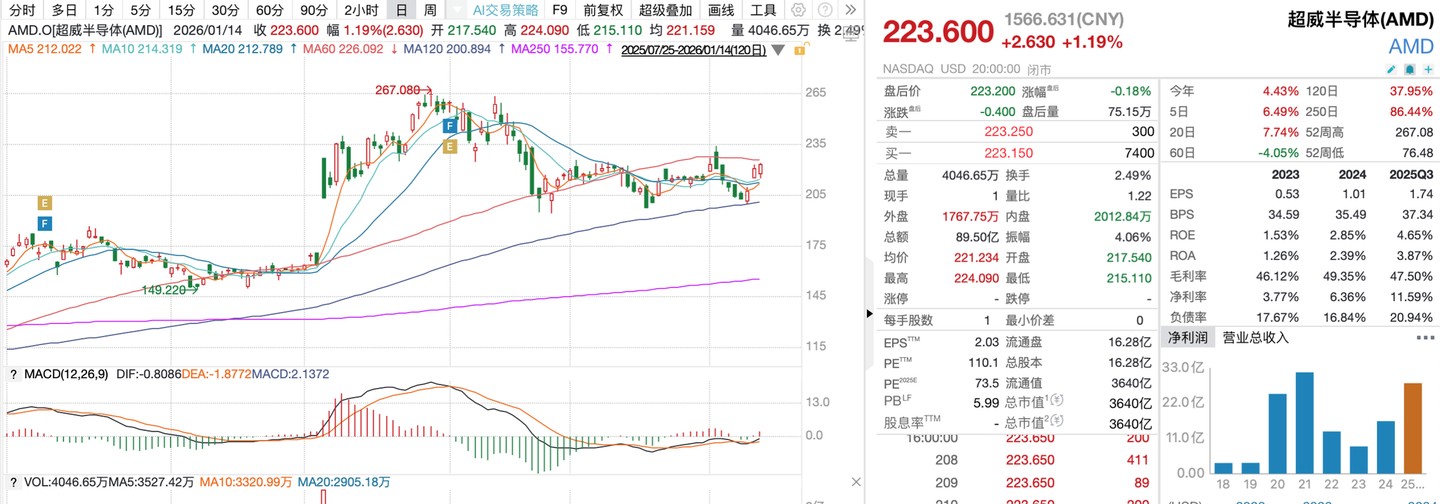
According to our communication with industry insiders, TSMC's transition to n3b will lead to a decline in its PC CPU shipment volume, resulting in price increase challenges for Chinese customers' CPUs, with an expected price increase of 20-30% in the first quarter. Leading U.S. companies Intel and AMD have recently continued to outperform market and sector indices.

In addition to the price increase expectations, CPUs also face significant opportunities for industrial logic reconstruction. In our earlier VIP article "DeepSeek Continues to Reduce Costs! Engram Technology Disrupts the Storage Revolution??", we mentioned that the explosion of thrust demand will boost CPU demand on the AI side, introducing CPUs as cost-effective engines for small language models and data preprocessing pipelines.
As the infrastructure of the computing field, the importance of CPUs is expected to be further highlighted.
① High-end AI servers generally follow the configuration of "2 high-end CPUs paired with every 8 GPUs." The CPU is the core that coordinates hardware and ensures system stability; without a CPU, server startup, monitoring, fault diagnosis, and other system-level tasks cannot be completed.
② As a general-purpose processor, it excels at handling serialized tasks and complex logical operations, covering the entire AI process (data preprocessing, model training assistance, inference, post-processing), especially suitable for non-parallel tasks that GPUs are not adept at.
③ The software ecosystem accumulated over many years (operating systems, databases, development tools) is all based on CPU design, requiring no additional adaptation; when handling non-GPU-adapted tasks, CPUs are more cost-effective, balancing performance and cost.
At this critical turning point where AI computing power is transitioning from "large model training" to "full-scene inference" and "autonomous Agents," the computing architecture is undergoing a disruptive revolution. Over the past two years, the market's fervent pursuit of GPUs and HBM (high bandwidth memory) has overshadowed the core position of general-purpose processors (CPUs) in system-level energy efficiency. However, with DeepSeek's release of the groundbreaking paper "Conditional Memory via Scalable Lookup" and the launch of its core module Engram, the underlying logic of hardware demand has been completely rewritten
II. Why is it Important? The Arrival of the Agent Era
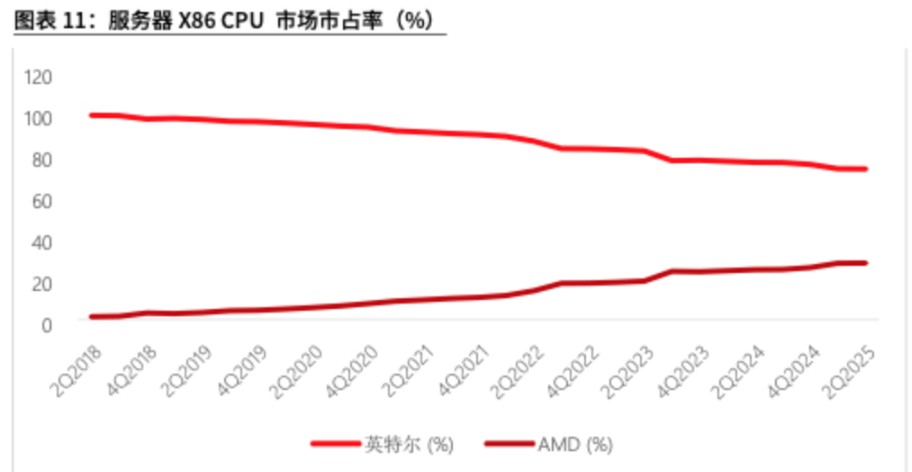
The arrival of the AI Agent era has transformed the CPU from merely being the "commander" of the system to becoming the core "productivity" in the reasoning chain. In areas such as reinforcement learning (RL) environment construction, tool invocation, and data preprocessing, the CPU is replacing the GPU as the new system bottleneck. Currently, the global server CPU market has entered a "seller's market," with lead times for Intel and AMD's main models extending to over 20 weeks, and production capacity for 2026 nearly sold out. Expert communication minutes indicate that CPU ASP (average selling price) is facing a systematic increase of 10%-15%. The early mass production of Intel's 18A process and AMD EPYC's nearly 50% market share in the data center market mark a new phase of efficiency-driven competition between the two giants. 
Source: Huaxing Securities
In the trend of AI Agents, models are no longer just outputting text; they need to perform closed-loop operations through external tools (Tools) such as Python interpreters, web searches, and database retrievals.
① Pressure of Environment Construction: When conducting Agent-related reinforcement learning training and reasoning, the CPU needs to build massive simulation tools and environments in real-time.
② Concurrency Bottleneck: The CPU determines how fast data can be concurrently generated, evaluated, and fed to the GPU. If the CPU's performance is insufficient, it will lead to a significant drop in GPU utilization, Policy Lag, and slower training convergence.
For a large number of long-tail reasoning tasks that do not require top-tier GPU computing power (such as vectorized preprocessing and small language model SLM reasoning), the CPU, with its high flexibility and low deployment threshold, has become the preferred cost-effective engine. We observe that the proportion of reasoning in AI computing is continuously increasing, which will reintroduce the CPU as the core of reasoning.
According to our latest industry research and supply chain feedback, server CPUs are facing the most severe shortage since 2021:
① Intel: The fourth and fifth generation scalable Xeon series are severely out of stock, primarily due to the AI trend driving cloud service providers (including leading North American internet companies) to purchase large quantities of older models for reasoning optimization. Current lead times have extended to over 20 weeks, and the shortage is expected to persist throughout the first half of 2026.
② AMD: Starting from Q4 2025, its fourth and fifth generation EPYC processors with 6-7 core models are also experiencing shortages.
Due to the CPU shortage and rising prices of upstream storage media, server OEM manufacturers (Lenovo, Inspur, Dell, etc.) have raised their profit requirements for complete machine shipments in Q1 2025 by 30%-40% compared to previous levels Mainstream institutions (such as KeyBanc) point out that both Intel and AMD are considering raising the ASP of server CPUs by 10%-15%.
III. What to focus on next? Intel and AMD
If the new version V4 of DeepSeek pushes Engram technology to a new peak, it will simultaneously benefit the two giants of server CPUs—Intel and AMD.
For AMD: A strong beneficiary of industry trends
① Direct benefits: AMD EPYC processors have established a good reputation in the AI inference market due to their advantages in core count, memory bandwidth, and energy efficiency. The demand for CPU computing power driven by Engram will allow AMD to directly gain market share with its existing product strength. Notes from the conference call indicate that AMD's global server CPU market share has exceeded 40%, with rapid growth in markets outside of China.
② Full-stack advantage: AMD offers a complete solution from CPU (EPYC), GPU (Instinct) to interconnect (Infinity Fabric), providing customers with a "one-stop" closed-loop choice for Engram architecture, which is attractive to customers looking to diversify their supply chains and reduce dependence on Nvidia.
For Intel: A potential disruptor of strategic synergy
Intel's benefits are more profound, with the potential to move from "recovery" to "leadership," centered on its unique strategic synergy:
① Perfect fit with the Saimemory project: Intel's joint venture with SoftBank, the Saimemory project, aims to develop low-cost, low-power stacked DRAM to replace HBM. Its goals (doubling capacity, reducing power consumption by 40-50%) align closely with Engram's demand for "large-capacity, low-cost memory." This is a unique strategic layout that AMD and other competitors do not possess.
② Advanced packaging applications: Intel's accumulation of advanced packaging technologies such as EMIB and Foveros can be used to optimize high-speed interconnections between CPUs and large-capacity memory (whether ordinary DRAM or future Saimemory), further reducing latency and enhancing the overall performance of the Engram architecture.
③ Supply chain and ecological discourse power: If the "CPU+Saimemory" route is successful, Intel is expected to break the current monopoly of the three giants in the HBM market, gaining autonomy in the critical AI storage segment and enhancing its ecological position in the AI industry chain, moving from component supplier to system-level solution provider.
What key investment dimensions should users focus on?
① Rebound in CPU and general memory (DDR5/DDR6) configurations
Since "CPU+DRAM" can perform the tasks of "GPU+HBM," the ratio of CPUs and memory capacity in inference servers will significantly increase. Manufacturers with high-performance server CPUs and deep layouts in stacked DRAM technology (such as Intel and AMD) will benefit ② Advanced packaging and stacked DRAM (HBM-Like DRAM)
To narrow the performance gap between DRAM and HBM, high-density memory modules with vertical stacking features, but not HBM, will become a cost-effective choice. Projects like Saimemory, a joint venture between SoftBank and Intel, as well as domestic pioneers in the field of advanced DRAM packaging.
③ Substantial performance realization of the CXL industry chain
Focus on CXL control chips and CXL storage expansion modules. These are the "blood vessels" for realizing the DeepSeek Engram architecture; without efficient interconnection, this "poor man's solution" cannot function.
④ The "long tail market" on the inference side: edge computing and private servers
Since billion-parameter models are no longer exclusive to HBM, this means that edge AI servers and even high-end workstations can run the full version of DeepSeek V4. This will greatly stimulate the penetration rate of consumer-grade high-performance DRAM (such as 32GB/64GB modules).
The next chapter of AI will be about inference and agents, marking the transition of computing from centralized training to widespread deployment and autonomous action. CPUs are no longer the silent background; they are stepping into the spotlight as a key pivot balancing performance, cost, and scalability. The current shortage and price increase in the CPU industry are the first shadows cast by this profound transformation. CPUs are the next core computing power segment to experience a revaluation of value and an explosion in demand, following storage, and their investment opportunities should not be overlooked.
Risk warning and disclaimer
The market has risks, and investment should be cautious. This article does not constitute personal investment advice and does not take into account the specific investment goals, financial conditions, or needs of individual users. Users should consider whether any opinions, views, or conclusions in this article align with their specific circumstances. Investment based on this is at one's own risk.