


The silver frenzy has temporarily paused, as Trump has not yet imposed tariffs on key minerals, and spot silver prices have once dropped over 7%

The Trump administration has decided to temporarily refrain from imposing comprehensive tariffs on key minerals, including silver and platinum, opting instead to seek bilateral negotiations and consider setting price floors. This decision has significantly alleviated market concerns about the U.S. taking comprehensive tariff measures. Wall Street is optimistic about the medium-term outlook for silver, believing that supply gaps, industrial consumption, and spillover demand from gold will continue to support silver prices, but warns of short-term risks
Investors taking profits, combined with the Trump administration's decision to temporarily suspend tariffs on key minerals, has led to a pullback in silver, which has seen a strong upward trend for over a year from record highs. Spot silver once fell over 7%, and other metals that set intraday records alongside silver, such as gold, copper, and tin, also declined.
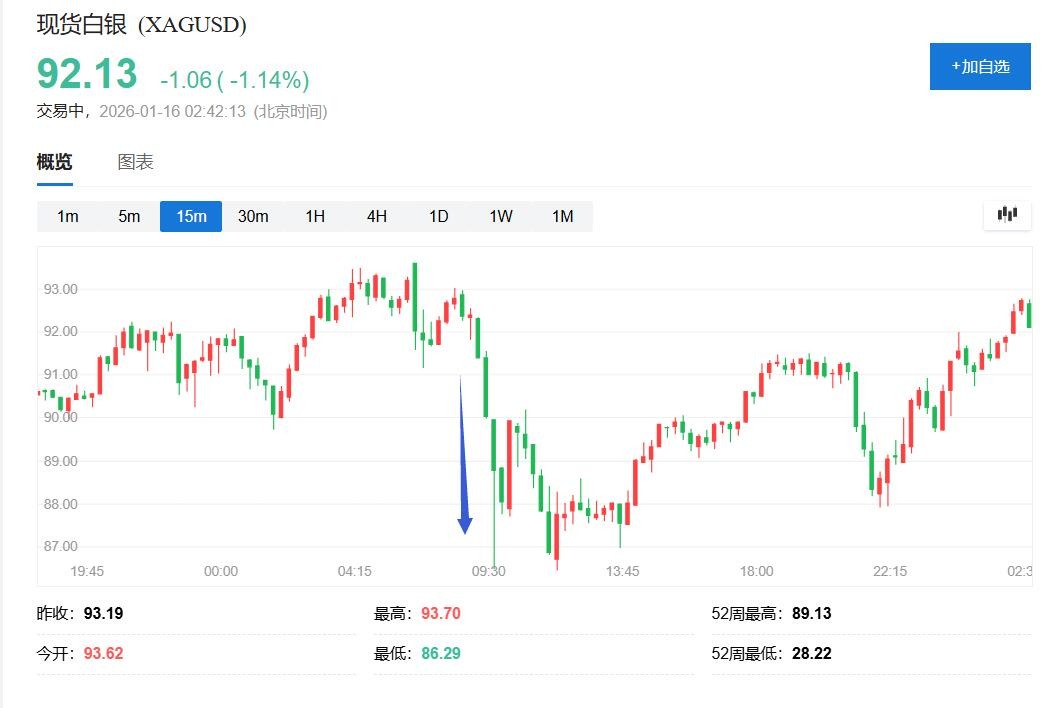
After completing a months-long national security review, the Trump administration decided not to impose comprehensive tariffs on key minerals, including silver and platinum, opting instead for bilateral negotiations and considering setting price floors. This decision significantly alleviated market concerns about the U.S. implementing comprehensive tariff measures, which had previously prompted a large amount of silver inventory to remain in U.S. warehouses, fueling a global short squeeze expected in 2025.
Despite the short-term volatility, Wall Street strategists remain optimistic about silver's medium-term prospects. Christopher Wong, a strategist at OCBC Bank, stated that supply gaps, industrial consumption, and spillover demand from gold will continue to support silver prices, but the rapid pace of recent movements means caution is needed in the short term.
Silver sharply dropped after hitting intraday historical highs for the fourth consecutive day on Thursday, having accumulated a rise of over 20% in the first four trading days. Year-to-date, silver prices have risen over 10%, continuing last year's nearly 150% increase.
Silver Falls from Record Highs, Other Metals Adjust
Spot silver rose above $93.75 at the beginning of the Asian market on Thursday, setting an intraday historical high for the fourth consecutive day, but then turned to decline and maintained a downward trend, hitting a daily low of below $86.40 during the Asian session, down nearly 7.3% for the day, with the decline narrowing to within 2% during the U.S. midday trading.
New York silver futures also turned down after reaching new highs. COMEX March silver futures rose above $93.75 at the beginning of the Asian market on Thursday, setting an intraday historical high, but fell below $86.20 during the Asian session, down nearly 5.8% for the day, with slight increases during U.S. trading.
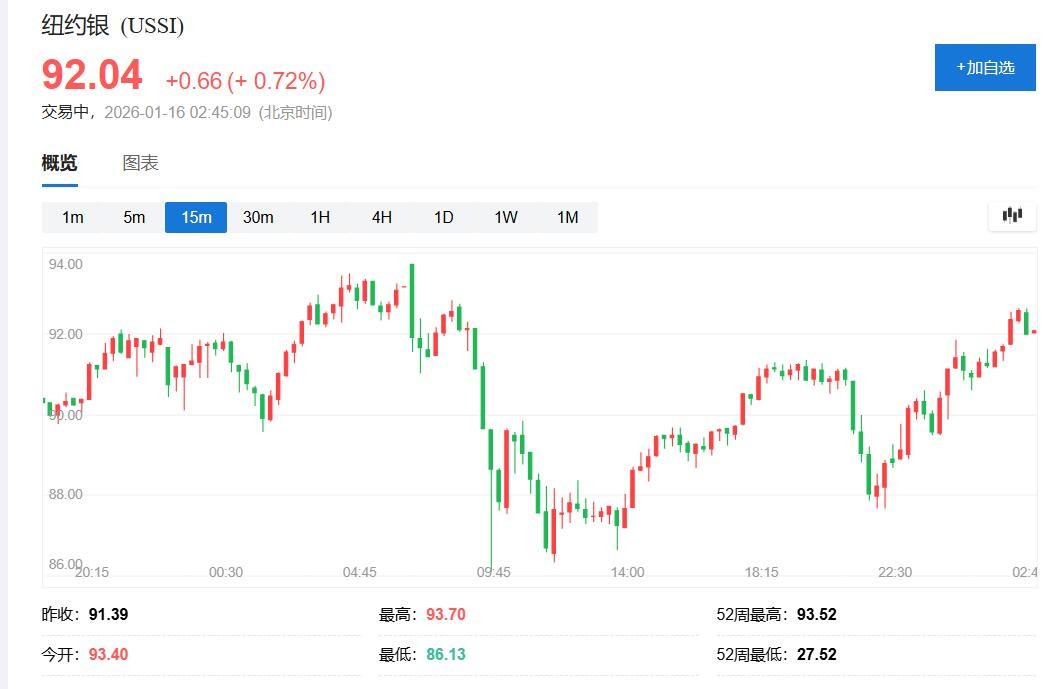
The upward momentum of other metals also stalled on Thursday. Gold was mostly in decline throughout the day, failing to set a new historical high in the first day of the last four trading days. During the Asian session, New York gold futures fell to $4584, down 1.1% for the day, while spot gold fell below $4581.40, down nearly 1% for the day.
Copper and tin, which set historical highs on Wednesday, both closed lower. LME copper futures fell about 0.6% to $13,106 per ton, failing to approach the closing record set last Tuesday. LME tin, which rose nearly 8% on Wednesday, fell nearly 2.7% to $52,031 per ton.
Trump Suspends Tariffs, Shifts to Bilateral Negotiations
U.S. President Trump has halted the imposition of comprehensive tariffs on imports of key minerals, including silver and platinum, stating that he will seek to engage in bilateral negotiations and has proposed the idea of setting price floors. This move comes after a months-long investigation into whether imports pose a threat to U.S. national security Daniel Ghali, a senior commodities strategist at TD Securities, stated in a report that Trump's decision "indicates that the U.S. government will take a more targeted approach in future decision-making." He believes this "significantly alleviates concerns about the U.S. taking comprehensive actions that could affect the physical metals supporting benchmark prices."
Concerns about potential tariffs from the U.S. have kept some metal supplies, including silver, in U.S. warehouses. The relevant warehouses at the New York Mercantile Exchange currently hold about 434 million ounces of silver, an increase of approximately 100 million ounces compared to a year ago. This has stimulated a global short squeeze in 2025 and continued to support silver prices into 2026.
Rhona O'Connell, an analyst at StoneX Group Inc., stated that these inventories could help ease tensions in other markets, but "any outflow of silver from the U.S. may encounter some degree of blockage." She pointed out that silver remains on the critical mineral list that could be targeted by future trade measures.
Multiple Factors Driving Silver Surge
Gold and silver benefited this week from broad buying in commodities, pushing precious metals like gold and silver, as well as industrial metals like copper and tin, to reach historic highs during Wednesday's trading session. The Trump administration's pressure on the Federal Reserve boosted prices and reignited the so-called "sell America" trade. Meanwhile, U.S. efforts to forcibly control Venezuelan leader Maduro, repeated threats to seize Greenland, and tensions surrounding Iran have increased safe-haven demand.
Silver outperformed gold last year, with prices rising nearly 150% over the year, while gold prices increased over 60%, reflecting a shift among some investors towards silver as gold became too expensive. Silver also benefited from strong industrial demand—particularly from the solar energy sector—and in recent weeks, buying from Chinese retail investors has added upward momentum to silver prices. Wall Street Journal mentioned last month that when silver broke through $80/ounce in the last week of 2025, the queue in front of the trading counters at Shenzhen Shuibei Market, the largest gold and jewelry trading hub in China, was even longer.
Insufficient liquidity and surging investor demand have made silver prone to sharp fluctuations in recent weeks, putting pressure on traders' risk limits. This volatility may be self-reinforcing, as rapid price changes can trigger forced selling or short covering.
Ole Hansen, head of commodity strategy at Saxo Bank, commented on social media: "Much of what traders see on their screens reflects forced capital flows, margin dynamics, options hedging, and short covering, rather than true supply and demand price discovery. In this environment, technical levels lose reliability, and stop-loss orders can be easily triggered, making it difficult for even the correct macro view to survive the short-term noise."
Wall Street Optimistic About Mid-Term Outlook but Warns of Short-Term Risks
Despite a short-term pullback in silver, Wall Street analysts remain optimistic about the mid-term outlook.
Christopher Wong, a strategist at OCBC Bank, stated that the mid-term outlook for silver remains clearly positive, supported by factors including supply gaps, industrial consumption, and spillover demand from gold However, the recent trend quickly indicates that a certain level of caution is needed in the short term.
Soojin Kim, an analyst at Mitsubishi UFJ Financial Group (MUFG), stated: "The earlier broader metal rebound was supported by geopolitical and economic uncertainties, which boosted demand for hard assets, but the tariff suspension gave the market reason to take profits and reassess recent price pressures."
According to Bloomberg's latest Markets Pulse survey, the rise in gold is expected to continue into January. While silver and copper have also reached similar milestones, there are signs that the inflow of funds into these metals is wavering as investors weigh the persistence of supply constraints.
MUFG analysts noted that the Trump administration did not immediately impose tariffs on key mineral imports, alleviating supply concerns. After months of reviewing the national security implications of certain imported products, the government did not impose tariffs but indicated that it is negotiating with trade partners to reduce U.S. dependence on other countries, without ruling out the possibility of future tariffs
