For a long time, "TSMC's largest customer," Apple now has to "snatch capacity."

Under the wave of AI, Apple's status as TSMC's "largest customer" is facing challenges. NVIDIA, due to the surge in GPU demand, has replaced Apple as TSMC's largest source of revenue for at least one to two quarters last year, and it is almost certain that it will fully surpass Apple by 2026. Apple is not only facing the largest increase in foundry prices in many years, but the more severe reality is that this iPhone manufacturer can no longer take for granted the priority scheduling of nearly twenty wafer fabs at TSMC for its chip designs as it did in the past
In the current context where the AI boom is reshaping the global semiconductor supply chain, Apple Inc.'s super VIP status as TSMC's long-term "largest customer" is facing unprecedented challenges. With chip giants like NVIDIA experiencing a sharp demand for advanced packaging capacity, Apple is not only facing the largest increase in foundry prices in years but also has to compete fiercely in a capacity allocation system that it no longer dominates.
On January 15, the news platform Culpium, which has long focused on Taiwan's semiconductor industry, reported that, according to informed sources, in addition to price increases, a more severe reality is that as GPUs from clients like NVIDIA and AMD occupy an increasingly larger area on wafers, this iPhone manufacturer can no longer take for granted priority scheduling at nearly twenty of TSMC's fabs.
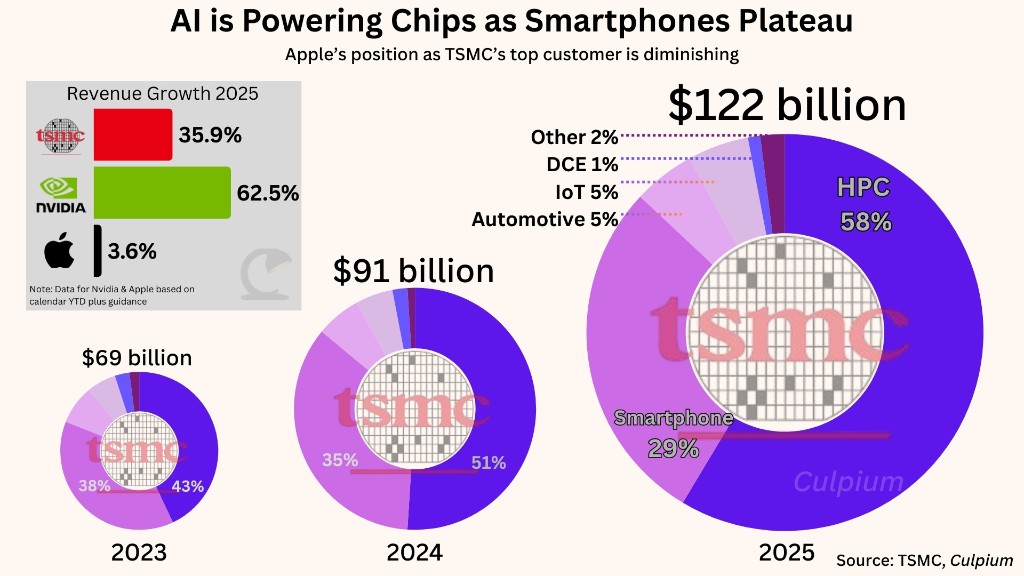
Behind this shift is a significant financial divergence. According to Culpium's analysis and supply chain news, NVIDIA is likely to have replaced Apple as TSMC's largest source of revenue for at least one or two quarters last year. If calculated on an annual basis, even if it has not fully surpassed by 2025, this transition is almost a foregone conclusion by 2026.
This also highlights TSMC's increasingly enhanced pricing power and bargaining ability. According to an article mentioned by Wall Street Insight, TSMC's latest financial report shows that its gross margin has soared to an astonishing 62.3%, approaching software company levels. Analysts point out that while Apple still provides indispensable order breadth and stability, NVIDIA is becoming the new core driving force in the pursuit of extreme performance and profits at advanced process nodes.
AI Reshaping Capacity Allocation Patterns
Although TSMC's Chief Financial Officer Wendell Huang stated that they "do not discuss specific customer rankings," public data has clearly outlined this trend.
According to Culpium's estimates, TSMC's revenue grew by 36% to $122 billion last year, while NVIDIA's sales are expected to soar by 62% by the fiscal year ending January 2026. In contrast, Apple's product revenue, excluding service business, is expected to grow by only 3.6% in the 12 months ending December 2025.
In fact, Apple's role as the main engine of TSMC's revenue growth ended five years ago. Back in 2018, without Apple's incremental purchases, TSMC's sales that year might have even declined. Now, as smartphone revenue growth slows to 11%, high-performance computing (HPC) business, including AI chips, has become TSMC's new growth pole, with this segment's revenue surging by 48% last year, continuing the previous year's high growth rate of 58%.

TSMC stated on Thursday that revenue will grow by nearly 30% in 2026, but capital expenditures will increase by about 32%, reaching a record between $52 billion and $56 billion In the long term, over the next five years until 2029, growth is expected to average 25%, but the AI business will grow at an average rate of 55% or higher during the same period. This forecast is higher than the previously expected figure of over 40%.
It is noteworthy that TSMC's latest earnings report demonstrates its ultimate strength not only in record revenue and net profit but also in gross margins that are close to those of software manufacturers and fabless chip designers. In the December quarter, this figure reached an astonishing 62.3%, up 280 basis points from the previous quarter. The gross margin would be even higher if not for overseas fabs (in Arizona and Japan).
As the AI boom continues, customers like NVIDIA and AMD are occupying a larger area per GPU on each wafer, and Apple's chip designs can no longer guarantee a place among TSMC's nearly twenty fabs.
Evolution of the Technical Roadmap is Unfavorable for Apple's Capacity Competition
According to Culpium, in the short term, the evolution of the technical roadmap seems to favor manufacturers like NVIDIA and AMD, which means Apple will still need to fight for capacity in the next year or two.
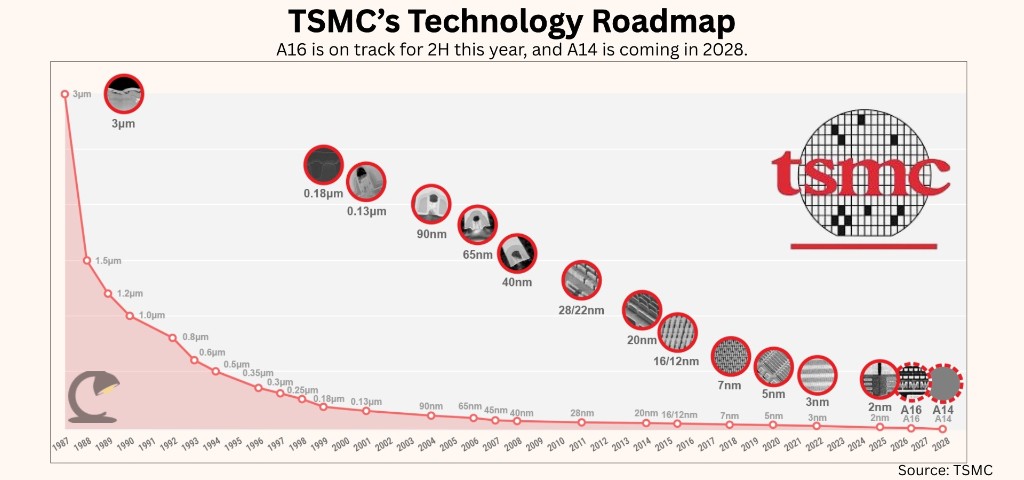
TSMC's most advanced 2-nanometer (N2) process has already entered mass production, with Apple as a major buyer, but the N2P variant and the new A16 node, which are planned for mass production in the second half of this year, will focus more on high-performance computing needs.
According to TSMC CEO C.C. Wei, the "Super Power Rail" technology used in the A16 node—i.e., the backside power delivery network—is best suited for HPC chips with complex signal routing. This technology is also a key battleground for Intel's attempts to capture foundry market share from TSMC.

Although the A14 node, expected to enter mass production in 2028, will rebalance support for mobile and HPC, at present, NVIDIA, which has a large and singular demand for advanced capacity, clearly aligns better with TSMC's current expansion pace than Apple, which has a more diversified product line.
Stability Remains Apple's Advantage
Despite external criticism from analysts like Benedict Evans regarding TSMC's expansion pace not being fast enough to meet all of NVIDIA's orders, according to a Wall Street Journal article, C.C. Wei remained highly vigilant during TSMC's earnings call yesterday.
He candidly expressed being "very nervous" during the investor meeting, emphasizing that failing to act cautiously could lead to a "huge disaster." Analysts suggest that this caution stems from TSMC's unique business model: unlike asset-light giants like Google or NVIDIA, which combine software and hardware, TSMC bears significant depreciation risks.
Data shows that TSMC's depreciation accounts for as much as 45% of its revenue costs, more than four times that of Google (10%) and nearly eight times that of fabless NVIDIA (5.7%) As a chip designer, NVIDIA enjoys a gross margin of over 70%, with its main risk lying in inventory; however, if TSMC encounters an industry downturn, the newly built fabs will become a heavy financial burden.
As Wei Zhejia stated, even with significant investments this year, the revenue contribution from this expenditure will be almost zero in the same year, but equipment depreciation will be immediately reflected on the books.
Therefore, despite Jensen Huang's rising influence, even surpassing Apple CEO Tim Cook in certain dimensions, the "stability" provided by Apple remains crucial for TSMC.
Analysis suggests that while NVIDIA's products are in high demand, they are relatively "niche" and concentrated; whereas Apple's product line spans over a dozen of TSMC's fabs, making this manufacturing footprint difficult for a single AI chip manufacturer to match. When the AI bubble eventually cools and the market growth curve flattens, the value of clients like Apple will once again become prominent