Silver soars, photovoltaic industry weeps

According to data from Bloomberg New Energy Finance, the proportion of silver paste in the total cost of photovoltaic modules has surged from 3.4% in 2023 to the current 29%. Silver paste has officially replaced silicon materials as the largest cost in photovoltaic modules. Amid the rising prices of silver, photovoltaic manufacturers are raising prices and accelerating plans to replace silver with cheaper materials such as copper. It is expected that the industry's silver usage will decrease by about 17% this year
Spot silver recovered most of its losses yesterday with a V-shaped recovery. In the eyes of commodity traders, silver prices are still in a bull market, but for photovoltaic manufacturing companies, it is a death knell regarding their survival.
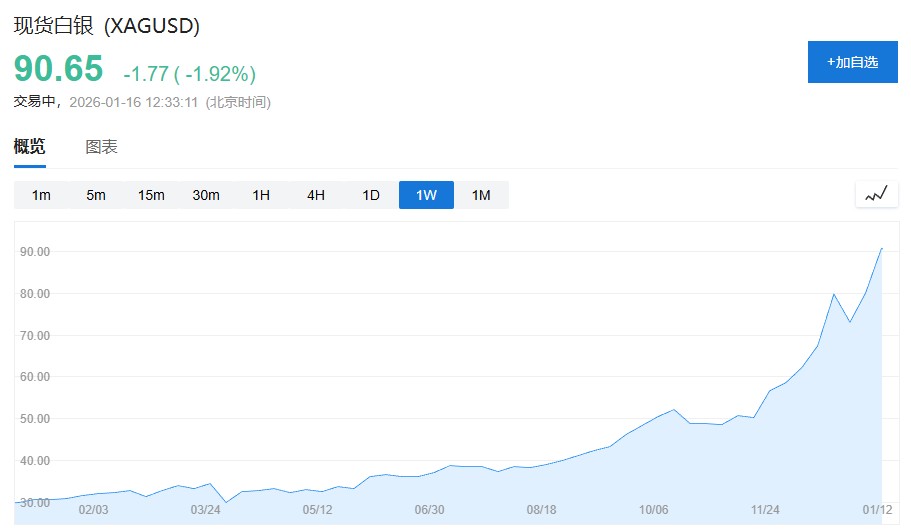
On January 16, Wallstreetcn mentioned that the Trump administration temporarily suspended tariffs on critical minerals, which once caused silver to pull back from record highs, but ultimately, the V-shaped trend recovered most of the losses during the day. Since the beginning of last year, when silver was at $29.41 per ounce, the spot silver price has increased by over 200% to date.

This increase has destroyed the cost model of the photovoltaic industry. According to Bloomberg New Energy Finance, the proportion of silver paste in the total cost of photovoltaic modules has soared from 3.4% in 2023 to the current 29%. Silver paste has officially replaced silicon materials as the largest cost factor in photovoltaic modules.
Under the rising silver prices, photovoltaic companies are facing severe tests. Some companies have chosen to halt production or raise prices to cope with challenges, while manufacturers are accelerating efforts to reduce silver usage.
For every 1,000 yuan increase in silver, costs rise by 1 cent
According to estimates, for every 1,000 yuan/kg increase in silver price, the cost per watt of solar cells will rise by 1 cent. For the thin-profit photovoltaic industry, this 1 cent is enough to determine a factory's operating rate.
BNEF analyst Yali Jiang pointed out that this surge in raw material prices has brought "irresistible cost pressure" to manufacturers.
Currently, the silver consumption of TOPCon batteries is about 10-13mg/W. If silver paste prices remain high or even rise further to 10,000 yuan/kg, the cost of just the paste will reach 0.1-0.13 yuan per watt.
This pressure is directly reflected in the end prices. InfoLink Consulting has monitored that this week, Chinese module manufacturers have raised prices by 1.4% to 3.8%, with the price of mainstream 500-watt modules rebounding to around 400 yuan (approximately $57).
Leading companies such as Longi Green Energy and Aiko Solar have recently raised their shipping prices. Aiko has explicitly stated that due to the impact of raw material prices, module costs are rising rapidly.
From "production limits to protect prices" to "production halts and holidays"
Compared to the price increase responses of leading companies, the situation for mid-tier companies is more perilous.
Cash flow depletion, broken financing channels, and inventory accumulation are forcing companies to make extreme choices: halt production.
Previously, Wallstreetcn mentioned that a battery manufacturer in Hunan with an annual production capacity of 2GW has fully halted production as of January 12, with its head stating, "There is currently no alternative plan." A more representative example is the established photovoltaic company EGing PV, whose bases in Changzhou and Chuzhou have already ceased production. Financial reports show that EGing PV's short-term liabilities exceed 2.5 billion yuan, while cash and cash equivalents are only 786 million yuan, resulting in a cash-to-short-term debt ratio of less than 0.32.
The earnings warnings issued by Trina Solar and JinkoSolar this week also confirm the chill in the industry. Despite experiencing a year-long capacity clearance and self-discipline measures, they will still face net losses in 2025.
This round of silver price surge is not merely financial speculation but a result of an imbalance in supply and demand fundamentals.
The explosion of demand in photovoltaics, AI servers, and new energy vehicles has caused industrial demand to account for 65% of total silver demand. According to SMM statistics, the silver consumption in the photovoltaic industry alone accounts for more than 15% of global silver production, with a projected supply-demand gap of 5,000 tons by 2025.
At the same time, the supply side has almost no elasticity. About 70-80% of the world's silver comes from copper, lead, zinc, and gold as by-products, and miners cannot simply expand production for the sake of rising silver prices.
Efforts to Reduce Silver Usage
In the face of high silver prices, "de-silverization" has become a necessity for survival.
LONGi Green Energy announced last week that it will accelerate the replacement of silver with base metals, and JinkoSolar and Shanghai Aiko Solar are also following suit.
SMM predicts that through technologies such as copper plating and silver-coated copper, the photovoltaic industry is expected to reduce silver usage by 17% this year. Jiang Chenyu, a photovoltaic cell analyst at Shanghai Nonferrous Metals Network, revealed that some technical routes can reduce silver content to 25%, theoretically achieving a reduction of up to 90%.
However, this aggressive substitution strategy carries significant risks. Gregor Gregersen, founder of Silver Bullion Group, warns:
If the panels fail in ten years but the warranty period is twenty years, manufacturers will face huge debts, potentially leading to bankruptcy.
Copper's chemical properties are not as stable as silver's and are prone to oxidation, while customers typically require component warranties lasting up to 20 years. Currently, large-scale copper substitution solutions lack sufficient long-term empirical data support. Jiang Chenyu also admits that the current solutions still face bottlenecks such as unstable paste printing and substandard yield rates.
At this moment, photovoltaic companies are walking a tightrope. On the left is the cash flow break caused by soaring silver prices, and on the right are the long-term landmines buried by aggressive technological substitutions. Either way, a heavy price must be paid