


Trump plans to intervene urgently in the electricity market: pressuring AI giants to sign a 15-year contract, footing the bill for a new power plant costing $15 billion

According to reports, the Trump administration will announce an emergency intervention plan on Friday, forcing tech giants to participate in special wholesale auctions and sign 15-year power purchase agreements to provide revenue guarantees for new power plants worth approximately $15 billion. This move aims to curb the surge in residential electricity prices caused by the explosion of data centers through a "self-generating" model, alleviating political pressure ahead of the midterm elections
The Trump administration will announce an unprecedented electricity market intervention plan on Friday, forcing tech giants to pay for new power plants to curb soaring residential electricity prices due to the surge in data centers. This emergency action marks the government's first direct intervention in regional electricity market pricing mechanisms, aiming to avoid electricity costs becoming a political burden for the Republican Party in this year's midterm elections without compromising AI competitiveness.
According to reports, the Trump administration has reached an agreement with several governors from northeastern states to push for a special wholesale electricity auction, requiring tech companies to bid for 15-year power supply contracts. Regardless of whether they actually use this electricity, tech companies must pay during the contract period, providing a stable revenue source for the construction of new power plants valued at approximately $15 billion. This auction will be conducted by PJM Interconnection, the largest regional grid operator in the U.S., serving 67 million customers in the northeastern region.
The backdrop for this plan is the continuous rise in electricity prices in the U.S. Data shows that the average retail electricity price in the U.S. rose by 7.4% to a historic high of 18.07 cents per kilowatt-hour in September last year; residential electricity prices surged by 10.5% from January to August 2025, marking one of the largest increases in over a decade. The surge in demand for data centers is the main factor driving up electricity prices, with PJM expecting its system peak demand to increase by 17% before 2030 compared to this year.
White House officials stated that this is a one-time emergency intervention aimed at addressing the acute issue of rapidly rising electricity prices in the Mid-Atlantic region. Trump emphasized on social media this week: "I absolutely do not want Americans to pay higher electricity bills because of data centers." The participation of Democratic governors such as Pennsylvania's Josh Shapiro and Maryland's Wes Moore is seen as a key support for this bipartisan effort.
Electricity Price Crisis Threatens Midterm Election Prospects
Rising electricity costs are becoming a significant risk for the Republican Party to maintain control of both houses of Congress. Although Trump repeatedly emphasizes the significant drop in oil and gasoline prices since he took office, electricity prices continue to rise due to surging demand, and opposition sentiment against data centers is accumulating.
According to the National Association of State Energy Officials, the increase in residential electricity prices reached 10.5% in the first eight months of 2025, a rate rarely seen in over a decade. In September last year, the average retail electricity price in the U.S. hit a record high of 18.07 cents per kilowatt-hour, up 7.4% year-on-year, marking the largest increase since December 2023.
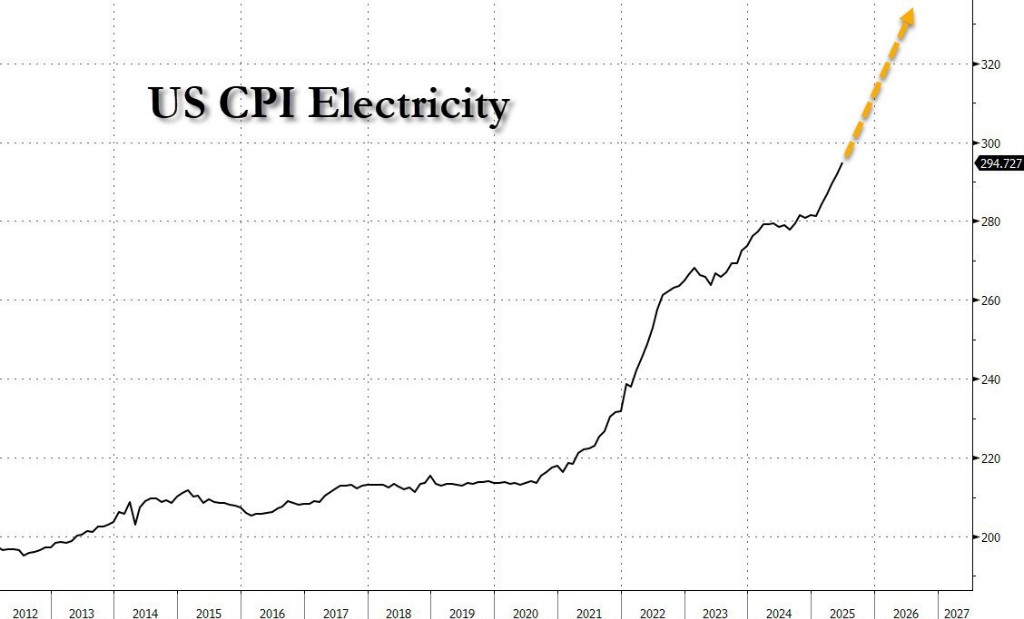
The electricity auction in the PJM region has become a political focal point in the national debate on electricity affordability. After the auction prices reached a historic high in 2024, despite Shapiro in Pennsylvania reaching a price cap agreement with PJM, the costs of the subsequent two auctions still hit new highs. The latest auction in December last year also saw a supply gap of 6.6 gigawatts, which PJM attributed to the surge in large-scale data center construction. In fact, without implicit price caps, residential electricity bills should have increased by another 60%
Mandatory Technology Giants Sign 15-Year Power Contracts
The plan announced on Friday will be presented in the form of a "principle statement" signed by the Trump National Energy Policy Council and governors from states such as Pennsylvania, Ohio, and Virginia. Although this is not a legally binding document, pressure from the Trump administration and a bipartisan coalition of governors is likely to prompt PJM to make a substantial response.
ClearView Energy Partners analyst Timothy Fox stated:
"While the 'principle statement' does not seem to include legal mandates requiring PJM to take action, pressure from the Trump administration and the bipartisan coalition of states is likely to prompt the grid operator to respond significantly."
The core of the plan is to require PJM to immediately hold a reliability backup auction—this is a mechanism that the grid operator has envisioned after multiple auction failures, but the government's and governors' plan means that an emergency auction will be held immediately after a clear failure, using special terms aimed at promoting a new wave of construction, with the only bidders being data center owners and operators.
Unlike PJM's existing 12-month term auctions, this auction will offer 15-year contracts. The White House and governors are urging PJM to hold this special one-time auction by the end of September. The startup times for new power plants may be staggered. The governors have committed to implementing and distributing these costs to data centers, ensuring that the prices of new power plants do not fall on ordinary households.
Notably, PJM representatives will not attend the announcement event on Friday. PJM spokesperson Jeffrey Shields stated in an email:
"We don't have much to say about this. We were not invited to the event they are apparently holding tomorrow, and we will not be present."
Demand Forecast Downgrade Reflects Project Delays Rather Than Weak Demand
Just two days before the Trump administration launched its intervention plan, PJM downgraded its load growth forecast for before 2032 in its annual report released on Wednesday, but raised its longer-term expectations. This adjustment was primarily due to a stricter review of planned data centers and large loads, as well as updates to electric vehicle and economic forecasts.
PJM lowered its summer peak demand forecast for 2028 by 4.4 gigawatts (a decrease of 2.6%), and the forecast for summer 2027 was lowered by about 4 gigawatts, reducing the reserve capacity gap for that capacity year to about 2.6 gigawatts. Compared to the last long-term load forecast report, large load factors caused this summer's peak load forecast to decrease by 0.7%, economic activity factors decreased by 0.5%, and electric vehicle factors decreased by 0.1%.
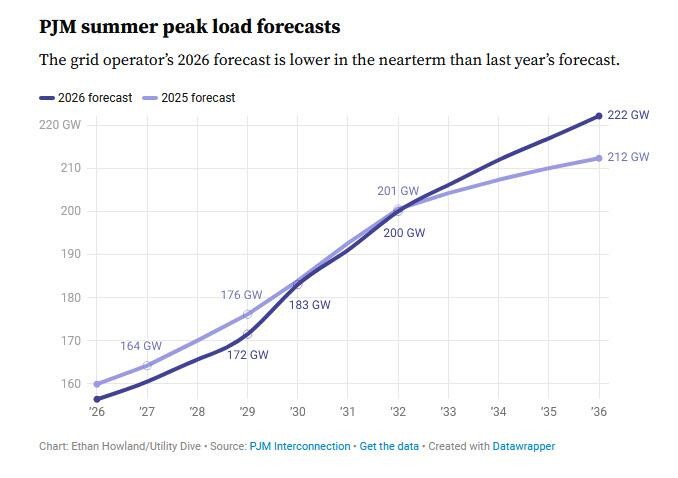
But in the longer term, PJM expects summer peak loads to grow at an annual rate of 3.6% to about 222 gigawatts by 2036, up from the previous forecast of 3.1%. The total growth over the next decade is approximately 65.7 gigawatts Investment bank Jefferies' stock analysts believe that PJM's downward adjustment of load forecasts does not indicate weak electricity demand. "We believe the load adjustment reflects delays rather than weak demand," they stated in a research report on Wednesday. "While we expect the gap in the next two auctions to improve by 3-4 gigawatts, there will still be shortages in the market—accelerating backup procurement is the right approach."
Analysts expect that even if PJM secures an additional 10 gigawatts of capacity through the procurement process, the prices in the next two capacity auctions will still "easily" reach the maximum cap of about $530 per megawatt day.
Large Tech Companies May Be Squeezed, Small AI Firms Face Cost Pressures
This plan could accelerate the development of natural gas power plants and even nuclear power stations by guaranteeing revenue and profits, specifically supporting the deployment of data centers required for artificial intelligence. The proposal may benefit large tech companies but harm the interests of smaller firms, while also favoring companies involved in advanced energy development, such as small modular reactor enterprises.
DA Davidson & Co. analyst Gil Luria pointed out that giants like Amazon, Google under Alphabet, and Microsoft have less exposure to electricity price fluctuations because they can pass these costs onto customers. However, small companies like Nebius and CoreWeave, which provide multi-year AI infrastructure contracts to cloud computing companies, may be more susceptible to significant price fluctuations as they must absorb higher electricity costs themselves.
"If they have to pay more for electricity, their margins will be squeezed," Luria stated.
Joe Bowring, president of the independent oversight organization Monitoring Analytics for PJM, said in a phone interview:
"This sounds like a significant improvement and a logical extension of the 'self-supply generation' program."
Trump's initiative will also bring another benefit: helping PJM address a major barrier—improving the accuracy of demand growth forecasts. Since tech giants will pay for the power plants they need, the proposal can eliminate speculative projects that distort demand growth forecasts.
White House officials stated that this effort has the potential to serve as a model for other regions in the United States. Government officials have discussed the plan with various stakeholders, including PJM executives, state government officials, utility companies, power plant developers, Wall Street, and the hyperscale cloud service providers building these data centers.
Friday's action was positioned as a one-time emergency intervention in the PJM market, necessary due to the rapid rise in electricity prices in the Mid-Atlantic region. White House officials indicated that after addressing this acute issue, the Trump administration and state governors would urge grid operators to return to market fundamentals. As required, PJM has also been asked to extend the auction price cap for this year.
Trump reiterated the idea that power plants should be built alongside data centers in a social media post on Monday, insisting that large tech companies building data centers must "pay for it themselves."
