Has TSMC's new "golden cycle" arrived? Goldman Sachs: Advanced packaging becomes the second growth engine, with a 60% gross margin possibly being the "new normal."

Goldman Sachs believes that Taiwan Semiconductor has entered a multi-year growth cycle driven by AI and has raised its target price to NT$ 2,600. Taiwan Semiconductor has revised its compound annual growth rate for AI and overall revenue, with advanced packaging becoming the second growth engine, expected to exceed 10% by 2026. Gross margin remains stable above 60%, and capital expenditures are accelerating to $56 billion. Goldman Sachs maintains a buy rating, emphasizing that supply and demand tightness will continue until 2027
According to news from the Wind Trading Platform, Goldman Sachs' Bruce Lu team released the latest research report on Taiwan Semiconductor on the 15th, significantly raising future growth expectations and profitability targets, believing that the company is entering a new multi-year growth cycle driven by AI. Goldman Sachs raised the 12-month target price from NT$2,330 to NT$2,600, maintaining a buy rating and its position on the Asia-Pacific confidence list.
At the analyst meeting held on January 15, Taiwan Semiconductor provided an outlook that exceeded expectations. The company raised its five-year compound annual growth rate (CAGR) for AI accelerator-related revenue (2024-2029) from the previous mid-40% to mid-to-high 50%, while also increasing the overall revenue five-year CAGR target from 20% to nearly 25%. Management stated that the supply-demand imbalance driven by AI has not yet been resolved, and advanced process capacity remains tight. Goldman Sachs expects this supply-demand gap to persist until 2027.
In terms of profitability, Taiwan Semiconductor raised its long-term gross margin target from "53% and above" to "56% and above," with the actual gross margin for the fourth quarter reaching 62.3%, exceeding market expectations. Although overseas capacity ramp-up is expected to dilute gross margins by 2-3 percentage points in 2026, improvements in production efficiency will directly contribute to profits. Goldman Sachs expects gross margins to reach 63.2% and 64.0% in 2026 and 2027, respectively, far exceeding the 59.9% expected in 2025.
In addition, advanced packaging is becoming Taiwan Semiconductor's second growth engine. Management guided that this business will account for 8% of revenue in 2025 and rise to slightly above 10% in 2026, with growth over the next five years expected to surpass the company's overall growth rate. Driven by this, Goldman Sachs raised its earnings per share forecast for 2026-27 by 11-12%.
AI Demand Drives New Growth Cycle
Taiwan Semiconductor has significantly raised its long-term growth expectations for AI business. Management currently expects AI accelerator-related revenue to grow at a mid-to-high 50% CAGR between 2024 and 2029, a significant increase from the previous mid-40%. This adjustment has led to an increase in the company's overall revenue five-year CAGR target from 20% to nearly 25% (in USD).
Management emphasized the sustainability of this growth trend. Cloud service providers are realizing actual financial returns from AI investments, and their financial conditions remain robust. Goldman Sachs continues to view AI as a multi-year growth engine for Taiwan Semiconductor, expecting the supply-demand imbalance to persist until 2027, as the exponential growth in token consumption will keep chip demand exceeding supply, while new capacity brought by the current capital cycle will not come online until 2028/2029.
Goldman Sachs expects the capacity utilization rates for N3/N5 processes to remain tight, driven by strong AI demand and ongoing improvements in production efficiency. The firm currently forecasts Taiwan Semiconductor's revenue (in USD) to grow by 34.5% and 27.4% in 2026 and 2027, respectively, further raising its previous expectations of 30.4% and 28.0%
Capital Expenditure Enters a New Upward Cycle
Taiwan Semiconductor Manufacturing Company (TSMC) announced that its capital expenditure guidance for 2026 exceeded market expectations, becoming another key highlight. The company guided a capital expenditure of USD 52-56 billion for 2026, significantly higher than USD 40 billion in 2025, and also surpassing Goldman Sachs' previous expectation of USD 46 billion and the market's general expectation of around USD 50 billion.
Goldman Sachs attributed this better-than-expected guidance to some equipment investments being brought forward from 2027 to 2026, as well as an increase in infrastructure spending. Management also indicated that capital expenditures over the next three years will be significantly higher than the USD 101 billion spent in the past three years, reflecting the higher capital intensity of the N2 process and sustained strong customer demand.
Based on the revised long-term AI growth trajectory, Goldman Sachs raised its capital expenditure forecasts for 2026/2027 to USD 56 billion / 65 billion (previously USD 46 billion / 54 billion), representing year-on-year growth of 37% / 16%.
Gross Margin Exceeding 60% Becomes the New Normal
TSMC's profitability has reached a historical high. In the fourth quarter, the gross margin reached 62.3%, an increase of 280 basis points quarter-on-quarter and 330 basis points year-on-year, exceeding Goldman Sachs and Bloomberg's consensus expectations of 60.7% / 60.6%. The guidance for the first quarter gross margin further increased to 63-65%, far above Goldman Sachs and market expectations of 59.6%.
This strong performance is attributed to better-than-expected manufacturing improvements and increased production efficiency. Management raised the long-term gross margin target from "53% and above" to "56% and above." Goldman Sachs expects that even in a high-cost environment, a gross margin level of over 60% will become the new normal.
Although the N2 process is expected to ramp up rapidly in the second half of 2026, management anticipates a dilution of 2-3 percentage points to the annual gross margin. However, the dilution of gross margins from overseas factories is lower than expected, and the continuous improvement in manufacturing efficiency will directly contribute to profits. Goldman Sachs currently predicts that gross margins will reach 63.2% / 64.0% in 2026/2027, significantly up from previous expectations of 60.4% / 60.6%, with gross margins in the second half slightly lower due to N2 dilution.
Advanced Packaging Becomes the Second Growth Engine
Advanced packaging is evolving into another growth engine for TSMC. Management guided that the revenue share of the advanced packaging business is expected to reach 8% in 2025 and rise to slightly above 10% in 2026, while the growth rate of this business is expected to exceed the overall average growth rate of the company over the next five years.
Goldman Sachs slightly adjusted its CoWoS shipment forecasts, expecting them to reach 1.197 million / 2.171 million wafers in 2026/2027 (previously 1.185 million / 2.195 million wafers), representing year-on-year growth of 90% / 81%, with capacity forecasts remaining unchanged at 1.275 million / 2.31 million wafers. The firm expects CoWoS revenue to grow year-on-year by 102.5% / 81.2% in 2026/2027, with revenue share rising to 11.7% / 16.7%.
TSMC maintains that 10-20% of its capital expenditure in 2026 will be allocated to advanced packaging, testing, photomask production, and other areas, while total capital expenditure is expected to grow by 37% year-on-year in 2026 Goldman Sachs believes that semiconductor equipment suppliers will fully benefit from the accelerated expansion of CoWoS and broader advanced packaging technologies.
Strong Performance Drives Valuation Upgrade
TSMC's fourth-quarter performance significantly exceeded expectations. Revenue reached NT$1,046.09 billion (US$33.73 billion), a quarter-on-quarter increase of 5.7% and a year-on-year increase of 20.5%, surpassing the company's guidance and market expectations. Earnings per share were NT$19.50, a quarter-on-quarter increase of 11.8% and a year-on-year increase of 35.0%, exceeding Goldman Sachs and market expectations. Gross margin of 62.3% and operating margin of 54.0% were both better than expected.
For the first quarter, management guided revenue of US$34.6-35.8 billion (based on an exchange rate of NT$31.6 to US$1), a quarter-on-quarter increase of 4%, with a gross margin of 63-65% and an operating margin of 54-56%. The revenue guidance is stronger than Goldman Sachs' expected quarter-on-quarter growth of 1.8%, and the gross margin guidance is significantly higher than the expected 59.6%, mainly benefiting from higher capacity utilization and ongoing cost efficiency improvements.
Based on the performance upgrade, Goldman Sachs raised its earnings per share forecasts for 2025/2026/2027 by 2.4%/10.8%/11.6%, and increased the 12-month target price from NT$2,330 to NT$2,600, based on a 22x expected price-to-earnings ratio for 2027 (unchanged). For ADRs, the target price was raised from US$466 to US$520. Goldman Sachs maintains a buy rating, with a target price offering 54% upside from the current stock price.
Goldman Sachs emphasizes that TSMC's solid technological leadership and execution capabilities make it more capable than its peers in seizing long-term structural growth opportunities in the industry, especially in the AI sector. The firm believes that the company has a clear prospect of achieving a 25% compound annual growth rate in revenue over the next few years, primarily driven by chip content growth and AI/HPC demand, with long-term gross margins expected to remain above 56%.
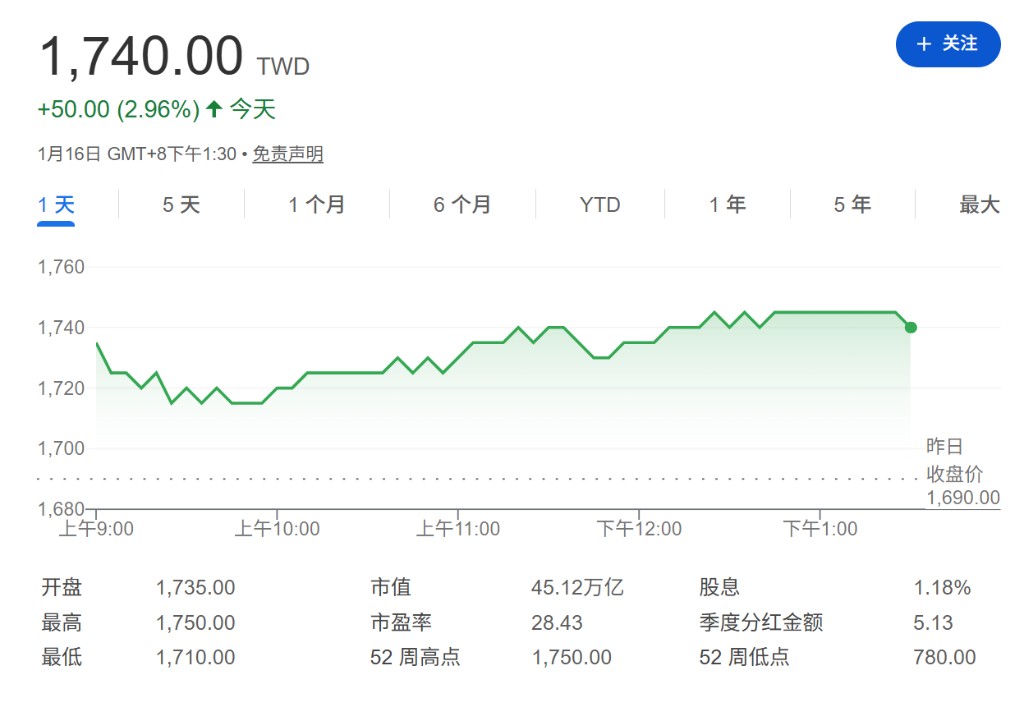
As of the time of writing, TSMC's stock price rose 2.96% to NT$1,740.